

Chemical plants and food factories are usually handled as two separate footwear categories, and it is more useful to treat them as one problem viewed from two angles. Both put the boot into a wet, contaminated environment; both depend on cleaning regimes rather than on the boot alone; and both punish footwear that was chosen from a catalogue description instead of from an assessment of the floor. The difference is what the contamination is, and what the plant does about it.
What This Environment Does to People and Equipment
The first thing these environments do is keep the floor wet. Food plants wash down equipment and floors between production runs, and chemical plants deal with process leaks, spillage and cleaning that follows both. Standing water, films of fat or sugar, and residues of cleaning agents all reduce friction in ways that change through the shift, and the floor that is safe at the start of a run may not be the floor the worker crosses at the end of it.
The second thing they do is attack the footwear itself. Cleaning chemicals, sanitising agents and process fluids degrade materials, and the degradation is not always visible. A sole compound can harden, an upper can become brittle at a flex point, and a seam can fail without the boot looking worn. In a plant where footwear is washed daily, the boot’s service life is usually set by the cleaning regime rather than by the distance walked.
The third effect is on worker behaviour, and it is the one that decides outcomes. Footwear that is heavy, wet or slow to put on gets worn for shorter periods than the task requires, and footwear that is difficult to clean encourages shortcuts. In both sectors the boot has to work within a hygiene routine that already exists, because the routine will not be redesigned around a product.
There is also a shift pattern to consider. Food plants often run two or three production runs in a day with cleaning between them, and chemical plants work continuous shifts, so the same pair of boots may be asked to dry and recover in a changing room with no time to do it. Where that is the case, the specification is not only about the product: it is about how many pairs exist, where they are kept, and who is responsible for making sure a pair is ready before the next shift starts.
The Hazards That Drive the Specification
The hazards vary by area within the same site, so the assessment is more useful when it is written area by area rather than for the plant as a whole.
- Slip on wet, greasy, sugary or chemically contaminated surfaces, including changes in floor finish and gradients.
- Chemical contact with cleaning agents, sanitising chemicals and process fluids, through splash, standing liquid or soaked boots.
- Impact and compression from pallets, trolleys, drums and falling product, which is where toe protection is decided.
- Penetration from below, from broken glass, bone, metal offcuts, staples and damaged pallets.
- Thermal exposure in bakeries, cooking areas, steam lines and cold stores.
- Biological and hygiene hazards, where the footwear itself can carry contamination between zones.
- Long shifts on hard floors, which turn a marginal fit into a reason not to wear the boot.
Two of those deserve a note. Chemical resistance is a property against a defined substance, so an assessment that says chemicals are present is not yet a specification; it has to name the substances and how the worker is exposed to them. And cross-contamination is a footwear hazard in its own right: in a plant with separated hygiene zones, where the boots are worn is as much a part of the risk as what they are made of.
Controls That Come Before the Equipment
Footwear is the last layer of control in these environments, and the layers above it carry a large part of the risk. Floor specification and drainage determine how much water stands where workers walk; cleaning method and agent choice determine what is left on the floor after the wash; and layout determines whether a wet route can be avoided at all. Anti-slip flooring, better drainage around wash-down points, absorbent matting at boundaries between zones, and prompts to clean spillage immediately are all cheaper and more reliable than a better sole.
Where manual handling of drums, sacks and trays is part of the task, mechanical aids and correct trolley selection reduce both the crushing risk to the toes and the fatigue that leads to inattention. Where the exposure is chemical, containment, closed transfer, and drip trays reduce the amount that reaches the floor and therefore the amount that reaches the boot. The assessment should show what has been done at each of these levels before the footwear decision is made, because the specification that follows is easier to defend and usually easier to live with.
What the Equipment Has to Do Here
A boot for these environments is being asked to do several things at once, and the specification is the record of how those demands were balanced.
It has to keep water and process fluids out. That is a design question rather than a coating: height, closure, seam construction and upper material all contribute, and a wellington-style design solves it differently from a laced boot with a membrane. It has to resist the substances present in the concentration used, which is a materials question. It has to hold friction on the contaminant that actually occurs, which is a sole compound and tread question. It has to be cleanable to the standard the hygiene plan states, which rules out constructions that trap product and materials that cannot be wiped or washed as the site requires. And it has to be wearable for the length of the shift, because all of the above only matter while the boot is on.
Protective features follow the assessment rather than the catalogue. Toe protection is specified where impact or compression is credible; penetration resistance where sharp objects are present on the floor or in waste; electrical properties where the work involves live systems, which is a specialist decision rather than a default. The standards that sit behind these properties, and how the American and European frameworks differ in how they express them, are covered in Shield Wings’ guide to ASTM and EN ISO 20345 footwear standards, which owns that topic.
Selection Criteria Specific to This Sector
| Demand | What it means for the boot | What to confirm before ordering |
|---|---|---|
| Wet floors and wash-down | Sole compound and tread selected for the contaminant, in the state it occurs | The condition the sole was tested under, compared with the plant floor |
| Cleaning chemicals and process fluids | Upper and sole materials selected against the substances present | The substances and concentrations the material is declared for |
| Hygiene zones | Construction that can be cleaned and does not trap product | Whether boots stay in one zone or move between them |
| Impact and compression | Toe protection sized to the handling risk | The assessment outcome, not a general expectation |
| Sharp debris and damaged pallets | Penetration resistant midsole where the hazard is credible | How the midsole behaves under repeated loading |
| Hot and cold areas | Insulation and materials that keep their properties in the working range | Behaviour after several hours at working temperature |
| Long shifts on hard floors | Fit, weight and footbed suited to the working pattern | A fitting step across the size range, not a size list |
Read down the table, the same boot is unlikely to satisfy every row. Larger plants usually end up with two or three specifications, one for wash-down and hygiene-controlled areas, one for packing and warehouse work, and one for maintenance, and that is a reasonable outcome rather than an inconsistency, provided each specification can be traced back to the assessment.
Typical Specification Failures in This Sector
Most failures in this category come from a specification that was written once and never revisited, so the boot no longer matches the process it was bought for.
- Slip resistance treated as a property of the boot. It is a property of the sole in contact with a particular floor and contaminant, so the marking has to be matched to the condition.
- Chemical resistance assumed from the word resistant. Resistance is defined against named substances, and a general claim does not establish it.
- Hygiene requirements considered after the purchase. A boot that cannot be cleaned to the plant’s standard will not be used in the areas that matter.
- One boot for the whole site. Wash-down, cold store and maintenance duties rarely resolve to the same sole and upper.
- Tread wear not inspected. Grip disappears gradually, and the upper still looks serviceable at the point where the sole has stopped working.
- No spare pair. A single pair per worker means boots are worn wet, which speeds up material degradation and reduces the time they stay effective.
- Cleaning arrangements left to the operator. How, where and how often footwear is washed decides its service life, so it belongs in the specification.
Building the Full Set Rather Than Buying Pieces
In these environments the footwear is one item in a set, and the items interact. Waterproof trousers, aprons and gaiter-style protection stop liquid reaching the top of the boot; gloves and sleeves address the part of the worker the boot cannot cover; and in cold areas an insulating sock or liner changes the fit of the boot that was specified for it. Where a plant has separate zones, the set includes the changeover arrangements: which footwear belongs to which zone, where it is stored, and how it is cleaned between uses.
Hand protection in food work has its own set of demands, and the cut, hygiene and laundering requirements for that side of the task are set out in Shield Wings’ article on cut resistant gloves for food processing. The footwear ranges discussed here are listed on the safety shoes and boots page, and the wider set is set out in the foot protection category.
Shield Wings manufactures foot protection at a Guangdong production base and works with food processors, chemical plants and distributors on sole and upper selection, size ranges, cleaning guidance and the documentation each product carries. The specification that works in a wet plant is the one that matches the contaminant on the floor and survives the way the site cleans its boots.
Frequently Asked Questions
What are the best safety shoes for food manufacturing?
There is no single best model, because the answer depends on the surface and the task. A dry packing hall, a wet wash-down area and a cold store present different demands, and the boot that suits one may be wrong for another. What distinguishes a good selection is that the sole compound matches the contamination present, the upper can be cleaned to the plant’s hygiene standard, and the protection the task requires is confirmed by the risk assessment rather than assumed from the word safety.
Do food plant boots need to be chemical resistant?
Where cleaning agents, sanitising chemicals or process fluids are handled or walked through, chemical resistance becomes part of the specification, and the material of the upper and sole has to be selected for the substances actually present. The employer’s assessment should identify those substances and the concentration used, because resistance is a property against a defined chemical and not a general quality. The supplier’s documentation states what the material is declared for.
Why do slip-resistant boots still slip in a food plant?
Because food environments combine contaminants that behave differently from the surfaces used in testing. Fats, sugars, blood, fine powders and dilute cleaning chemicals each produce different friction, and a sole tested on one condition may perform poorly on another. Wear makes it worse, since a tread pattern that has rounded off loses grip before the upper shows signs of failure. Matching the sole to the contaminant and inspecting the tread regularly is the practical control.
What footwear suits wash-down and hygiene-controlled areas?
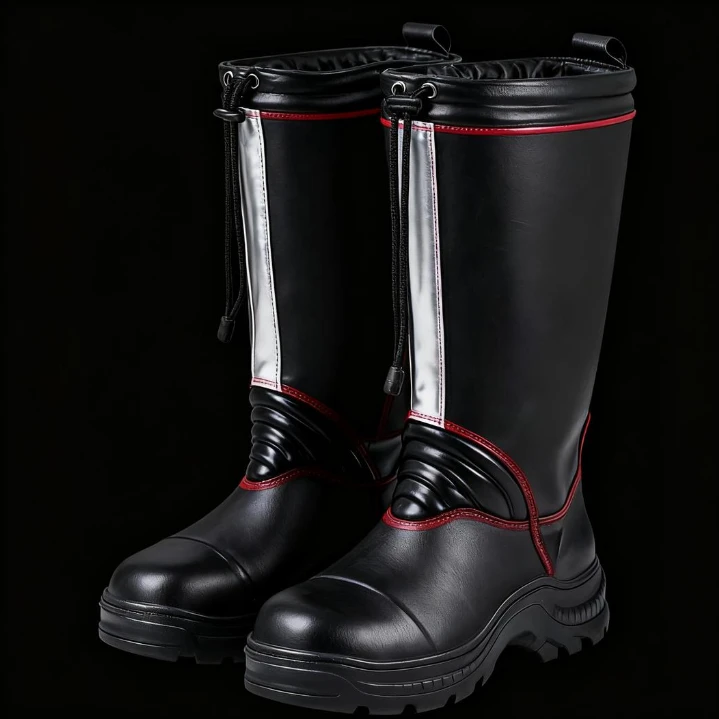
Wash-down areas reward a boot that keeps water and process fluids out, has a surface that can be cleaned and dried quickly, and does not trap product in seams, laces or cuffs. Height and closure matter here, since a taller boot or a wellington-style design reduces the area that liquid can reach. The hygiene plan should state whether footwear stays inside the area or moves between zones, because that decision determines how many pairs are needed.
How many pairs should a food or chemical plant issue?
Enough that a wet or contaminated pair can be withdrawn for cleaning without the worker being left without suitable footwear, which usually means a second pair on site or a defined changeover point. The number follows from the hygiene regime, the number of zones and the cleaning frequency rather than from a general rule. Running a single pair per worker tends to produce boots worn wet, which shortens their life and reduces the protection they provide.
Specifying footwear for a wet or hygiene-controlled plant?
Send the contaminants on the floor, the cleaning agents in use and the size range required. Shield Wings confirms the sole and upper options available, the size coverage and the documentation each product carries.
External references: 29 CFR 1910.136 foot protection, 29 CFR 1910.132, CCOHS guidance on safety footwear, UK HSE personal protective equipment guidance, CEN-CENELEC standards portal, Regulation (EU) 2016/425.