

Molten metal punishes the hand in a way that most heat hazards do not. It arrives as a liquid, so it runs, collects in cuffs and folds, and stays against the surface while it solidifies. Contact with a hot component is a different mechanism again, and radiant heat from an open furnace adds to both for the worker standing at the pour. Glove selection in this environment therefore asks three questions in order: what can contact the hand, how long does it stay, and where does it go if it runs.
What This Environment Does to People and Equipment
Duration changes the picture more than temperature alone. A glove that performs adequately for a two-second contact may be unsuitable where a hot component is carried for half a minute, because the heat accumulates through the material and the lining. In the assessment this shows up as a question about how the object is handled rather than how hot it is, and the answer often changes the task method as much as the glove: a carry becomes a drag, a manual hold becomes a tong-assisted one, and the glove requirement falls accordingly.
The three thermal mechanisms act differently on a glove. Splash deposits liquid metal on the surface, which then has to be shed or tolerated while it cools. Contact transfers heat directly through the material at the point of touch, and the temperature gradient inside the glove is what the lining and the construction have to manage. Radiant heat arrives without contact and loads the outer surface and, over a shift, the worker.
Gloves in these environments also degrade in characteristic ways. Material stiffens with repeated heat cycles, leather hardens and cracks, coatings and reflective surfaces lose effectiveness, and seams, cuffs and linings fail before the palm does. Contamination with metal, scale or moisture changes both the heat behaviour and the grip. That is why inspection criteria for this category are written around condition rather than appearance, and why a glove that has been exposed to an event is withdrawn rather than reassessed informally.
The Hazards That Drive the Specification
One exposure that is easy to overlook is steam and moisture. Water on a floor, a damp tool or a wet glove meeting molten metal produces a rapid expansion that throws material and heat, and the hand is often closest to it. The assessment should record the wet conditions in the area and the controls that keep moisture away, because those controls matter more than any glove property and they also determine how gloves should be stored between tasks.
The specification starts from the task assessment and from positions rather than job titles, since two workers in the same bay can face very different loads.
- What can reach the hand: splash from a pour, spatter, hot scale, hot components, hot surfaces, or steam where moisture meets hot material.
- The temperature and mass involved, including whether a heavy item is held or briefly touched.
- The duration of exposure and the number of cycles in a shift, since repeated short exposures accumulate.
- The direction of the splash, because it determines cuff design and how the glove is worn relative to the sleeve.
- The grip requirement, because a slip is how hands end up in the wrong place at the wrong time.
- The controls already in place, including whether the task is mechanised, tool-assisted or performed by hand.
The employer owns the requirement and the supplier documents what the glove is tested to. Where the assessment states the metal, the operation and the duration, the glove selection becomes a comparison against documented performance rather than a matter of preference. Where it does not, the site tends to buy the heaviest glove available and then discover that workers cannot hold anything with it.
Controls That Come Before the Equipment
Hand exposure around molten metal is reduced most effectively by removing the hand from the process. Ladles, tongs and handling tools with adequate length, mechanised pouring, jigs and fixtures that hold the mould, remote operation of furnace doors, and tooling that keeps the hand out of the splash path all reduce the hazard. Dry floors, dry tools and dry material matter in the same way, because moisture meeting molten metal produces an event that no glove was designed for.
Administrative controls follow: procedures that define how close a worker may stand, who performs which operation, and how spillages and spills of metal are handled. Training in the specific task carries much of the load, because the difference between a controlled pour and an uncontrolled one is usually technique and preparation. Personal protective equipment is the last line of defence, and in this environment the earlier controls are what keep the exposure within the range any glove can address.
What the Equipment Has to Do Here
Dexterity deserves a place in the requirements because it decides whether the protection is used. Gauntlet length, palm thickness and lining all reduce the ability to grip and manipulate, and a worker who cannot feel a mould seat properly will either remove the glove or work more slowly and less safely. Where a task genuinely requires fine control against a heat hazard, the better answer is usually to change the handling method so that the fine work happens away from the heat, and to keep the glove specified for the exposure that remains.
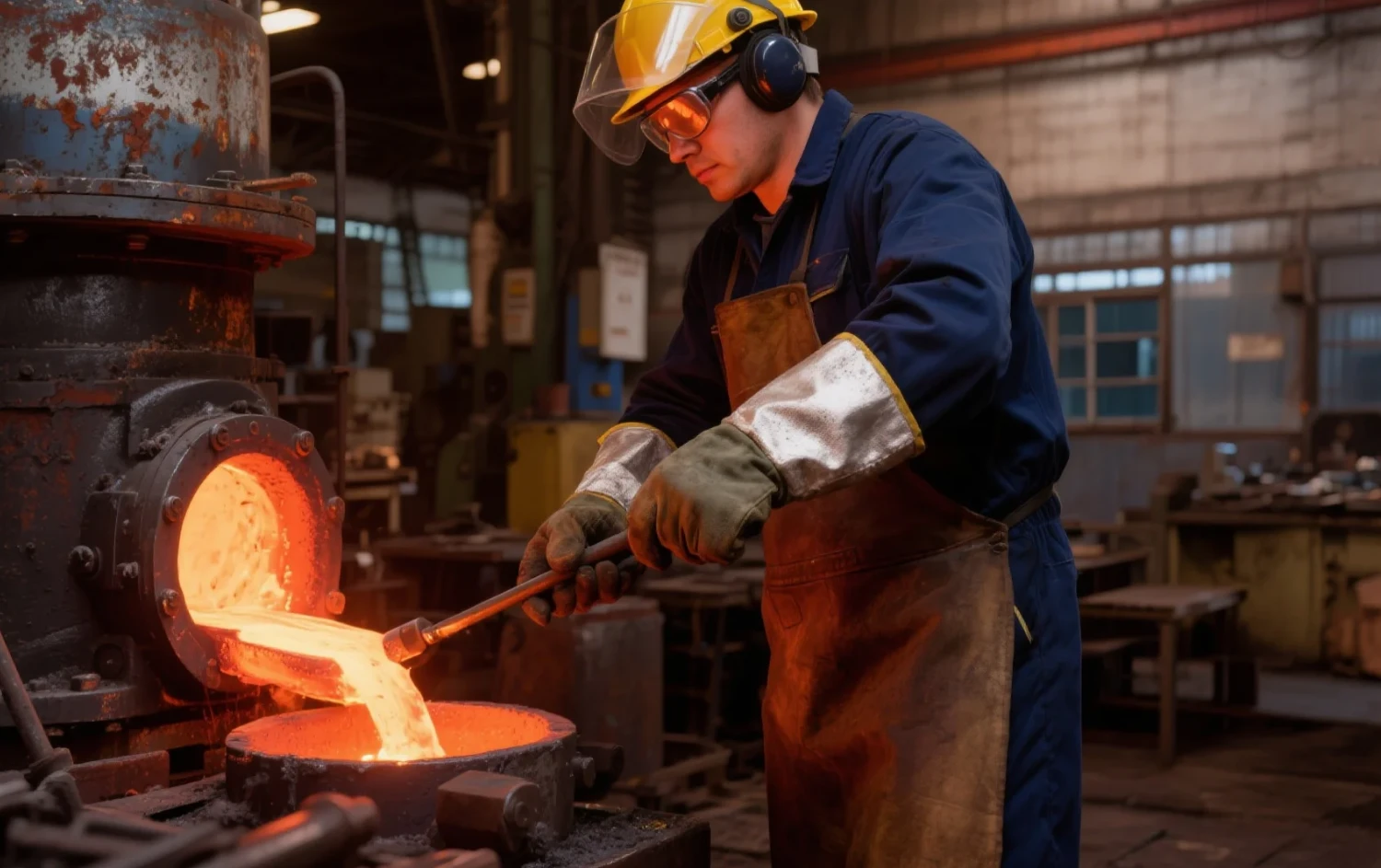
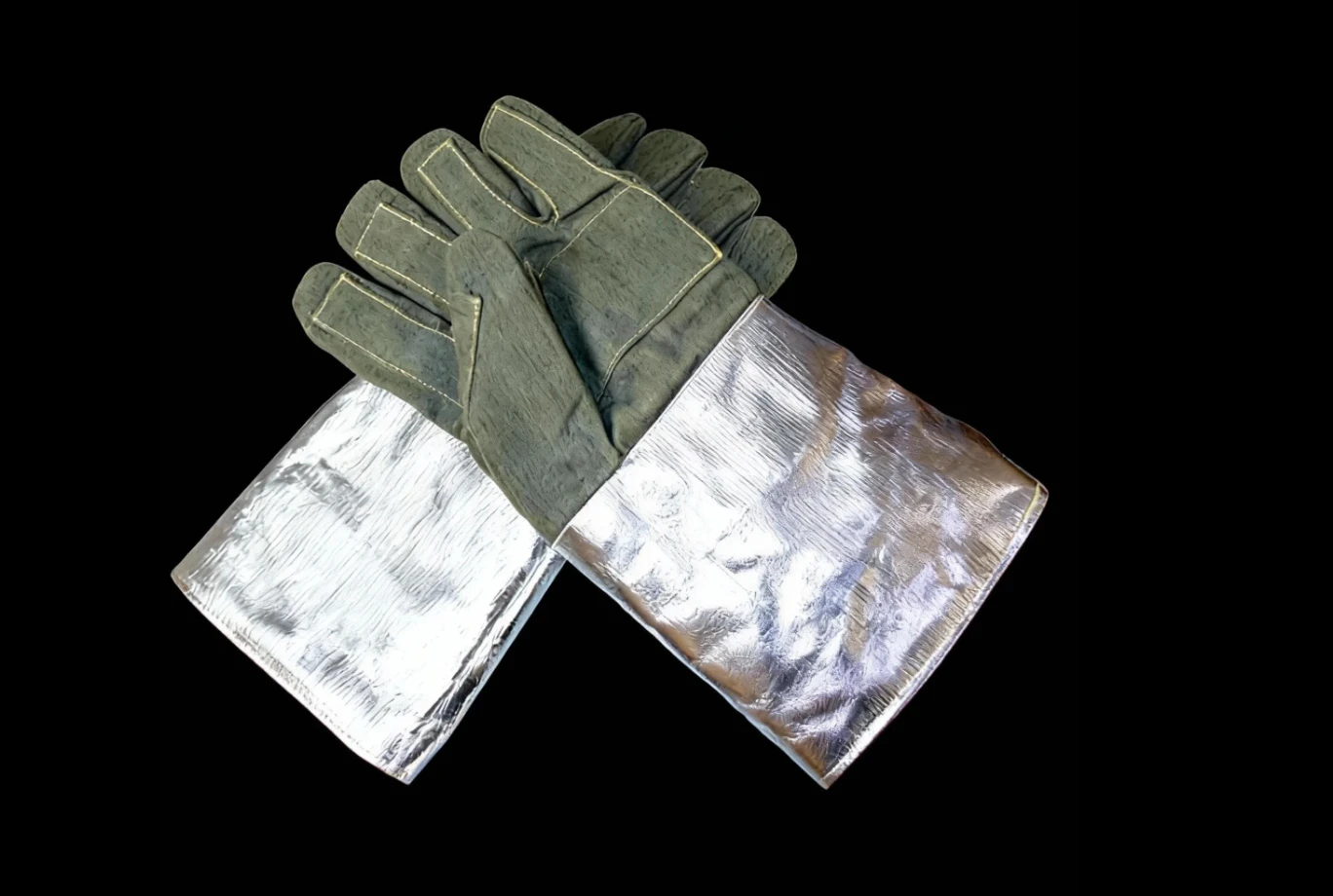
A glove for molten metal and hot contact has to do three things at once: resist the heat, avoid collecting material, and allow the worker to hold the tool or component securely. The construction therefore emphasises cuffs long enough to cover the wrist, seams positioned so that material does not pool, and materials that do not melt, shrink or burn through quickly. Reflective or aluminised surfaces are used where radiant load dominates, while heavier leather and heat resistant fabrics are used where contact and spatter are the main exposures.
The interface with the sleeve is part of the protection, not a detail. A glove worn over the sleeve sheds material away from the arm; a glove that ends at the wrist invites it in. Whichever arrangement the assessment specifies, the stock and the training have to match it, because a glove worn the wrong way relative to the sleeve provides less protection even though it is the correct product.
Selection Criteria Specific to This Sector
| Task | Dominant exposure | Glove characteristics that follow | What to verify |
|---|---|---|---|
| Pouring and ladle work | Splash from a metal stream, radiant heat | Long gauntlet, heat resistant construction, dry grip | Performance documentation for the exposure claimed |
| Mould handling and casting | Contact with hot moulds and components | Contact heat performance with enough dexterity to seat the mould | Contact temperature and duration in the task assessment |
| Slag and dross removal | Splash, spatter, sharp hot material | Heavier construction with mechanical durability and cut consideration | Documentation for the properties claimed on the same glove |
| Furnace door and inspection work | Radiant heat, occasional spatter | Reflective outer surface with a heat resistant liner | Condition of the reflective surface and replacement criteria |
| Hot component handling after forming | Contact heat with grip requirement | Contact heat performance with a grip pattern suited to the part | Trial with the actual component and temperature |
| Maintenance in the hot area | Mixed exposure, unpredictable contact | Set chosen for the maintenance task, often with forearm protection | Pre-task check and the assembly as worn |
Two rules complete the table. First, the required performance is a site decision taken from the assessment and expressed in the language of the applicable standard. Second, where the task involves both mechanical and thermal exposure, each property has to be documented on the glove concerned rather than assumed from one claim.
Typical Specification Failures in This Sector
Most of these failures trace back to one habit: choosing the glove from a catalogue category rather than from a described task. Heat resistant is a description, not a specification, and two gloves carrying the same words can answer contact heat and molten metal splash very differently. Writing the task, the metal, the duration and the direction of exposure into the assessment is what makes the difference visible before the order is placed rather than after the first incident.
- Glove and sleeve not considered together. Material runs into the gap at the wrist when the arrangement is not specified.
- Meltable layers underneath. Synthetic liners or personal gloves worn inside can make a burn worse, which is why the inner layers are part of the specification.
- One glove for the whole plant. Radiant heat, contact heat and splash need different surfaces and constructions.
- Gloves kept past contamination. Metal, scale and moisture change performance, and a stiffened glove is a retirement trigger.
- Grip traded for insulation. A glove that cannot hold the tool safely produces the incident it was bought to prevent.
- No rule for an event. A glove that has received a heavy splash or a heat soak should be withdrawn until assessed, not returned to the hook.
- Process controls treated as fixed. Changes to the method, the pour size or the handling tool can invalidate the glove requirement, and the assessment should trigger a review.
Building the Full Set Rather Than Buying Pieces
For molten metal work, the glove is one component of an assembly that includes forearm protection, a body garment with closed construction, face and head protection, and footwear designed to keep material out at the opening. The gaps between those items are where burns occur, so the specification should describe the overlaps and the direction of the overlap rather than listing items. The standards behind those garments are set out in Shield Wings’ article on molten metal splash protection, which owns that topic.
Shield Wings manufactures high temperature gloves and the wider hand protection range at a Guangdong production base, and supports foundry, steel and glass customers with material selection, cuff and construction options and the documentation each thermal claim requires. The full range is listed in the hand protection category.
The specification that works in this environment is the one written around the task cycle at the specific position, with the cuff, the sleeve and the inner layers all decided in advance, and with a withdrawal rule that a supervisor can apply on the spot.
For the wider topic and related decisions, see our Heat, Molten Metal & Furnace Protection.
Frequently Asked Questions
What gloves are used for molten metal splash?
Gloves specified for the thermal exposure of the task, typically with heat resistant constructions and a cuff long enough to shed material away from the arm rather than into it. The selection comes from the assessment: the metal, the quantity and direction of any splash, the contact temperatures involved and the duration of the task. A general purpose heat glove is not automatically suitable for molten metal contact.
Why does the cuff design matter so much?
Because molten metal runs. A short cuff or an open gauntlet creates a path for material to enter at the wrist, where it stays in contact with skin while it cools. Gloves for these tasks are specified with cuffs that cover the wrist and overlap the sleeve, and the assessment should confirm which way the glove is worn relative to the sleeve in the task actually performed.
Can a heat resistant glove be reused after metal has contacted it?
It should be inspected before any return to service, and where metal has adhered, the material has stiffened or a hole has formed, the glove is withdrawn. Contamination with metal can hold heat against the surface and affect how the glove behaves next time. The manufacturer’s instructions govern, and repairs to restore a damaged heat glove are usually not permitted.
Are synthetic liners a problem underneath heat resistant gloves?
They can be. A material that melts or shrinks against the skin under heat can make an exposure worse, which is why the layers worn inside protective gloves are specified rather than left to personal choice. Where the task involves high contact temperatures or molten material, the specification should state what may be worn underneath and what is prohibited.
What else should be specified with these gloves?
The interfaces: sleeves or gauntlets that overlap the cuff, forearm protection, body protection with closed construction, face and head protection for the same task, and footwear that keeps material out at the boot opening. Molten metal reaches people through gaps between items, so the assembly is the specification rather than the glove alone.
Equipping a pouring floor or hot handling position?
Send the task, the material and the temperatures involved. Shield Wings confirms the glove construction, cuff arrangement and inner-layer requirements, with documentation for each claimed performance.
External references: 29 CFR 1910.138 hand protection, 29 CFR 1910.132, CCOHS guidance on protective gloves, CEN-CENELEC standards portal, UK HSE personal protective equipment guidance, Regulation (EU) 2016/425.
{“@context”:”https://schema.org”,”@type”:”FAQPage”,”mainEntity”:[{“@type”:”Question”,”name”:”What gloves are used for molten metal splash?”,”acceptedAnswer”:{“@type”:”Answer”,”text”:”Gloves specified for the thermal exposure of the task, typically with heat resistant constructions and a cuff long enough to shed material away from the arm rather than into it. The selection comes from the assessment: the metal, the quantity and direction of any splash, the contact temperatures involved and the duration of the task. A general purpose heat glove is not automatically suitable for molten metal contact.”}},{“@type”:”Question”,”name”:”Why does the cuff design matter so much?”,”acceptedAnswer”:{“@type”:”Answer”,”text”:”Because molten metal runs. A short cuff or an open gauntlet creates a path for material to enter at the wrist, where it stays in contact with skin while it cools. Gloves for these tasks are specified with cuffs that cover the wrist and overlap the sleeve, and the assessment should confirm which way the glove is worn relative to the sleeve in the task actually performed.”}},{“@type”:”Question”,”name”:”Can a heat resistant glove be reused after metal has contacted it?”,”acceptedAnswer”:{“@type”:”Answer”,”text”:”It should be inspected before any return to service, and where metal has adhered, the material has stiffened or a hole has formed, the glove is withdrawn. Contamination with metal can hold heat against the surface and affect how the glove behaves next time. The manufacturer’s instructions govern, and repairs to restore a damaged heat glove are usually not permitted.”}},{“@type”:”Question”,”name”:”Are synthetic liners a problem underneath heat resistant gloves?”,”acceptedAnswer”:{“@type”:”Answer”,”text”:”They can be. A material that melts or shrinks against the skin under heat can make an exposure worse, which is why the layers worn inside protective gloves are specified rather than left to personal choice. Where the task involves high contact temperatures or molten material, the specification should state what may be worn underneath and what is prohibited.”}},{“@type”:”Question”,”name”:”What else should be specified with these gloves?”,”acceptedAnswer”:{“@type”:”Answer”,”text”:”The interfaces: sleeves or gauntlets that overlap the cuff, forearm protection, body protection with closed construction, face and head protection for the same task, and footwear that keeps material out at the boot opening. Molten metal reaches people through gaps between items, so the assembly is the specification rather than the glove alone.”}}]}