

Firefighting boots are rarely bought by brand or appearance. They are bought because a previous pair failed somewhere specific: a sole that went slick, a closure that jammed full of grit, a shaft that let water in, or a toe that took an impact. Selecting the next pair well means knowing which component carries which requirement, and which ones wear out first under the work the crew actually does.
The Hazard First, the Product Second
It is also worth recognising what the boot is doing while the crew is not at an incident. Structural boots are worn during inspections, training, standby and station work, and that is where most of their service hours and much of their wear accumulate. Sole abrasion from training grounds, closures damaged during drills and moisture from wet working all show up before the fireground exposure does, which is why wear patterns should be reviewed against the whole duty cycle rather than against incidents alone.
The interior firefighting environment loads footwear in several ways at once. There is heat from the floor, from hot debris and from radiant load near the fire; water at high volume, often hot and contaminated; sharp debris, glass and structural material underfoot; impact from falling objects; and the mechanical wear of walking, climbing and kneeling in protective clothing. Add the need to don and doff quickly when an alarm sounds, and the boot has to satisfy conflicting requirements.
The requirements are framed by the ensemble standards the market applies, with NFPA 1971 in the United States and EN 469 alongside the footwear requirements in Europe. Those standards define the performance for the ensemble and its components; the selection of a specific boot for a specific brigade still comes from the tasks the service performs, whether that is predominantly interior structural firefighting, vehicle extrication, technical rescue or a mixture.
What the Risk Assessment Has to Establish
- The tasks the boot has to serve, including interior firefighting, extrication and rescue work, and how often each is performed.
- The duration of wear, since structural boots are worn for long incidents and for standby duties in some services.
- The thermal environment: hot floors, embers, hot liquids and the possibility of contact with hot surfaces.
- The ground conditions: broken surfaces, glass, metal, mud, ice and water depth.
- The need for quick donning, including whether the boot is worn with protective trousers already in place.
- The fit requirements across the crew, including width and the ability to wear the boot with the trousers in the specified arrangement.
The employer owns the requirement, and the supplier documents what the components carry. Where a service operates across several roles, the assessment often produces more than one specification, which is why many brigades hold structural footwear and lighter wildland footwear rather than attempting to cover both with one boot.
Which Hazards This Category Covers and Which It Does Not
The distinction between levels of protection is also useful during specification. A boot intended for structural firefighting and a boot intended for station duties may look similar and be built quite differently, and the difference appears in the barrier, the liner and the sole rather than in the profile. Where a service issues one model for both, the specification should be written for the more demanding role, and the fit and comfort consequences accepted deliberately rather than discovered by the crew.
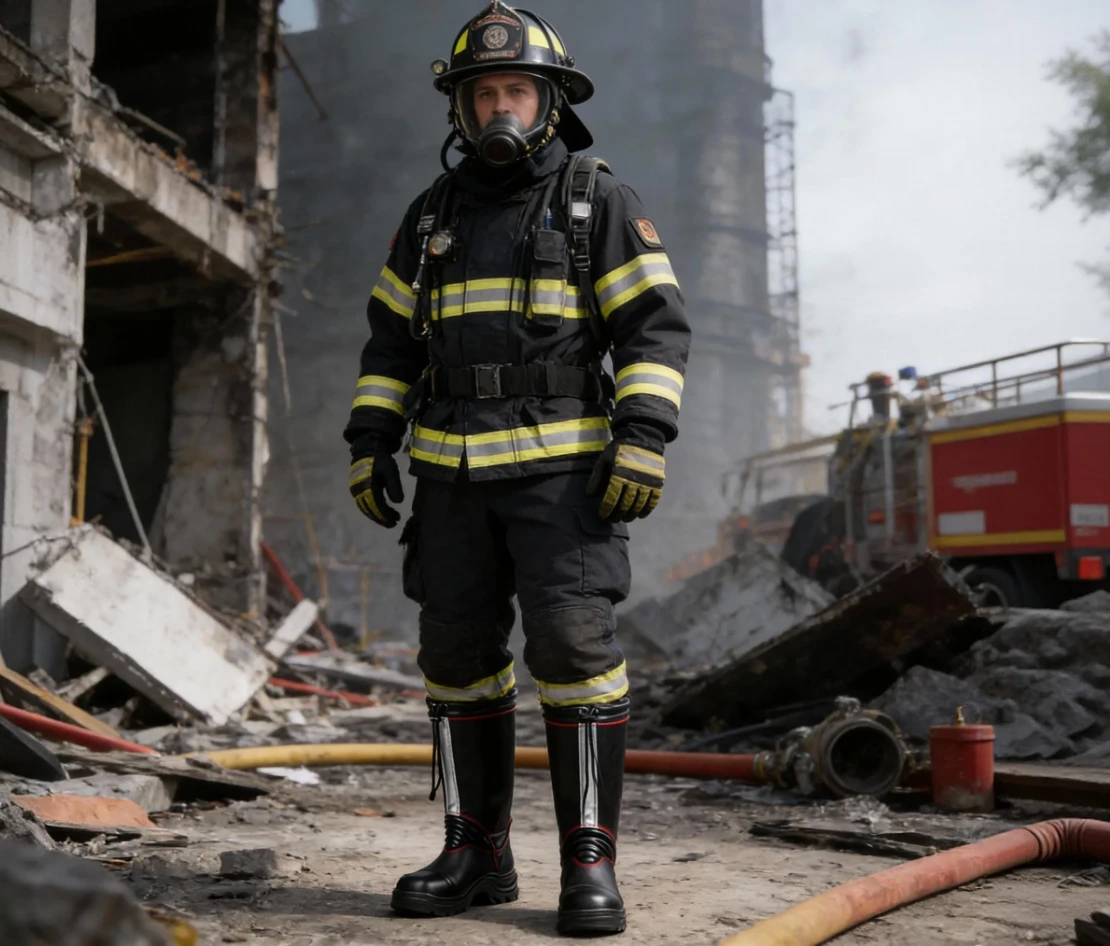
Structural firefighting boots cover the foot and lower leg: thermal protection, water resistance, penetration resistance, impact protection at the toe, slip resistance and, in some designs, additional coverage of the ankle and shin area. They are designed to be worn with the protective trousers of the same ensemble, which typically overlap the boot shaft.
Their limits are worth stating clearly. They do not protect against chemical warfare agents or hazardous materials unless the ensemble is specified for that, which is a separate certification. They are not designed for prolonged wildland work, where weight and heat build-up become the dominant problem. They do not replace the rest of the ensemble: the boot protects the foot, and the trouser, coat, helmet and gloves protect everything else. And no boot removes the hazard: tactics, command decisions, ventilation and the use of water determine what the crew is exposed to, with protective equipment as the last line of defence.
Matching Task to Protection Level
| Task or role | What dominates | Boot characteristics that follow | What to verify |
|---|---|---|---|
| Interior structural firefighting | Heat, water, debris underfoot | Thermal protection with a moisture barrier, penetration resistant sole and robust closure | Ensemble documentation and the boot’s part in it |
| Vehicle extrication | Broken glass, metal edges, awkward positions | Sole and upper abrasion resistance with penetration protection | Ground hazard assessment for the response area |
| Long standby and station duties | Comfort over hours, quick donning | Fit that supports the foot without pressure, closure operable with gloves | Fit trial with the crew and the trouser arrangement |
| Mixed structural and wildland response | Weight against thermal protection | Separate specifications for the two roles rather than one compromise | Role-based issue recorded in the programme |
| Technical rescue and rope work | Foot stability and grip on structure | Sole grip on steel and concrete, shaft support, secure closure | Trial on the surfaces the work involves |
Read across the table, the boot specification is short at the component level and long at the task level: thermal, barrier, sole, toe, closure and fit, applied to the roles the service performs.
Where Selection Usually Goes Wrong
One further failure appears after the purchase rather than during it. Where the boot is cleaned and dried by the crew individually, practice varies: some leave it in the apparatus bay, some dry it near a heater, and some store it damp in a locker. Over a few seasons the boots age at very different rates, and the resulting condition survey looks as though the product is inconsistent when the care practice is the variable. A written drying and storage arrangement, with somewhere to do it, is the cheapest improvement available in this category.
- Buying on weight alone. A lighter boot is welcome, but where it is lighter it is usually thinner, and the thermal and barrier components are what the interior environment demands.
- Ignoring the closure mechanism. Sand, grit and hot debris reach closures; a mechanism that jams or is hard to operate with gloves becomes a practical problem on the fireground.
- Fit decided by size alone. Structural boots are worn with protective trousers and sometimes with extra socks; the fit has to be checked in that configuration.
- Drying practices that damage the boot. Direct heat and direct sun degrade adhesives and barrier materials; the manufacturer’s drying instructions matter.
- Contaminated boots returned to service. Combustion products and contaminated water remain on the boot and in the lining, which is a health issue as well as a performance one.
- Age used as the retirement criterion. Wear and condition decide, and a boot can be serviceable at five years or compromised at two.
- One boot for every role. Structural and wildland work present different problems, and a boot that suits both rarely serves either well.
The Hierarchy of Controls Around the Selection
Equipment reviews in fire services are most useful when they include the operational context. A change in tactics, a new response area, longer response distances, or a shift in the proportion of extrication and rescue calls can all change what the boot needs to do, and the boot that was correct five years ago may no longer match the work. Recording the call profile alongside the specification is what makes that visible.
In firefighting, the controls that sit before personal protective equipment are operational: incident command, size-up, the decision to commit crews to an interior attack, ventilation, the use of protective lines, and the discipline of the crew working as a team. Those decisions determine the thermal and physical load the crew experiences, and the ensemble reduces the consequence. The boot is part of that ensemble, and it is the last line of defence for the foot rather than a solution to the hazard.
Training and competence sit alongside the equipment: knowing how to move in a structure, how to withdraw, and how to work as a team changes exposure more than any equipment change. Where a service reviews its footwear after incidents, the useful discussion usually includes those factors alongside the boot itself.
Specification Points to Fix Before Ordering
Where a service runs a trial before ordering, the trial should last long enough to include a training session and a wet shift. Short trials reward the boot that feels best when new, which is rarely the boot that performs best after a month of use, and the components that decide the outcome — sole, closure and barrier — only reveal themselves under real conditions.
- The roles the boot must serve, and the frequency of each in the service’s actual call profile.
- The standard the boot is tested to and its place in the ensemble, named with the scope it covers.
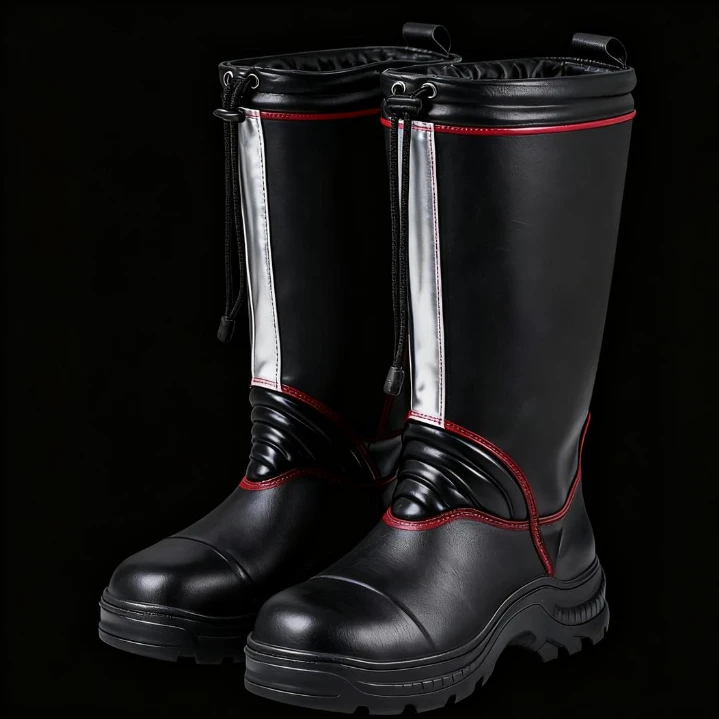
- Component requirements: upper, moisture barrier, thermal liner, toe protection, sole properties and closure type.
- Shaft height and the interface with the protective trousers, including which item overlaps which.
- Fit requirements and the size range, with a trial that includes the trousers and the socks used on shift.
- Donning time and closure operation with gloves, verified in a drill rather than described by the supplier.
- Care, decontamination, drying and inspection rules, with the criteria for withdrawal.
- Documentation required with each delivery, including the marking and traceability reference.
The performance requirements behind this boot and how they are defined are covered in Shield Wings’ article on structural firefighting boots under NFPA 1971, which owns that topic. The products are listed on the structural firefighting boots page and within the wider foot protection range.
Shield Wings manufactures firefighting and protective footwear at a Guangdong production base and works with fire services, industrial brigades and distributors on component selection, sizing and the documentation each specification requires. Component-level specification is what makes a boot programme reviewable, and it is also what allows a brigade to explain, after an incident, why the footwear it issued was appropriate for the task.
For the wider topic and related decisions, see our Safety Footwear & Boots.
Frequently Asked Questions
What components make up a structural firefighting boot?
An upper that resists heat, abrasion and water; a moisture barrier that keeps liquid out while allowing some vapour movement; a thermal liner; protective components in the toe and sometimes the whole sole structure; a sole specified for heat, slip and penetration; and a closure that can be operated quickly with gloves on. Each component has its own wear pattern, which is why inspection covers the boot as an assembly rather than the upper alone.
What is the most common failure point?
In practice, the sole and the closure. Soles wear through abrasion, heat and repeated wetting, and closures fail through contamination, grit in the mechanism and damage from hot material. Moisture barrier and liner damage is less visible but more serious, because it affects both protection and the health of the wearer. Inspection should therefore look at the sole and closure first and the interior condition deliberately.
How should structural boots be cleaned and dried?
Follow the manufacturer’s instructions. In practice that means removing loose contamination, cleaning with the approved agents, and drying at a controlled temperature away from direct heat, which can degrade adhesives and barrier materials. Boots should never be dried on a heater or in direct sun, and contaminated footwear should be kept separate until it has been cleaned or withdrawn.
When should firefighting boots be withdrawn from service?
When the sole is worn, cracked or separated, when the upper is cut, burnt or hardened, when the barrier or liner is compromised, when the closure no longer holds or releases reliably, or when the boot has been exposed to a condition outside its specification. Age alone is a weak criterion; the programme should define condition criteria and record the decisions.
How does boot selection interact with the rest of the ensemble?
The boot is part of a system that includes the protective trouser, which should overlap or sit over the boot to keep material out, and often a flash hood or knee protection depending on the role. Fit and shaft height affect how those items sit, so any change of boot model should be reviewed against the rest of the clothing rather than treated as an isolated purchase.
Specifying boots for a fire service?
Send the roles, the call profile and the ensemble in use. Shield Wings confirms the component options, the size range and the documentation each specification needs.
External references: NFPA 1971 protective ensembles for structural firefighting, NFPA 1977 protective clothing for wildland firefighting, 29 CFR 1910.132, CCOHS guidance on safety footwear, CEN-CENELEC standards portal, Regulation (EU) 2016/425.