

High temperature gloves must match the heat source — contact heat from a hot part, radiant heat from a furnace, or molten splash — because each transfers energy differently and needs a different glove construction. This guide explains the types and the selection logic, with reference to Shield Wings’ high temperature gloves.
Last updated:
Quick definition: The main types are contact-heat gloves with thick insulating liners, radiant-heat gloves with aluminized surfaces, leather gloves for sparks and abrasion, and specialized constructions for molten splash and extreme…
Key Takeaways
- Contact heat, radiant heat, and molten splash behave differently at the glove surface, so a glove that handles one can fail on another — the selection starts with naming the heat source and the exposure, not the…
- High temperature gloves are tested against standards that measure contact heat, convective heat, and radiant heat separately, so the rating on the label must match the heat mode of your task — a contact-heat rating does…
- Match the glove to the exposure by asking three questions: what is the heat source, how long is the contact, and what else must the glove do — grip, cut resistance, or chemical protection — then verify the rating for…
- High temperature gloves trade dexterity for protection, so the selection must find the balance the task demands — a glove too thick for fine work will be removed, and a glove too thin for the heat will be removed by the…
- Choose in five steps: name the heat source and task, set the required protection level, match the construction, trial the gloves on the job, and verify the test report before bulk ordering.
Why Does the Heat Source Decide the Glove?
Contact heat, radiant heat, and molten splash behave differently at the glove surface, so a glove that handles one can fail on another — the selection starts with naming the heat source and the exposure, not the temperature alone.
A worker grabbing a hot casting needs insulation against direct contact; a worker near a furnace needs a reflective or insulating surface against radiant energy; a welder needs protection against sparks and brief contact. Temperature numbers help, but they do not tell the whole story — exposure time, pressure of contact, and whether the heat is wet or dry all change the requirement. The practical question is always: what touches the glove, for how long, and with what force?
What Are the Main Types of High Temperature Gloves?
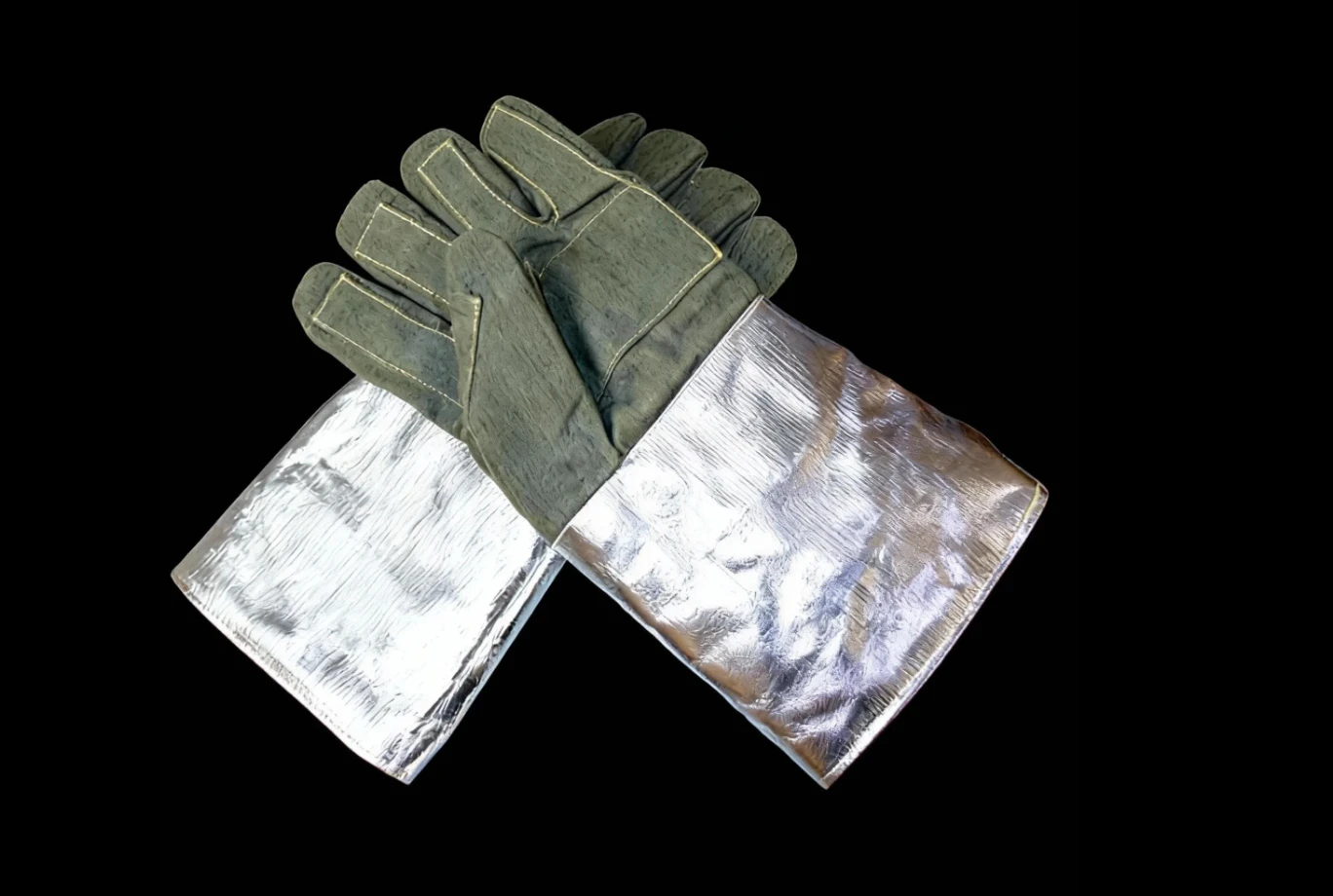
The main types are contact-heat gloves with thick insulating liners, radiant-heat gloves with aluminized surfaces, leather gloves for sparks and abrasion, and specialized constructions for molten splash and extreme temperatures.
| Heat exposure | Recommended glove type |
|---|---|
| Contact heat (hot parts) | Insulated knit or leather with thermal liner |
| Radiant heat (furnaces) | Aluminized surface gloves |
| Sparks and welding | Leather welding gloves |
| Molten splash | Foundry-rated heat gloves |
| Extreme temperatures | Specialized high-heat constructions |
Kevlar-type aramid fibers resist heat and cut, leather resists sparks and abrasion, and aluminized surfaces reflect radiant energy. The liner does the insulating work, so glove ratings depend on the whole construction — outer material, liner thickness, and cuff design — not the outer shell alone. For molten splash, the material must shed the metal rather than absorb it, which is why foundry gloves are tested specifically for that hazard.
How Do Glove Ratings and Standards Work?
High temperature gloves are tested against standards that measure contact heat, convective heat, and radiant heat separately, so the rating on the label must match the heat mode of your task — a contact-heat rating does not cover a radiant-heat exposure.
The tests apply heat in controlled ways and measure how long the glove prevents the inner surface from reaching a burn threshold. Because the modes are tested separately, a glove with an excellent contact-heat rating may offer little against radiant heat, and vice versa. Read the certificate for the exact model, note which heat modes are covered and at what level, and match them to your task. The same logic applies to molten splash — only a glove tested for that hazard should be used near molten metal. A rating is only meaningful when it measures the hazard you actually face.
How Do You Match the Glove to the Temperature and Task?
Match the glove to the exposure by asking three questions: what is the heat source, how long is the contact, and what else must the glove do — grip, cut resistance, or chemical protection — then verify the rating for the exact model.
For brief contact with hot parts, an insulated glove with a high contact-heat rating covers the task. For sustained radiant exposure, an aluminized glove reflects the energy. For welding, leather with the right thickness and cuff matches the process. Add the secondary requirements — a cut-resistant liner where edges are present, chemical resistance where oils and solvents exist — because a glove that protects against heat but fails on the other hazards is half a solution. Temperature ratings should come from the test report for the exact model, with the standard and level stated.
What About Fit, Dexterity, and Wear?
High temperature gloves trade dexterity for protection, so the selection must find the balance the task demands — a glove too thick for fine work will be removed, and a glove too thin for the heat will be removed by the injury.
Workers handling hot parts need enough finger feel to hold and position them; welders need to control the torch and filler. Test the candidate glove on the real task, because a glove that feels acceptable in the office can be unusable after an hour of hot work. Check the cuff: longer cuffs protect the wrist and forearm where sparks and splashes reach. Inspect gloves before each use for cracks, burns, and worn liners, and replace them when the protection is compromised — a glove that has lost its liner or coating no longer meets its rating.
Run the trial through the full work cycle, not a single touch: repeated contact, gripping hot parts, and any fine manipulation the task demands. Watch for the heat that transfers through the glove during sustained contact — a glove can pass a short test and still heat up during a longer cycle. Collect feedback on heat protection, dexterity, and durability, and compare the candidates on total cost including replacement frequency. The glove that survives the real cycle, with the test report to back it, is the one to standardize.
How Do You Choose and Verify High Temperature Gloves?
Choose in five steps: name the heat source and task, set the required protection level, match the construction, trial the gloves on the job, and verify the test report before bulk ordering.
Start with the task description — what touches the glove, at what temperature, for how long. Then select the glove type and any secondary requirements such as cut or chemical resistance. Order samples in the sizes your crew needs, trial them through real work, and collect feedback on heat protection, dexterity, and durability. Finally, request the test report for the exact model and confirm the delivered batch matches. A glove that performs on the real task, with the report to back it, is the glove to standardize.
Heat ratings do not cover cut, chemical, or steam hazards; assess the full task and confirm with the manufacturer’s instructions and the applicable standard.
Asking for the Rating by Heat Source
Heat gloves are bought by temperature far too often. The exposure that matters is the type of heat — contact, radiant, convective, or molten splash — because each is tested differently and a glove can be strong in one and weak in another.
| Exposure at the task | What the supplier should state | What the number does not tell you |
|---|---|---|
| Contact with a hot surface | The contact-heat performance at a stated temperature | How long the wearer can hold it — contact tests are time-to-burn at that temperature |
| Standing in front of a furnace or hot billet | Radiant-heat performance for the exposure | Nothing about contact protection or grip |
| Reaching into a hot oven | Convective-heat performance | Nothing about molten metal behaviour |
| Foundry pour or splash risk | Molten splash performance for the metal involved | The temperature of the metal in your process, unless it is stated |
| Mixed task | Which of the above were tested for this model | Anything for the exposures that were not tested |
Worked example: two quotes, one usable answer
Illustrative. One supplier quotes “heat resistant to 500 °C”; the other quotes contact-heat performance at 250 °C, radiant-heat performance at a stated level, and names the molten-metal test for the model. The second answer can be matched against the task, because it says what kind of heat was tested and at what level. The first number cannot be checked against the exposure at all — a radiant-heat figure and a contact-heat figure at the same temperature describe completely different situations, and the first quote leaves the buyer to guess which one was meant.
Where the glove stops protecting
Sizing and dexterity decide the outcome more often than the rating does: a thick glove that gets removed for a fiddly task protects nothing, and a loose cuff lets molten splash run down the wrist. Leather handles spatter well and stiffens with use; aluminised surfaces reflect radiant heat but abrade; coated aramid resists contact heat and slips when oily. Match the construction to the exposure, then check that the crew can still do the task wearing it.
For the wider topic and related decisions, see our Heat, Molten Metal & Furnace Protection.
FAQs
Is the temperature rating the same for contact and radiant heat?
No. Contact-heat and radiant-heat tests measure different exposures; match the rating type to your actual heat source.
Can leather gloves handle molten splash?
Only if tested for that hazard. Molten splash requires foundry-rated constructions that shed the metal rather than absorb it.
How often should high temperature gloves be replaced?
Inspect before each use and replace when the liner, coating, or leather is damaged or worn — frequency depends on the duty.
How do we get high temperature gloves specified for our site?
Tell us your heat source and task, and we will recommend the type with documentation via our contact page or the high temperature gloves page .
What gloves can withstand heat up to 1,000 degrees Fahrenheit?
A single number does not answer this, because 1,000 °F of radiant heat and 1,000 °F of contact heat are different problems. Ask for the tested performance in the exposure your task actually has — contact heat at a stated temperature, radiant heat, convective heat, or molten metal splash — and match that to the job.
How do I compare heat-resistant gloves from two suppliers?
Compare like with like: which exposures were tested, at what level, and for which model. A quote that names only a maximum temperature cannot be compared with one that names contact-heat performance at a stated temperature, so ask both suppliers for the tested performance in your exposure before choosing on price.
Related Articles
- Cut Resistant Gloves for Food Processing: What to Look For
- PPE Import Shipping Guide: Incoterms Lead Times and Costs
- FR Clothing Certifications: NFPA 2112 ASTM F1506 and EN ISO 11612
- Aluminum Foil Hoods: Heat Protection Applications
- Aluminum Foil Heat Protective Clothing: How It Works
- Thermal Protective Clothing for Steel Mills