

Face protection at a furnace is chosen under conditions that change minute by minute. The door opens, the radiant load rises, a tap hole is lanced, slag is raked, the door closes and the load falls again. A shield bought for the average condition will be wrong for the worst minute of the shift, and the worst minute is when the specification matters. Selecting the shield therefore means describing the work around the opening, not the job title of the person standing in front of it.
The Hazard First, the Product Second
Three hazards reach the face at a furnace, and they are often present together. Radiant heat arrives continuously while the opening is exposed, and it is the load a worker feels on the face and chest rather than the heat of the air. Glare and optical radiation come from the incandescent surface or the flame, which is a comfort and a long-term eye issue rather than an acute burn. Molten metal, slag, scale and hot particles arrive intermittently, when a door is opened, a charge is made, a tap hole is worked or slag is removed.
Each hazard loads the shield differently. Radiant heat is managed by the reflective behaviour of the surface and by the coverage between the shield and the body. Glare is managed by the transmittance of the visor. Splash is managed by the visor’s resistance, by the gap between the shield and the face, and by everything worn underneath and around it. That is why the specification names the dominant hazard first and then selects the shield, rather than choosing a model and describing it as heat resistant.
Position matters as much as the hazard type. Standing square to an open door presents the whole face to the radiant load, while working at an angle presents less radiant heat but more exposure from the direction the door opens and from whatever the furnace throws sideways. Workers who move past the opening carry a different risk again, because their exposure is short but frequent and their face protection is usually the lightest in the area. A single shield specification applied to all three positions tends to satisfy none of them, which is why the assessment should describe the position as well as the operation.
What the Risk Assessment Has to Establish
The assessment for a furnace position has to describe the task cycle rather than the average condition, because the protective requirement is set by the worst moment.
- Which operations bring the worker face-on to the opening: charging, tapping, lancing, slag removal, temperature measurement, sampling or inspection through a port.
- The distance from the opening and the duration of each exposure, including whether the worker is stationary or moving past.
- Whether molten metal or slag can travel towards the face, and the direction it would come from.
- The radiant load at the position, including reflection from the surrounding structure and from the furnace shell.
- What is worn on the head already, since the shield has to be compatible with a safety helmet, a hood or a respirator.
- The controls in place: door operation practice, screens, cordons, position of the worker relative to the flow.
The employer owns the requirement, and the shield is then matched to it. Where the task combines a hot opening with a possible splash, the answer is normally a layered set rather than a single item, which is why the head and face decision here is inseparable from the choice of hood and clothing.
Which Hazards This Category Covers and Which It Does Not
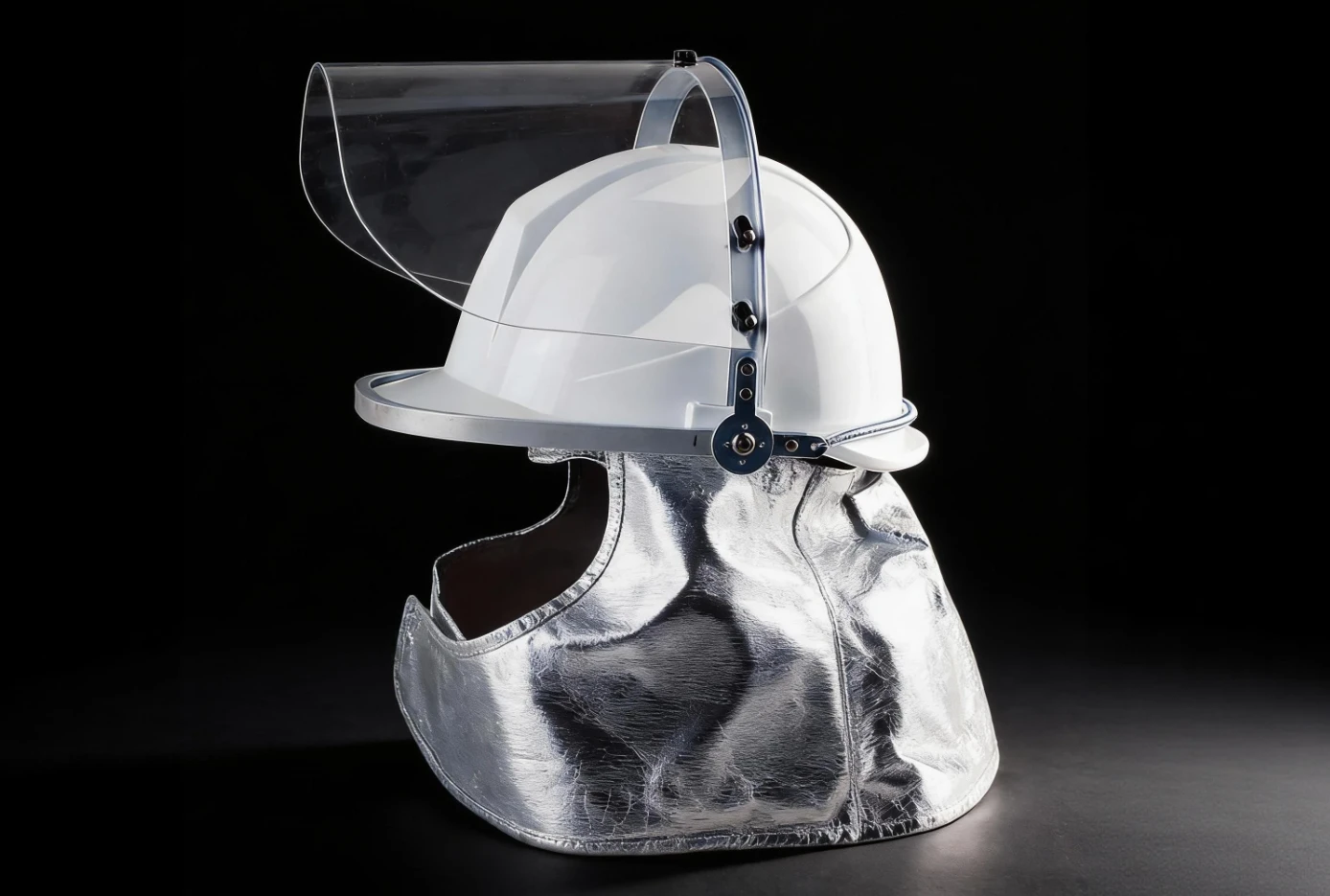
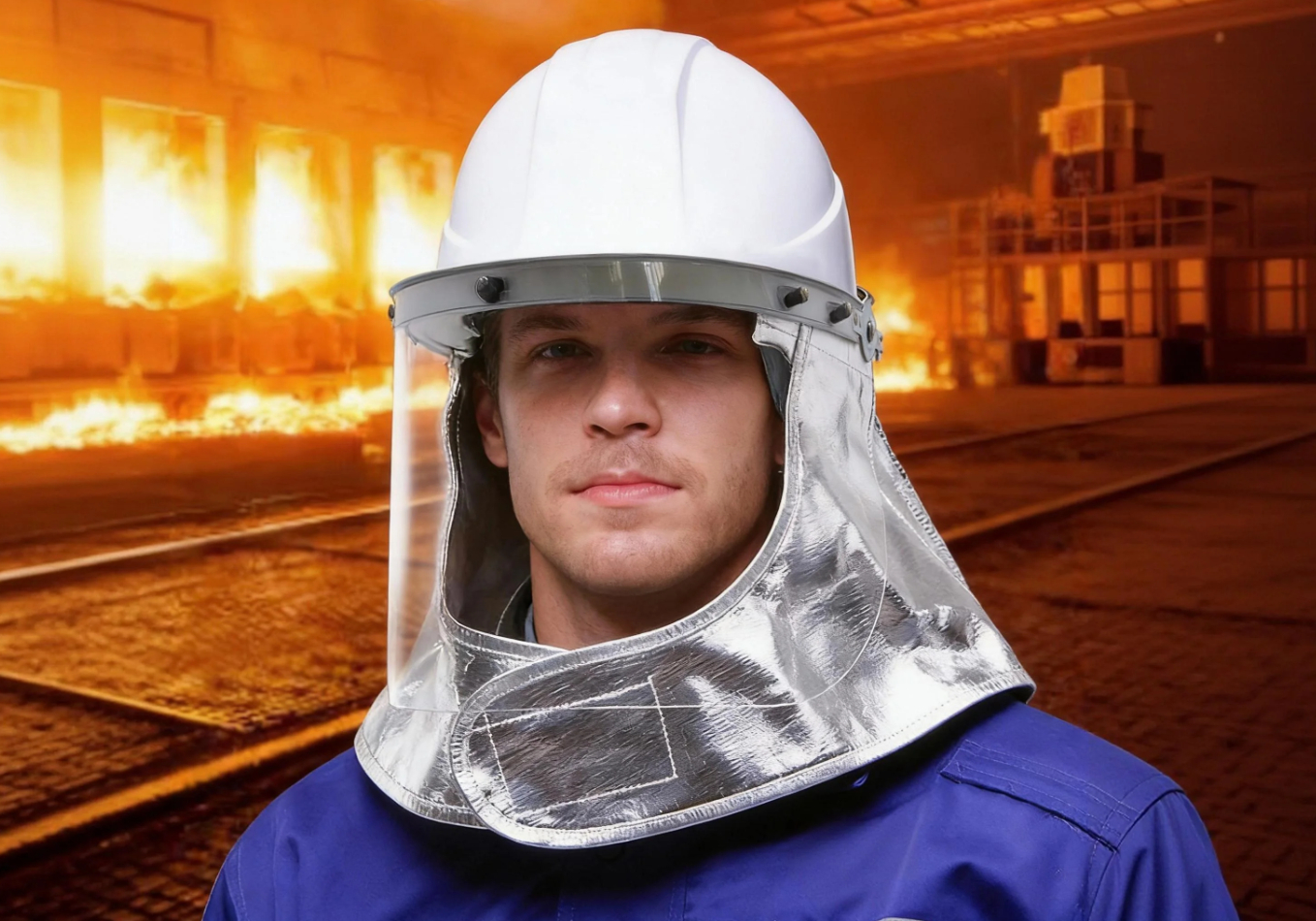
Face shields in this category cover the face, the front of the head and, in some designs, the throat and the sides of the neck. They are available as helmet-mounted visors, as shield and hood combinations, and as hand-held or fixed shields used during specific operations. Their purpose is to place a protective barrier between the worker and the heat or splash source while allowing the task to be observed and performed.
What they do not do is equally specific. A face shield does not replace primary eye protection, because it is designed to be a secondary barrier and does not provide the close-fitting coverage of spectacles or goggles. It does not protect the top of the head, the back of the neck or the shoulders, so a hood or a helmet is part of the same assembly. It does not address respiratory exposure, which is managed by extraction and ventilation first and by respiratory protection where those measures cannot control the exposure. And it does not remove heat, glare or splash: it reduces what reaches the worker, which is the definition of personal protective equipment in the hierarchy of controls.
Matching Task to Protection Level
| Task at the furnace | Dominant hazard | Shield specification that follows | What to verify |
|---|---|---|---|
| Observing or inspecting through a port or a partly open door | Radiant heat and glare | Reflective visor with the transmittance suited to the viewing task, mounted on a helmet | Radiant performance claimed, shading, fit over the helmet |
| Charging, tapping or lancing | Radiant heat plus intermittent splash and hot particles | Reflective shield with hood or neck coverage, worn over protective clothing | Coverage at the neck and throat, and the interface with the collar |
| Slag removal and deslagging | Splash, hot particles and mechanical impact | Impact-resistant reflector with full face coverage and a helmet underneath | Impact and heat performance claimed for the visor |
| Working beside the opening rather than facing it | Reflected radiant heat, spatter from adjacent operations | Shield or hood retained for the position, with the exposure stated rather than assumed | Task assessment for that specific position |
| Maintenance in the hot area | Residual heat, dust, splash from adjacent work | Set chosen for the maintenance task, often with a hood rather than a visor alone | Pre-task check and supervision of the set |
Two rules bound the table. The first is that the shield is one layer: it sits in front of primary eye protection and under or over head protection depending on the design, and the assembly is what protects. The second is that the required performance is a site decision taken from the assessment, expressed in the language of the standard the market works to, rather than a generic recommendation.
Where Selection Usually Goes Wrong
Furnace face protection fails in ways that are visible on any walk-through.
- A general-purpose visor used at a furnace. Impact protection is not heat protection, and the two are tested differently.
- Visor worn without head protection. The shield covers the face and leaves the crown exposed where hot particles fall from above.
- Gaps at the neck and throat. Splash enters between the visor and the clothing collar, which is why hoods exist for these tasks.
- No primary eye protection underneath. The visor is lifted for a closer look and the eye protection goes with it.
- Scratched, crazed or coated visors kept in service. Optical clarity and reflective behaviour both degrade, and the worker compensates by looking around the shield.
- Shield fouled with metal or scale. Residue on the surface holds heat and blocks the view; the correct response is replacement, not scraping.
- Only the worst task specified. The most exposed position is equipped properly while the adjacent position, which still faces radiant heat, is not.
There is one more failure worth naming because it is cultural rather than technical. At many furnaces, the shield is treated as something issued for a specific job and left on a hook for the rest of the shift, while the worker spends the rest of the shift in spectacles near the same radiant source. The requirement is a property of the position and the exposure, not of the task in the schedule, so the specification should state which positions require head and face protection continuously and which require it only when the door is open. Written that way, it is enforceable; left to judgement, it drifts by the end of the week.
The Hierarchy of Controls Around the Selection
Furnace work is another case where the earlier controls do the heavy lifting. Door operating practice that keeps workers to one side of the opening, screens and heat shields between the furnace and the working position, mechanised lancing and slag removal, changes to the charging method, cordons during a tap, and adequate ventilation all reduce the exposure that reaches the face. Personal protective equipment is then specified for the residual load that remains at each position.
That framing matters commercially as well as technically. Where the process has been arranged so that nobody has to stand in front of an open door, the face protection requirement becomes narrower, cheaper and easier to sustain; where it has not, the site ends up buying the heaviest available shield and asking the worker to wear it for eight hours, which is a specification that will be worked around rather than followed.
Specification Points to Fix Before Ordering
A furnace face shield specification should be precise enough for a second supplier to quote against, and short enough to be read at the furnace.
- The tasks and positions the shield is issued for, with the dominant hazard at each.
- The standard the shield is tested to, named with its scope, and the performance claimed for radiant heat, impact or splash as applicable.
- The mounting: helmet-mounted, hood combination, hand-held or fixed, with the compatible helmet model named.
- Coverage requirements at the face, throat and sides of the neck, and how the shield meets the collar of the garment.
- Primary eye protection to be worn underneath, specified for the same task.
- Cleaning instructions that preserve the reflective surface and the optical clarity of the visor.
- Inspection and replacement criteria for the visor, the mount and the headband, with a consumables list.
- Documentation required with the quotation: test evidence for the model, instructions and traceability.
The design and behaviour of reflective protective surfaces are explained in Shield Wings’ article on how aluminium foil heat protective clothing works, which owns that topic. The equipment itself is listed on the furnace face shield page and within the wider head and face protection range, alongside the hoods that complete the set.
Shield Wings manufactures furnace face shields and heat protective head and face equipment at a Guangdong production base and supports foundry, steel and glass customers with material selection and the documentation for each claimed performance. The specification that holds up is the one written around the task cycle at the opening, and it names the layer that protects each part of the face rather than relying on a single item.
For the wider topic and related decisions, see our Heat, Molten Metal & Furnace Protection.
Additional selection checks from the consolidated guide
The following checks were retained while consolidating overlapping coverage into this primary guide.
What Hazards Does a Furnace Face Shield Face?
A furnace face shield faces radiant heat from the furnace, molten metal splash, and heat reflected from surrounding surfaces — hazards that a standard impact shield is not designed to handle.
Near a furnace, the face absorbs radiant energy from every direction, and molten metal can splash when pouring or tapping. The shield must reflect or block the heat while keeping the worker’s view clear enough to work. Standard impact shields are not rated for this exposure; the furnace shield uses heat-rated materials and construction. The hazard is thermal first, impact second, so the specification starts with the heat rating.
What Materials Are Used in Furnace Face Shields?
Furnace face shields use heat-rated visor materials — often with reflective or coated surfaces — and frames and headgear that withstand the environment without warping or degrading.
The visor may use a heat-resistant transparent material with a reflective coating that bounces radiant energy away, and the frame must hold it securely in the heat without distortion. The headgear must stay comfortable under the thermal load. The combination is tested as a system for the furnace environment. Ask for the heat performance documentation for the exact model, because a shield that fails in the heat is worse than no shield — it creates a false sense of protection.
What Should You Verify Before Choosing?
Verify the heat rating for the exact model, the compatibility with other PPE, the visibility and comfort in the working position, and the documentation that proves the performance.
Confirm the shield is rated for the heat source and the splash hazard of the specific furnace work, and that it fits over safety glasses and other PPE without gaps. Check the visibility in the actual working position — a shield that fogs or distorts gets removed at the worst moment. Run a trial in the real environment, because the thermal load cannot be judged in an office. The documentation and the trial together confirm the shield belongs on the furnace floor.
How Do You Care for Furnace Face Shields?
Clean the visor with approved materials, inspect it before each use for heat damage, crazing, and coating wear, and replace it when the protection is compromised.
Heat exposure and cleaning both stress the visor over time. Inspect for crazing, discoloration, and coating damage that signal degraded protection, and replace the visor or shield when any appears. Store shields away from direct heat and scratches, and keep spares for the models in use. A furnace shield that has taken heat is a shield that has earned retirement when the inspection says so.
What Completes Face Protection in Furnace Work?
The shield is part of a system: safety glasses or goggles underneath, an FR hood or balaclava for the neck and scalp, and the full heat-protective clothing ensemble for the body.
The face shield protects the face; the hood closes the gap at the neck; the clothing ensemble protects the rest. The system should be specified and documented together, because protection is only as strong as the missing piece. Confirm each component’s heat rating and keep the documentation with the ensemble. A worker fully covered, with each piece rated, is a worker the furnace environment cannot reach.
Match heat protective clothing to the heat source and the standard codes; confirm the garment, gloves, and hood against the job hazard assessment and the applicable standard.
Furnace work should also specify the shield as part of the wider heat program: the visor, the hood, the clothing, and the gloves are selected and documented together, and the replacement cycle follows the exposure. Work with a manufacturer that supplies the heat-rated face protection with documentation for the exact model and guidance for the foundry environment, so the program is built from verified components rather than assumptions. Keep the documentation with the ensemble, review the spec when the furnace or the process changes, and retire components on evidence. The furnace floor is unforgiving; the program is what keeps the worker covered.
Ask for the heat performance documentation before purchase and trial the shield in the real furnace environment, because a shield without a verifiable heat rating is a shield whose protection is unknown near the furnace.
Which Furnace Shield Questions Do Buyers Ask Most?
What documentation and shift routine does furnace face protection need?
Ask for the heat performance documentation before purchase, because a shield without a verifiable heat rating is a shield whose protection is unknown near the furnace.
The furnace face protection program should also include the shift routine: the pre-use inspection, the cleaning between tasks, and the retirement of any visor that shows heat damage. Assign the inspection to the crew and audit it on a schedule, because the furnace environment is unforgiving to components that are not checked. A program that makes the inspection a habit keeps the shield protecting through every pour and tap.
Can a standard face shield be used near a furnace?
No. Furnace work needs a shield rated for radiant heat and molten splash, not a standard impact visor.
Do furnace shields fit over safety glasses?
Most are designed to; confirm the fit with the rest of the PPE before ordering.
How often should the visor be replaced?
Inspect before each use and replace when heat damage, crazing, or coating wear appears; follow the manufacturer’s guidance.
How do we get furnace shields for our foundry?
Tell us your furnace environment, and we will recommend the shield with documentation via our contact page or the furnace face shield page.
For the wider topic and related decisions, see our Heat, Molten Metal & Furnace Protection.
Frequently Asked Questions
When does furnace work require a face shield rather than safety spectacles?
When the face is exposed to radiant heat, to glare from the furnace opening, or to the possibility of molten metal or hot particles reaching it. Spectacles protect the eyes; a face shield protects the face as well, and the two are usually specified together rather than as alternatives. The assessment decides the combination, based on the task, the position and whether metal or slag can travel towards the worker.
Does a face shield replace eye protection underneath?
No. A visor is a secondary layer: it reduces the energy reaching the eyes and face, but it does not provide the close-fitting, all-round coverage of primary eye protection, and it can be lifted during work. Primary eye protection is worn underneath, chosen for the exposure the task presents, and the two are checked together so that both stay in position.
Why do reflective visors matter in furnace work?
Radiant heat travels without a medium, so the surface in front of the worker determines how much of it is reflected away and how much is absorbed. Reflective surfaces reduce the radiant load reaching the wearer, which is why they are used at furnace openings and in hot areas where the exposure is continuous rather than momentary. The choice depends on the dominant heat type, not on the appearance of the visor.
How should a furnace face shield be inspected and replaced?
Check the visor for scratches, crazing, heat damage, distortion and contamination, and check the headband, the mount and the sweep of the shield for damage or a loose fit. Coatings and reflective surfaces degrade with abrasion and cleaning, so the manufacturer’s cleaning instructions matter, and a visor that can no longer be seen through clearly is replaced rather than polished. Inspections are recorded against the unit.
What else belongs in the set for furnace work?
A safety helmet under or with the shield where impact is credible, a hood or neck protection where splash can reach the head and neck, heat protective clothing with closed construction, gloves long enough to meet the sleeve, and footwear that keeps molten metal out at the boot opening. The interfaces matter more than the individual items, because that is where heat and splash reach skin.
Equipping a furnace or casting position?
Send the operations at the opening, the distance from the heat and the splash risk. Shield Wings confirms the shield, hood and helmet combination for each position and the documentation behind each claim.
External references: 29 CFR 1910.133 eye and face protection, 29 CFR 1910.132, 29 CFR 1910 Subpart I, CCOHS PPE answers, CEN-CENELEC standards portal, Regulation (EU) 2016/425.
{“@context”:”https://schema.org”,”@type”:”FAQPage”,”mainEntity”:[{“@type”:”Question”,”name”:”When does furnace work require a face shield rather than safety spectacles?”,”acceptedAnswer”:{“@type”:”Answer”,”text”:”When the face is exposed to radiant heat, to glare from the furnace opening, or to the possibility of molten metal or hot particles reaching it. Spectacles protect the eyes; a face shield protects the face as well, and the two are usually specified together rather than as alternatives. The assessment decides the combination, based on the task, the position and whether metal or slag can travel towards the worker.”}},{“@type”:”Question”,”name”:”Does a face shield replace eye protection underneath?”,”acceptedAnswer”:{“@type”:”Answer”,”text”:”No. A visor is a secondary layer: it reduces the energy reaching the eyes and face, but it does not provide the close-fitting, all-round coverage of primary eye protection, and it can be lifted during work. Primary eye protection is worn underneath, chosen for the exposure the task presents, and the two are checked together so that both stay in position.”}},{“@type”:”Question”,”name”:”Why do reflective visors matter in furnace work?”,”acceptedAnswer”:{“@type”:”Answer”,”text”:”Radiant heat travels without a medium, so the surface in front of the worker determines how much of it is reflected away and how much is absorbed. Reflective surfaces reduce the radiant load reaching the wearer, which is why they are used at furnace openings and in hot areas where the exposure is continuous rather than momentary. The choice depends on the dominant heat type, not on the appearance of the visor.”}},{“@type”:”Question”,”name”:”How should a furnace face shield be inspected and replaced?”,”acceptedAnswer”:{“@type”:”Answer”,”text”:”Check the visor for scratches, crazing, heat damage, distortion and contamination, and check the headband, the mount and the sweep of the shield for damage or a loose fit. Coatings and reflective surfaces degrade with abrasion and cleaning, so the manufacturer’s cleaning instructions matter, and a visor that can no longer be seen through clearly is replaced rather than polished. Inspections are recorded against the unit.”}},{“@type”:”Question”,”name”:”What else belongs in the set for furnace work?”,”acceptedAnswer”:{“@type”:”Answer”,”text”:”A safety helmet under or with the shield where impact is credible, a hood or neck protection where splash can reach the head and neck, heat protective clothing with closed construction, gloves long enough to meet the sleeve, and footwear that keeps molten metal out at the boot opening. The interfaces matter more than the individual items, because that is where heat and splash reach skin.”}}]}