

A shutdown is a different environment from normal operation, even though the plant is the same. The furnace is stopped but still hot, the work moves inside structures that are normally inaccessible, several trades are compressed into a short period, and the dust and debris generated by demolition are new. Head and face protection has to be specified by stage and by position, because the exposure at the hearth on day one is not the exposure on the access platform on day six.
What This Environment Does to People and Equipment
Schedule pressure is part of the environment and belongs in the assessment. Shutdowns have a fixed window, and the cost of exceeding it is visible to everyone, which means that working practices that would be questioned at any other time are accepted as temporary. The protective equipment specification should therefore be settled before the window opens, because during the shutdown the answer to a question about protection is usually the equipment that is already on site.
Residual heat is the defining condition. A furnace cools slowly and unevenly, so some surfaces remain hot while others are workable, and the radiant load on a person inside the structure can be substantial without any visible flame. Refractory removal adds dust, and the material being removed may contain constituents that the assessment has to identify. Scaffolding and access equipment add working-at-height considerations, and the interior of a large furnace is a confined space with restricted egress.
Equipment suffers from the combination. Reflective surfaces dull, face shields scratch and cloud, and respiratory protection filters load up quickly in a dusty environment. Helmets and hoods are used intensively for a few weeks and then stored, and the condition they are stored in determines whether they are usable at the next shutdown. The tempo of the work also matters: with a schedule to meet, equipment that is uncomfortable or hard to see through will be adjusted or removed.
The Hazards That Drive the Specification
Two exposures are easy to leave out. The first is heat stress inside protective equipment in a hot structure, which reduces the time a person can work and increases the chance of errors; the second is noise inside an enclosed space, where the structure reflects and amplifies it. Both belong in the same document as the dust and heat exposures, and both affect the rotation and welfare arrangements rather than only the equipment.
- Radiant heat from hot surfaces and residual material, which varies by position and over the course of the shutdown.
- Contact heat from surfaces that are still hot, including floors and structures.
- Refractory dust, which combines an inhalation hazard with an eye and skin irritant effect.
- Falling material, including brickwork, scale and debris from above.
- Chemical exposure from cleaning agents, coatings and process residues.
- Confined space conditions: restricted egress, poor ventilation, and the need for atmosphere monitoring and a rescue plan.
- Heat stress, because protective equipment is worn inside a hot structure for extended periods.
- Noise from demolition, cutting and air tools, often in an enclosed space where it is amplified.
The employer owns the assessment, and the supplier documents what the equipment is tested to. During a shutdown the assessment should be revisited as the work progresses, because the temperature inside the structure changes and the tasks move from demolition to repair to rebuilding.
Controls That Come Before the Equipment
Temperature monitoring deserves to be treated as a control rather than as a measurement, because the entry decision for each area depends on it, and because the reading changes through the shift as the structure continues to cool unevenly.
Shutdown safety is planned before the first person enters. Cooling procedures and temperature monitoring define when and where work can start; ventilation and extraction address the dust and fume; water suppression reduces airborne dust at the point of generation; access, egress and rescue arrangements are agreed for each area; permits and task sequencing control who is where; and the schedule itself is arranged so that trades are not working above one another.
Administrative controls then carry the day-to-day discipline: entry procedures with atmosphere monitoring, defined work limits related to temperature, supervision, communication across several contractors, and welfare arrangements including cooling and hydration. Personal protective equipment is the last line of defence, and during a shutdown it is worth checking whether the work could be rearranged — a different sequence, a longer cooling period or a different access route — rather than absorbed by heavier equipment.
What the Equipment Has to Do Here
Compatibility deserves particular attention in a shutdown because several items are worn at once and the workforce includes contractors who have their own equipment. A reflective hood worn over a respirator, a face shield mounted on a helmet worn with hearing protection, and gloves that meet a sleeve are all combinations that have to be checked rather than assembled. Where a site brings several trades onto one job, stating the required assembly per task is what keeps the combinations consistent.
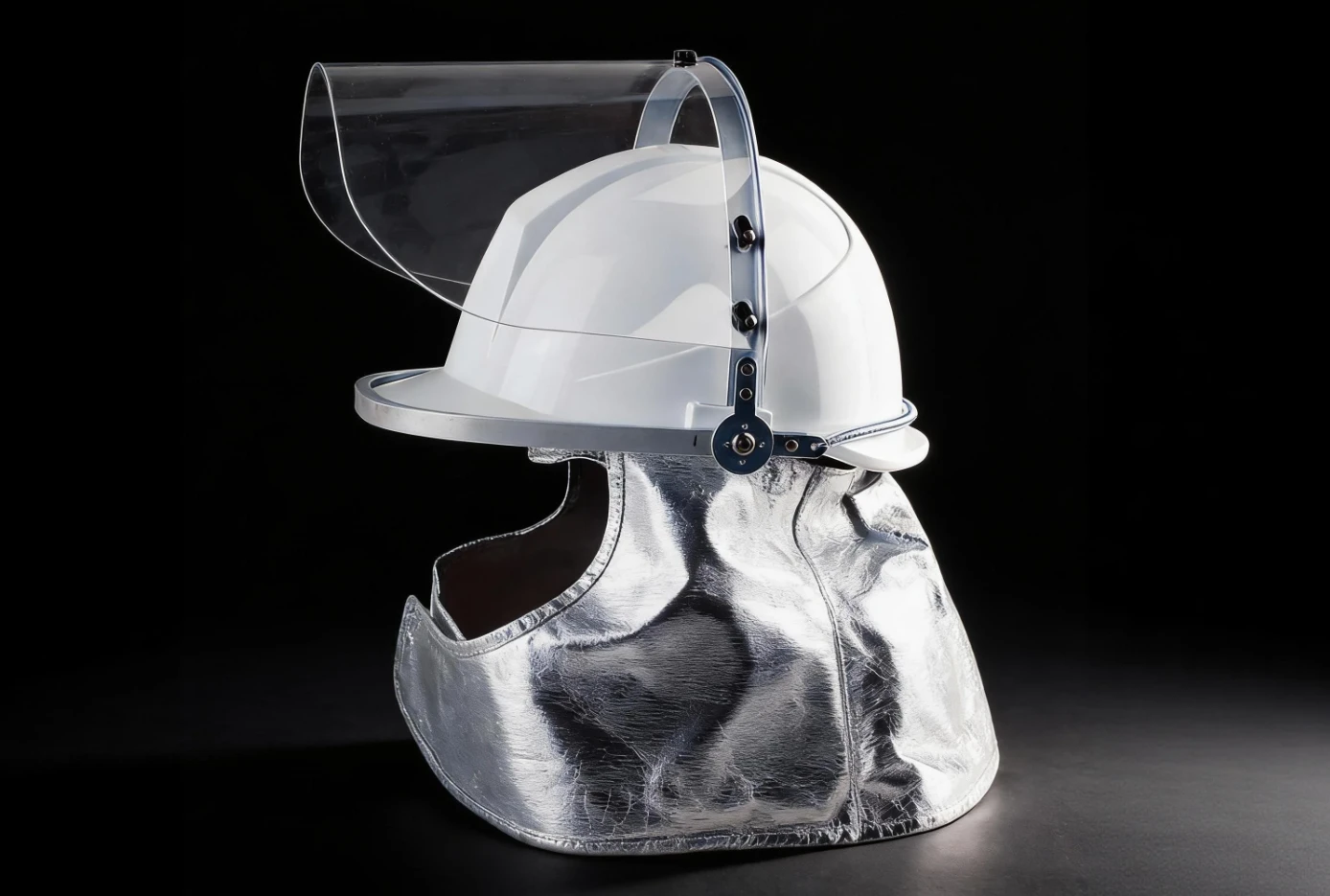
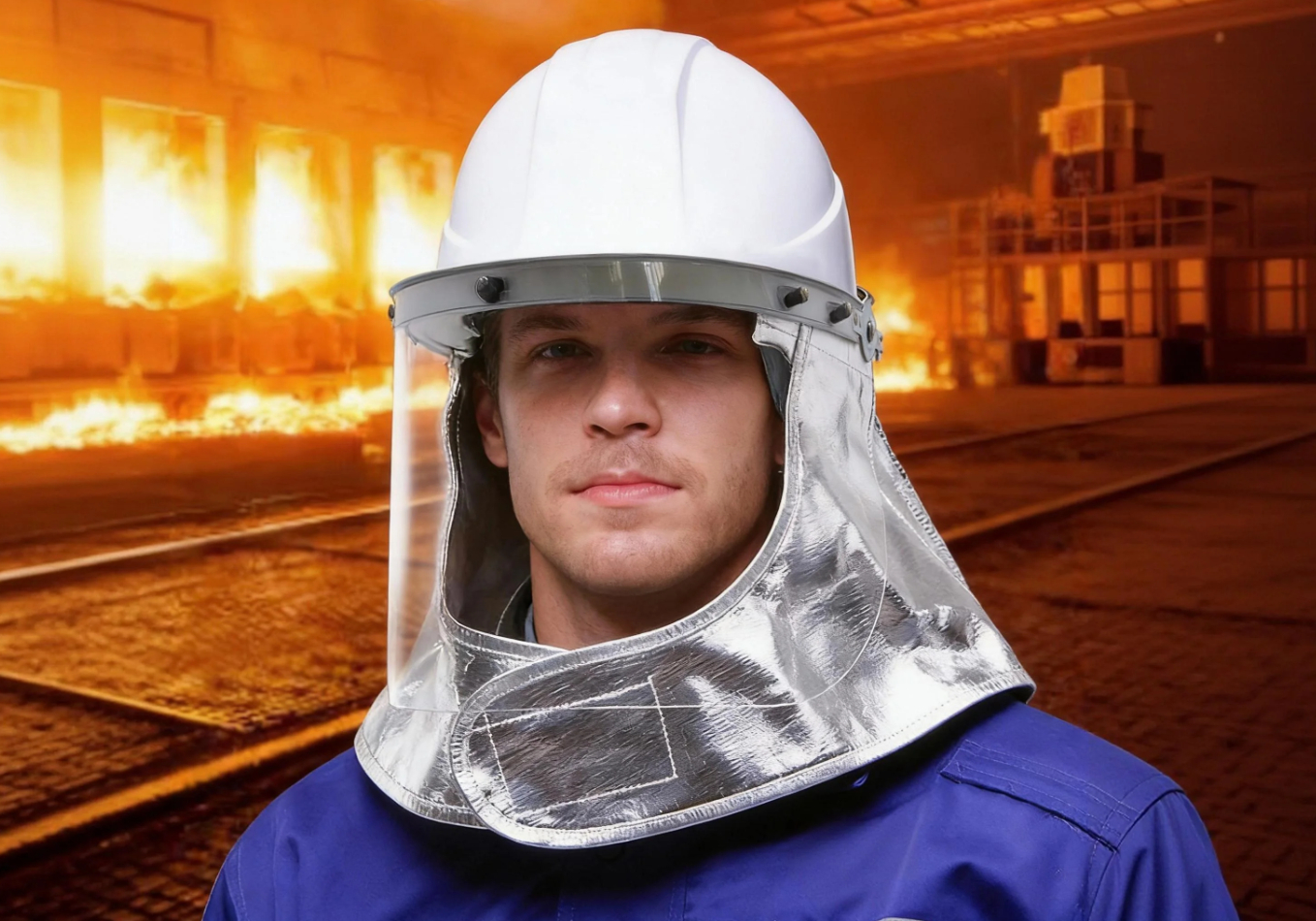
Head and face protection during shutdown work has to cover three different exposures, sometimes simultaneously. Where radiant heat dominates, reflective hoods and face shields reduce the load reaching the face and head, and they are worn with heat protective body clothing. Where falling material is the risk, impact-rated face protection and a helmet with secure retention are required. Where dust or chemical exposure is present, the protection has to be compatible with respiratory equipment and with eye protection.
How reflective surfaces behave, and why they are used at furnace positions, is covered in Shield Wings’ article on how aluminium foil heat protective clothing works, which owns that topic. What matters at specification stage is that the equipment is chosen for the stage of the shutdown, that the interfaces with respiratory protection and with the rest of the set are confirmed, and that the assembly is checked in the position it will be used in.
Selection Criteria Specific to This Sector
| Stage or position | Dominant exposure | Protection that follows | What to verify |
|---|---|---|---|
| Initial entry and inspection after cool-down | Residual radiant heat, hot surfaces, poor visibility | Reflective hood or shield with heat protective clothing, plus respiratory protection | Temperature measurement for that area and the equipment suited to it |
| Refractory removal and demolition | Dust, falling debris, impact, noise | Impact-rated face protection, helmet with retention, respiratory protection and hearing protection | Dust controls in place and the materials involved identified |
| Working inside the structure | Confined space, heat, restricted egress | Lower-profile protective assembly that fits the space and does not impede exit | Fit inside the space and the rescue arrangements |
| Repair and rebuilding tasks | Mixed: heat, dust, welding, mechanical | Equipment per task, with interfaces between welding protection and the rest | Task list and the assembly for each one |
| External work on the shell and platforms | Working at height, falling objects, weather | Helmet with retention, impact face protection and fall protection | Access arrangement and the fall protection set |
| Post-shutdown clean-up and inspection | Dust, residual heat in isolated areas | Protection retained until the area is confirmed suitable | Confirmation that conditions have changed, rather than assumption |
Read across the table, the requirement changes with the stage rather than with the job title, which is why shutdown equipment is best specified as a set of stages with the equipment for each one identified in advance.
Typical Specification Failures in This Sector
One failure is organisational: the host site assumes the contractors will bring the right equipment, and the contractors assume the host will provide it. The result is usually a mixture, with the most exposed positions covered by whoever happened to plan best. A short statement of what the host requires, and what it provides, removes that ambiguity before mobilisation rather than during the first shift.
- Equipment planned late. Specifications, sizes and condition are settled before the shutdown or improvised during it.
- One set for the whole job. Reflective protection for radiant heat and impact protection for demolition are different requirements.
- Dust treated as a nuisance. Refractory dust is an inhalation and irritation hazard, and its control belongs in the plan.
- Respiratory compatibility assumed. A hood, a mask and a face shield that were each chosen separately rarely work as one assembly.
- Heat stress ignored. Protective clothing plus a hot structure plus a tight schedule produces fatigue that reduces judgement.
- Equipment reused after exposure. Hoods, shields and filters used at the hottest positions are inspected before they return to stock.
- Contractor inconsistency. Several trades on one site often arrive with different equipment standards, and the host should state its requirement.
Building the Full Set Rather Than Buying Pieces
It is also worth planning the logistics of the set, because a shutdown concentrates demand. The number of respirator filters, hoods, shields, helmet parts and covers needed for a two-week job is not the same as for routine operations, and running out mid-shutdown usually means using something that has already been used past its condition. Ordering consumables against the shutdown plan is a small administrative step with a large effect on the condition of the equipment in use.
The set for shutdown work typically includes a helmet with retention, reflective hood or face shield for hot positions, impact face protection for demolition, respiratory protection suited to the dust, hearing protection, heat protective clothing, gloves and footwear for the surfaces involved, and fall protection where working at height applies. The interfaces are the critical part: the hood and the respirator, the helmet and the face shield, the clothing and the gloves.
Shield Wings manufactures head and face protection at a Guangdong production base, including furnace face shields and hoods, and supports foundry, steel and industrial customers with configuration guidance and the documentation each product carries. The wider family is listed in the head and face protection range.
A shutdown is planned weeks in advance, and the protective equipment should be planned on the same timescale. Where it is, the equipment is available, inspected and fitted before the work starts, and the schedule does not have to absorb the consequences of getting it wrong.
For the wider topic and related decisions, see our Heat, Molten Metal & Furnace Protection.
Frequently Asked Questions
What head and face protection is needed for furnace shutdown work?
It depends on the position and the stage of the shutdown: reflective hoods and face shields where radiant heat from hot surfaces dominates, impact-rated face protection where falling refractory or material is possible, and respiratory protection for the dust that the work generates. The assessment should be written by task and by area, because a shutdown moves through stages with very different exposures.
Why is refractory dust such a concern?
Demolishing and removing refractory generates fine dust from materials that may contain crystalline silica and other constituents, and the exposure can be significant in an enclosed space with limited ventilation. The controls are water suppression, extraction, restricted access and respiratory protection, and the assessment should identify the materials involved rather than treating all refractory dust as equivalent.
How does residual heat affect the specification?
A furnace that has been shut down is still hot, and it cools unevenly, so the exposure changes hour by hour and differs between the top, the side walls and the hearth. The plan should include temperature monitoring and defined entry or work limits, and the protective equipment should reflect the condition of the specific area rather than the fact that the furnace is nominally shut down.
How should equipment be handled between shutdowns?
It should be inspected and cleaned before being stored, with anything exposed beyond its specification withdrawn rather than returned to stock. Shutdown equipment is often kept for long periods and used intensively for a few weeks, which makes the pre-shutdown check the point at which condition and availability are actually determined.
What is the most common planning failure?
Treating the protective equipment as a procurement step to be arranged at the start of the shutdown. The specifications need to be settled, the equipment inspected and the sizes confirmed before the work begins, because during the shutdown the access, the scaffolding and the schedule make it difficult to change anything, and the equipment that is not ready is the equipment that gets improvised.
Planning protection for a shutdown?
Send the stages, the positions and the trades involved. Shield Wings confirms which head and face configurations suit each stage, with the documentation for each claim.
External references: 29 CFR 1910.132 hazard assessment and equipment selection, 29 CFR 1910.146 permit-required confined spaces, 29 CFR 1910 Subpart I, CCOHS PPE answers, CEN-CENELEC standards portal, Regulation (EU) 2016/425.
{“@type”:”FAQPage”,”@context”:”https://schema.org”,”mainEntity”:[{“@type”:”Question”,”name”:”What head and face protection is needed for furnace shutdown work?”,”acceptedAnswer”:{“@type”:”Answer”,”text”:”It depends on the position and the stage of the shutdown: reflective hoods and face shields where radiant heat from hot surfaces dominates, impact-rated face protection where falling refractory or material is possible, and respiratory protection for the dust that the work generates. The assessment should be written by task and by area, because a shutdown moves through stages with very different exposures.”}},{“@type”:”Question”,”name”:”Why is refractory dust such a concern?”,”acceptedAnswer”:{“@type”:”Answer”,”text”:”Demolishing and removing refractory generates fine dust from materials that may contain crystalline silica and other constituents, and the exposure can be significant in an enclosed space with limited ventilation. The controls are water suppression, extraction, restricted access and respiratory protection, and the assessment should identify the materials involved rather than treating all refractory dust as equivalent.”}},{“@type”:”Question”,”name”:”How does residual heat affect the specification?”,”acceptedAnswer”:{“@type”:”Answer”,”text”:”A furnace that has been shut down is still hot, and it cools unevenly, so the exposure changes hour by hour and differs between the top, the side walls and the hearth. The plan should include temperature monitoring and defined entry or work limits, and the protective equipment should reflect the condition of the specific area rather than the fact that the furnace is nominally shut down.”}},{“@type”:”Question”,”name”:”How should equipment be handled between shutdowns?”,”acceptedAnswer”:{“@type”:”Answer”,”text”:”It should be inspected and cleaned before being stored, with anything exposed beyond its specification withdrawn rather than returned to stock. Shutdown equipment is often kept for long periods and used intensively for a few weeks, which makes the pre-shutdown check the point at which condition and availability are actually determined.”}},{“@type”:”Question”,”name”:”What is the most common planning failure?”,”acceptedAnswer”:{“@type”:”Answer”,”text”:”Treating the protective equipment as a procurement step to be arranged at the start of the shutdown. The specifications need to be settled, the equipment inspected and the sizes confirmed before the work begins, because during the shutdown the access, the scaffolding and the schedule make it difficult to change anything, and the equipment that is not ready is the equipment that gets improvised.”}}]}