

A boot that looks perfectly serviceable can already have lost its protection. A staple embedded in the sole, a hairline crack from ozone, or a pair stored damp over winter creates a conductive path that no amount of visual inspection catches — and the worker wearing them has no way to feel the difference. Dielectric protection is invisible, so it lives or dies on documentation and discipline rather than appearance.
(Last modified date: October 1, 2026)
Quick definition: Dielectric boots are constructed from non-conductive materials, including the soles and the fasteners, so they resist the passage of electrical current. They are built for workers who may contact live conductors or energised equipment.
Key Takeaways
- Dielectric boots work by keeping the body isolated from ground: if hands or tools contact a live part, the current finds no path through the footwear to earth.
- Dielectric boots are tested to a dedicated standard for live electrical work; EH-rated boots give secondary protection against incidental contact at lower voltages. The two are not interchangeable for high-voltage work.
- ASTM F1117 is the dedicated dielectric footwear standard, ASTM F2413 covers general protective footwear including the EH rating, and OSHA 1910.136 makes protective footwear mandatory where electrical hazard remains after other controls.
- Protection is proven by high-voltage proof testing that measures leakage current, so the certificate and the test schedule carry the same weight as the boot itself.
- Inspect before every use, keep them clean and dry, and never modify them — a metal insole, a repair or conductive debris recreates the path the boot exists to block.
What Are Dielectric Boots and Who Needs Them?
Dielectric boots are built from non-conductive materials — including the soles and the hardware — and they are designed for workers who may contact live conductors or energised equipment.
Utility linemen, substation technicians and electrical maintenance crews wear them as a second layer of insulation. They are not a replacement for insulating gloves, insulated tools or proper de-energising procedures; they are the last line of defence when a worker steps on or touches something live. The defining feature is that every part of the boot, including the hardware and the outsole, is non-conductive, so current has no easy path through the footwear to ground.
Beyond utilities, dielectric boots appear wherever energised equipment is serviced: electrical construction, mining, railway electrification, and industrial plants with live switchgear. The common thread is that crews cannot always de-energise what they have to approach. For those teams the boot is part of a documented electrical PPE package, selected from the same risk assessment that specifies gloves, sleeves and tools. That is why the purchase should start with the electrical safety procedure rather than a catalogue.
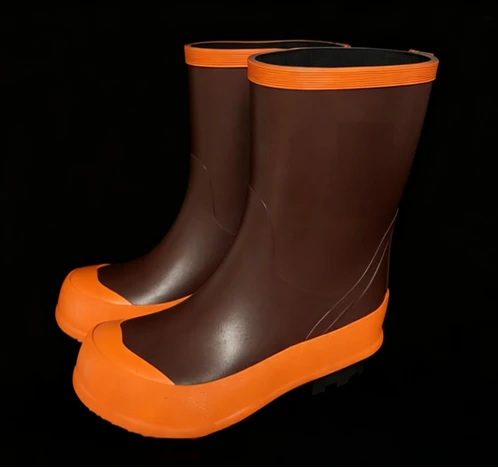
Every component, including the hardware and outsole, has to be non-conductive.
How Do Dielectric Boots Protect Against Electrical Hazards?
They keep the body electrically isolated from ground. If the hands or a tool contact a live part, the current finds no path through the footwear, which removes the shock path rather than resisting it.
Electrical injury happens when current flows through the body between two points — typically from a hand or tool down to the ground through the feet. A dielectric outsole and upper interrupt that path. The protection depends on the material staying dry, clean and intact: moisture, embedded metal or conductive contamination can bridge the insulation. That is why dielectric boots carry strict care, testing and inspection requirements, and why they must never be modified with metal fasteners or cleats.
What’s the Difference Between Dielectric and EH Rated Boots?
Dielectric boots are tested to a dedicated standard for workers facing live electrical equipment; EH-rated boots provide secondary protection against incidental contact at lower voltages. They are not interchangeable for high-voltage work.
| Feature | Dielectric (ASTM F1117) | EH rated (ASTM F2413) |
|---|---|---|
| Purpose | Work near live conductors | Incidental electrical contact |
| Test voltage | High-voltage proof test | 18,000 V, 60 Hz |
| Construction | Fully non-conductive | Non-conductive outsole only |
| Typical users | Utility and substation crews | General industry, electricians |
The practical rule is simple: electricians and general industry workers can rely on EH-rated footwear, but crews working on or near energised high-voltage equipment should use boots tested to ASTM F1117. Confirm the requirement in your site’s electrical safety procedures before choosing. The side-by-side decision is covered in dielectric boots vs EH rated boots.
Which Standards Govern Dielectric Footwear?
ASTM F1117 is the dedicated standard for dielectric footwear, ASTM F2413 covers general protective footwear including the EH rating, and in the United States OSHA 1910.136 makes protective footwear a requirement where electrical hazard remains after other controls.
ASTM F1117 sets proof-test requirements for dielectric footwear, verifying that a boot withstands a specified high-voltage test without excessive leakage. It also covers the construction details that preserve insulation, such as non-conductive soles and hardware. ASTM F2413 defines the EH rating used across general industry.
The regulatory layer is worth reading before you specify. OSHA 1910.136 requires the employer to ensure protective footwear is used where there is a danger of foot injury from falling or rolling objects, from objects piercing the sole, or where protective footwear will protect the employee from an electrical hazard — including static-discharge and electric-shock hazards — that remains after other protective measures have been taken. The same section names ASTM F2413 (with ASTM F2412 test methods) among the recognised consensus standards. When you buy dielectric boots, request the certificate for the specific model and confirm both the test voltage and the standard edition, because documentation is what survives an audit.
What Tests Prove Dielectric Protection?
Dielectric boots are proven by high-voltage proof testing: a specified voltage is applied across the boot and the leakage current is measured. Passing within the allowed leakage limit certifies the insulation for its rated class.
The test simulates the worst real-world moment — a worker standing on a conductive surface while contact occurs with an energised part. The boot has to block the voltage and hold leakage inside limits. Because the test degrades the sample and is expensive to run, it is performed on sample pairs and on periodic in-service boots rather than on every pair — which is exactly why the certificate and the proof-test schedule carry the weight they do. Buyers should ask for the certificate, confirm the tested voltage, and verify that the production batch matches the certified model.
How Do You Fit and Wear Dielectric Boots?
Fit them snugly with the socks actually worn on the job, wear them only with non-conductive accessories, and never modify them — an added metal insole, a field repair or conductive debris creates the exact current path the boot is designed to block.
Fit matters for stability: workers on ladders and scaffolds need a boot that holds the heel and supports the ankle. Wear them only in their intended electrical environment and keep them separate from general work boots, so metal shavings and conductive debris never ride into the work zone. Insoles, if used, must be non-conductive and approved for the boot. Any modification — new soles, added hardware, field repairs — voids the dielectric rating and takes the boot out of service.

Fit is part of the protection: a boot that shifts on a ladder puts the worker off balance.
How Should Dielectric Boots Be Tested and Inspected?
Visually inspect before every use, keep them clean and dry, and proof-test them on the manufacturer’s and employer’s schedule — because a small defect defeats the insulation completely.
The pre-use check takes seconds: look for cuts, cracks, embedded metal, worn soles, and any sign of water or contamination. Store boots away from heat, sunlight and ozone sources that degrade rubber. Employers typically schedule laboratory proof-testing at set intervals and retire boots after a defined service life. Never patch a damaged dielectric boot and return it to service — replacement is the only safe answer. Document inspection dates and test results for every pair.
Turn the check into a routine with a fixed sequence: wipe the boot down and inspect the surface in good light; run fingers along the sole and heel for embedded debris; flex the boot to expose hairline cracks; check the hardware and lacing for exposed metal; confirm the boots are dry inside and out. Assign each pair a number and log its inspection and test dates so a question in the field can be answered from records rather than memory. Crews that follow this sequence catch problems while they are still cheap to fix.
Where Dielectric Boots Fail in Service
The danger with dielectric boots is that the protection is invisible, so complacency sets in quickly. The failure modes are consistent across crews, and each one has a control:
- Embedded debris — a staple or metal shaving in the sole bridges the insulation. Control: inspect the sole and heel every use and keep the boots out of general workshop areas.
- Ozone and UV cracking — rubber degrades near motors and in sunlight. Control: store flat, dark and cool, away from ozone sources.
- Damp storage — moisture inside the boot creates a path. Control: dry thoroughly after use and never store them wet.
- Buying EH-rated instead of dielectric — cheaper and easier to source, and wrong for energised high-voltage work. Control: verify the ASTM F1117 certificate before the order, not after.
- Unauthorised repair — a patched sole or an added metal insole voids the rating. Control: retire and replace; never repair.
Dielectric Boot Specifications at a Glance
The specification points to verify when sourcing are the standard, the construction, the proof-test voltage, the sizing, the maintenance schedule and the ordering terms.
| Specification | What to confirm |
|---|---|
| Standard | ASTM F1117 dielectric test certificate |
| Construction | Non-conductive upper, sole and hardware |
| Test voltage | Proof-test voltage from the certificate |
| Sizing | Fit over work socks, with room for insoles if used |
| Maintenance | Storage, cleaning and proof-test schedule |
| Ordering | Samples, wholesale lots, OEM branding |
Because the boots’ entire value sits in materials and testing, the certificate and the factory’s QC records matter as much as the price. Batch traceability is kept on every dielectric boot order we ship.
Can You Get Dielectric Boots Through OEM or Wholesale Programs?
Yes. Dielectric boots are available through wholesale and OEM programmes, including custom sizing ranges, branding and packaging for utilities and distributors.
Utilities generally want a standardised model across crews, with branding and clear size coding for fast matching. Distributors may need private-label packaging and inventory programmes. Because the boots are manufactured in-house, construction details can be confirmed before production and the test documentation that accompanies each batch is supplied with it. Wholesale buyers can start with sample pairs, test them in the field and then scale, with lead times confirmed in writing before committing.
Utility procurement usually runs on an annual cycle: sample evaluation, field trial, then a bulk award with a defined delivery window. Factories that can supply test documentation, size runs and replacement stock across the year make that cycle straightforward. Ask about reorder lead times and minimum quantities early, because a utility that runs out of dielectric boots cannot simply substitute another model without re-approving it in the safety procedure.
What Should Your Next Step Be?
Confirm whether your electrical work requires dielectric (ASTM F1117) or EH-rated footwear, then request sample pairs and certificates before ordering for the crew. Decide who manages the proof-testing schedule — your own lab, a third party, or the manufacturer’s programme — because that decision shapes the documentation you request with delivery. Many operators pair their bulk order with a testing and replacement schedule so boots rotate out of service on time. Send your electrical safety procedures or current boot specification through the contact page or the dielectric boots product page, and our team will recommend the right footwear, confirm the test documentation and arrange samples for field testing.
For the wider topic and related decisions, see our Arc Flash & Electrical Safety PPE.
FAQs
How often should dielectric boots be proof-tested?
Follow the manufacturer’s and your employer’s schedule; many programs test annually and retire boots on a set service cycle. Document every result.
Can dielectric boots be used for regular work too?
They can, but they are specialized for electrical environments. Wearing them for heavy industrial work shortens their service life and increases contamination risk.
What ruins dielectric boots fastest?
Moisture, contamination, embedded metal, ozone, and improper storage. Keep them clean, dry, and away from heat and sunlight.
Do dielectric boots need to be replaced after a shock incident?
Any boot involved in an electrical incident should be removed from service and proof-tested or replaced, even if it looks undamaged.
Related Articles
- Dielectric Boots vs EH Rated Boots: What’s the Difference
- PPE for Electrical Workers: The Complete Guide
- Arc Flash Protection
Official Resources
References
- 29 CFR 1910.136 — Foot protection: when protective footwear is required and the recognised consensus standards. Electronic Code of Federal Regulations.
- ASTM F1117 — standard specification for dielectric footwear. ASTM International.
- ASTM F2412 / F2413 — test methods and performance requirements for protective footwear, including the EH rating. ASTM International.