Arc flash safety failures rarely start with the arc itself — they start with small decisions: a skipped analysis, a mismatched glove, a suit stored damp. This article lists the ten most common mistakes and how to correct them, with reference to arc flash safety mistakes from Shield Wings.
(Last modified date: October 3, 2026)
Quick definition: What Are the Ten Most Common Mistakes?
Key Takeaways
- Arc flash mistakes keep happening because the hazard is invisible until it happens: complacency builds between incidents, and small shortcuts — an unverified rating, a mixed kit, an outdated label — accumulate until one…
- Correction follows the same pattern for each mistake: name the gap, add the verification step, and audit until it holds.
- The program should include a current hazard analysis, a written task-to-equipment matrix, matched kits with certificates, rubber goods on test schedules, care and inspection records, and field audits that check what…
Why Do Arc Flash Mistakes Keep Happening?
Arc flash mistakes keep happening because the hazard is invisible until it happens: complacency builds between incidents, and small shortcuts — an unverified rating, a mixed kit, an outdated label — accumulate until one of them becomes the cause.
Electrical work is routine until it is not, and routine creates shortcuts. The mistakes below are the ones that recur on real sites, and each one has a correction that fits into a normal program. The pattern across all ten is the same: decisions made without verification. Fix the verification habit — the label, the certificate, the matrix, the inspection — and most of the list stops being a problem.
What Are the Ten Most Common Mistakes?
- Skipping the hazard analysis — selecting PPE without knowing the incident energy is guessing; run or update the study and label the tasks.
- Trusting the label without the certificate — a category printed on a garment is a claim; the test report for the exact model is the evidence.
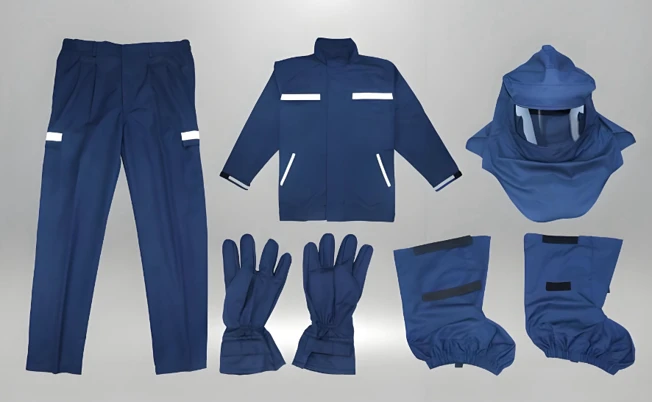
- Mixing pieces from different systems — a rated jacket with an unrated hood or mismatched gloves leaves the face and hands exposed; buy matched kits.
- Buying the highest rating for everything — heavier suits cause heat stress and get removed; match the rating to the task with margin, not to comfort.
- Using FR coveralls as arc protection — flash fire resistance is not an arc rating; confirm the arc rating for electrical tasks.
- Ignoring the hood and gloves — the face, neck, and hands face the highest energy; every component must carry a matching rating.
- Skipping rubber goods for shock — arc-rated clothing does not stop shock; use voltage-rated gloves and insulated tools for energized work.
- Storing or laundering suits wrong — damp storage, bleach, and fabric softeners degrade the system; follow the care label and inspection cycle.
- Letting labels go stale — system changes alter incident energy; update the analysis, labels, and matrix on the review cycle.
- Training without verification — a slide deck does not build the inspection habit; run drills, audit the field, and correct what you find.
How Do You Correct the Mistakes?
Correction follows the same pattern for each mistake: name the gap, add the verification step, and audit until it holds.
For every item above, write the correction into the program rather than relying on awareness: the matrix names the equipment, the certificate check happens at receipt, the kit is issued complete, and the field audit verifies what is actually worn. Review the list quarterly and after incidents. The discipline is the same across all ten — verify before you trust, and check the field, not just the paperwork.
What Should the Corrective Program Include?
The program should include a current hazard analysis, a written task-to-equipment matrix, matched kits with certificates, rubber goods on test schedules, care and inspection records, and field audits that check what crews actually wear.
Each element closes one of the ten gaps. The analysis and matrix close the selection mistakes; the certificate and matched-kit rules close the equipment mistakes; the care and inspection records close the maintenance mistakes; and the field audit closes the compliance mistakes. Assign an owner to each element and review the whole program on the same cycle as the analysis. A program built to correct the ten common mistakes is a program that has learned from them.
Use the site’s arc-flash label and electrical safety program for each specific task; do not select PPE from a generic category table alone, and confirm equipment against the applicable standard.
The ten mistakes are corrected not by awareness alone but by turning each correction into a step of the program that someone owns and the audit verifies.
The Arc-Rated Thresholds, Written Out
Most of the mistakes listed above are variations on one omission: nobody wrote down which body areas need arc-rated protection and at what incident energy. Where 29 CFR 1910.269 applies, the rule answers that with numbers, and the exemptions matter as much as the requirement.
| Situation | What applies | Paragraph |
|---|---|---|
| Work where an arc could ignite clothing, or contact above 600 V, or incident heat energy above 2.0 cal/cm² | Clothing that will not melt or ignite; no meltable synthetics | (l)(8)(iv) |
| Estimated incident heat energy above 2.0 cal/cm² | Arc-rated clothing and equipment covering the whole body, with an arc rating at least equal to the estimated energy | (l)(8)(v) |
| Hands, when incident energy is 14 cal/cm² or less | Rubber insulating gloves with protectors, or heavy-duty leather work gloves of at least 407 g/m² (12 oz/yd²) | (l)(8)(v)(A) |
| Feet | Heavy-duty work shoes or boots; arc-rated protection is not required | (l)(8)(v)(B) |
| Head, single-phase arc in open air below 9 cal/cm² | Head protection meeting § 1910.135 is sufficient without arc-rated headwear | (l)(8)(v)(C) |
| Head, other exposures below 5 cal/cm² | Head protection meeting § 1910.135 is sufficient without arc-rated headwear | (l)(8)(v)(C) |
Why the exemptions are the useful part
The frequent real-world mistake is not wearing too little arc-rated equipment; it is buying a full arc-rated ensemble for a job whose estimated incident energy sits below the thresholds, then finding that the crew cannot work in it and quietly stops using it. The table above gives the honest boundary: for a job at 8 cal/cm² involving a single-phase arc in open air, body protection must be arc-rated to at least that estimate, while the head can be covered by head protection meeting § 1910.135 and the feet by heavy-duty work boots. That is not a loophole — it is the rule’s own allocation of protection, and it is why the incident-energy estimate has to exist before anyone orders equipment.
Where this framework applies
29 CFR 1910.269 governs electric power generation, transmission and distribution work. General industry sites fall under the Subpart S and Subpart I requirements instead, and NFPA 70E is widely used as the consensus framework for the hazard analysis itself. The thresholds above are therefore a precise answer for utilities and contractors working under 1910.269, and a useful reference — not a substitute — for sites that have to establish their own arc-flash boundary and PPE levels.
For the wider topic and related decisions, see our Arc Flash & Electrical Safety PPE.
FAQs
Where do the receiving check and the mistake review belong?
Add the receiving check to the procurement step: verify models, certificates, and batch records when equipment arrives, and reject anything that does not match the order before it enters the truck.
What is the single most common mistake?
Skipping or trusting the hazard analysis — selecting equipment without knowing the incident energy, or trusting a label without the test report.
Do we need rubber insulating gloves with arc-rated clothing?
For energized work, yes — arc-rated clothing addresses arc flash , while rubber goods and insulated tools address shock; both belong in the task system.
How often should the program be audited?
On the same cycle as the hazard analysis review, after incidents, and whenever the electrical system changes.
How do we get matched arc-rated kits?
Ask the manufacturer for the arc flash safety checklist for your site — via our contact page or the electrical utility PPE page.
At what incident energy does arc-rated clothing become mandatory?
Under 29 CFR 1910.269(l)(8), the requirement to wear arc-rated protective clothing and equipment applies when the estimated incident heat energy exceeds 2.0 cal/cm², and the arc rating must be at least equal to that estimate. The same paragraph allows specific alternatives for hands, feet and head at the thresholds set out in (l)(8)(v).
Can arc flash happen at 240 V?
Yes. Arc flash is not limited to high voltage systems — the incident energy depends on the available fault current, the clearing time and the working distance, not on the nominal voltage alone. That is why the estimate has to be calculated for the equipment and the protection settings in front of you.
Related Articles
- PPE Procurement Guide: How to Buy Safety Equipment for Your Team
- Eye Protection for Welders: Helmets Goggles and Filters
- Auto-Darkening vs Passive Welding Helmets
- Arc Flash Suit vs FR Coveralls: Key Differences
- Arc Flash Suit Ratings Explained: ATPV, Cal/cm² and HRC
- Arc Flash Suit Care: Inspection Storage and Maintenance
Official Resources
- Arc Flash Protection The Complete Guide For Electrical Workers
- Arc Flash Protection The Complete Guide For Electrical Workers 2
- Contact Shield Wings