

Arc flash protection is the system of arc-rated clothing, face and hand gear, and safe work practices that limit burn injury when an electrical fault releases explosive energy. At Shield Wings, a China-based PPE manufacturer, we supply certified arc flash suits rated from 8 to 40 cal/cm² to utilities, manufacturing, and oil and gas teams worldwide.
(Last modified date: August 31, 2026)
Quick definition: Arc flash protection combines arc-rated PPE with procedures that prevent and survive an arc flash event.
Key Takeaways
- An arc flash can exceed 35,000°F — roughly four times hotter than the surface of the sun — and generate blast pressure, molten metal spray, and sound loud enough to rupture eardrums, all in a fraction of a second.
- Utility work concentrates arc flash risk in switching, racking breakers, cable testing, and capacitor bank work, where energized equipment can fault while workers stand close; each task needs its own incident energy…
- NFPA 70E defines four PPE categories: Category 1 requires a minimum arc rating of 4 cal/cm², Category 2 of 8, Category 3 of 25, and Category 4 of 40 cal/cm², each with a prescribed set of arc-rated clothing.
- Start with your incident energy analysis, then select a suit whose ATPV exceeds that value, check the required category, add layers for comfort and coverage, and verify certification against NFPA 70E or IEC 61482 before…
- Inherently flame-resistant fabrics — aramid fibers such as Nomex-type materials, modacrylic, and engineered FR blends — offer the best defense because they self-extinguish, never melt or drip, and keep insulating even…
- The table below shows the configurable range we offer from our Shenzhen factory.
What Is Arc Flash Protection and Why Does Your Team Need It?
Arc flash protection combines arc-rated PPE with procedures that prevent and survive an arc flash event. It matters because electrical faults happen without warning, and the right suit can turn a life-threatening burn into a survivable one while keeping your operation compliant with NFPA 70E or IEC 61482.
An arc flash is a violent discharge that travels through the air between energized conductors. Unlike electric shock, which flows through the body, it attacks from outside: radiating heat, hurling molten metal, and blasting pressure in every direction. Protection is built in layers — engineering controls isolate or de-energize equipment, administrative controls restrict who works near live parts, and arc-rated PPE gives workers a final barrier sized to the energy of the task.
For a B2B buyer, the takeaway is simple: arc flash protection is a matched system of jacket, bib overalls, hood, face shield, and gloves whose ratings line up with the incident energy on site. Buying one piece without the others leaves gaps — and gaps are where burns happen.
How Hot and Powerful Can an Arc Flash Be?
An arc flash can exceed 35,000°F — roughly four times hotter than the surface of the sun — and generate blast pressure, molten metal spray, and sound loud enough to rupture eardrums, all in a fraction of a second.
The number that matters for PPE selection is incident energy, measured in calories per square centimeter (cal/cm²). At just 1.2 cal/cm², bare skin suffers a second-degree burn; at higher levels, clothing can ignite and continue burning against the skin. Industry studies estimate thousands of arc flash incidents every year, many of them serious enough to require hospital treatment.
Distance changes everything. The same fault that produces 10 cal/cm² at three feet can produce far more at one foot. That is why one-size-fits-all programs fail: the rating your team needs depends on equipment, fault current, and working distance. Those figures come from a formal arc flash hazard analysis — the starting point for every suit order we process.
What Are the Most Common Arc Flash Hazards in Utility Work?
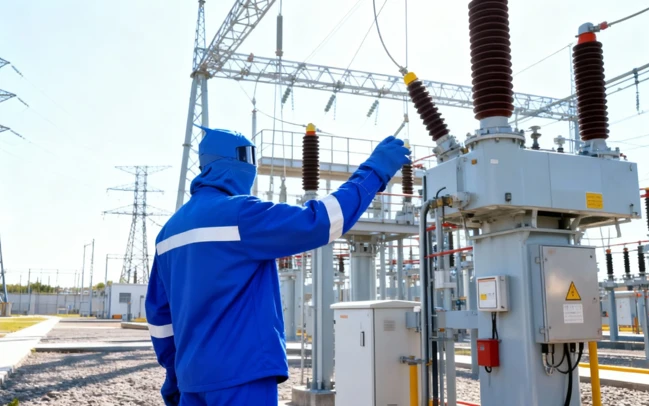
Utility work concentrates arc flash risk in switching, racking breakers, cable testing, and capacitor bank work, where energized equipment can fault while workers stand close; each task needs its own incident energy rating.
Switchgear and panel work are the most common exposure points because workers open doors, rack breakers, and take measurements while equipment stays live. Cable testing carries stored energy risks, and capacitor banks can discharge violently if not grounded correctly. Substation work adds proximity hazards: workers move through fields of energized equipment, and a fault anywhere nearby can injure them even if their own task is de-energized.
Each of these tasks belongs on a hazard inventory with its own cal/cm² value. That inventory drives which electrical utility PPE your crews carry on the truck and which suits they wear for each job. Utility buyers often standardize on one or two ratings — for example, Category 2 for routine switching and Category 4 for substation work — so training and inventory stay manageable.
Hazard inventories also change over time. A utility that adds battery energy storage, underground cable, or higher fault current levels on a feeder should revisit the study, because incident energy depends on those system characteristics. Review the inventory after any significant network change and at least every five years, or sooner if standards in your region require it. When the numbers change, the suits on the truck change with them.
What Are the Arc Flash PPE Categories?
NFPA 70E defines four PPE categories: Category 1 requires a minimum arc rating of 4 cal/cm², Category 2 of 8, Category 3 of 25, and Category 4 of 40 cal/cm², each with a prescribed set of arc-rated clothing.
| Category | Minimum arc rating | Typical protection set |
|---|---|---|
| 1 | 4 cal/cm² | Arc-rated shirt and pants or coverall |
| 2 | 8 cal/cm² | Arc-rated coverall or shirt and pants, plus face protection |
| 3 | 25 cal/cm² | Double-layer switching coat and pants, hood, and gloves |
| 4 | 40 cal/cm² | Full arc flash suit kit with hood, face shield, and gloves |
The category is a floor, not a ceiling. If your analysis shows 12 cal/cm², a Category 2 suit is not enough and Category 3 gives a comfortable margin. Many teams standardize on Category 2 for routine switching and keep Category 4 kits for high-energy tasks like racking breakers. Two details are easy to miss: a category is a combination of layers, not one garment, and the printed rating must match a test report from a certified laboratory. Request that documentation before any wholesale order.
How Do You Choose the Right Arc Flash Suit?
Start with your incident energy analysis, then select a suit whose ATPV exceeds that value, check the required category, add layers for comfort and coverage, and verify certification against NFPA 70E or IEC 61482 before ordering.
Five steps work well for most procurement teams:
- Pull the cal/cm² values from your arc flash study for each task.
- Choose a category and a suit rating above your worst-case number.
- Confirm the kit is complete: jacket, bib overalls, hood with face shield, and rated gloves.
- Fit it properly — an oversized suit reduces protection and increases trip hazards.
- Ask the supplier for test certificates and a sample before committing to volume.
For a team switching panels at 8 cal/cm², a Category 2 system with an 8.5 or 10 cal/cm² rating is the practical default. For substation work, most managers choose 40 cal/cm² kits so one suit covers every task. Comfort matters more than it looks: a worker who finds a suit stiff and hot will find reasons not to wear it. Our factory focuses on ergonomic cuts, breathable linings, and adjustable closures for that reason.
Which Fabrics Offer the Best Arc Flash Defense?
Inherently flame-resistant fabrics — aramid fibers such as Nomex-type materials, modacrylic, and engineered FR blends — offer the best defense because they self-extinguish, never melt or drip, and keep insulating even after repeated exposure.
The enemy is not only heat but melted fabric. Non-FR synthetics can melt into the skin, making an injury far worse. Inherently FR fibers resist flame as part of their chemistry, so the protection cannot wash out; treated fabrics can pass the standard but lose performance with heavy wear or improper laundering.
Layering is part of the story: a Category 3 or 4 system pairs an outer shell with a secondary layer, and the total rating comes from the combination. Moisture-wicking liners and anti-static finishes improve comfort without lowering the rating. For wholesale and OEM orders, our engineers match fabric to rating, climate, and budget.
Arc Flash Suit Specifications at a Glance
The table below shows the configurable range we offer from our Shenzhen factory. Ratings, fabrics, and add-ons are matched to the customer’s hazard analysis and compliance requirements.
| Specification | Available options |
|---|---|
| Arc rating (ATPV) | 8 / 12 / 25 / 40 cal/cm² |
| Standards | NFPA 70E, IEC 61482, CE |
| Outer fabric | Aramid, modacrylic blends, FR cotton blends |
| System components | Jacket, bib overalls, hood, face shield, gloves |
| Customization | Logo embroidery, colors, sizing, pockets, closures |
| Ordering | Samples, wholesale lots, OEM/ODM programs |
Every suit we ship is inspected against a written checklist, and each batch is traceable to its fabric lot and test certificate. For buyers, that traceability is worth as much as the rating: when an audit raises questions, you can point to documentation instead of guessing.
Can You Customize Arc Flash Suits for Your Team?
Yes. As a factory, Shield Wings customizes arc flash suits with embroidered logos, company colors, tailored sizing, and configurable pockets and closures — with flexible MOQs and sampling programs for B2B buyers.
Most safety managers do not think of arc flash suits as brandable, but a uniformed team reads as more professional and makes compliance easier to enforce. Customization options include heat-transfer and embroidered logos, reflective trim, radio and tool pockets, zipper or snap closures, and extended sizing for a diverse workforce.
The OEM/ODM process is straightforward: agree on rating and design, approve a sample, then produce. Because we are the manufacturer, not a trading company, lead times are shorter and mid-order changes are easier. Wholesale buyers can start with one sample, test it in the field, and scale without a huge first order.
Shield Wings: A Factory Built for Arc Flash Protection
Shield Wings carries a manufacturing legacy that began in 1999 and now operates from a state-of-the-art facility in Shenzhen, producing certified protective clothing under CE, ANSI, and ISO programs. We are the factory behind the brand — not an intermediary — which is why our customers get direct access to engineering, quality control, and pricing.
Our arc flash line sits inside a broader PPE catalog — FR hoods, anti-static workwear, welding helmets, face shields, hand and foot protection. That breadth lets one qualified supplier consolidate lines and simplify vendor management. For buyers, the factory relationship changes the conversation: instead of reading a spec sheet and hoping, you can request fabric swatches, review inspection records, and make changes before mass production.
Expert Views
“The most common failure I see is a team buying an arc-rated garment without checking whether the full system matches the hazard. A jacket rated 25 cal/cm² is meaningless if the hood is rated 8 and the task needs 25. The second failure is documentation — buyers accept a label without asking for the test report, and then cannot prove compliance during an audit. My third concern is comfort treated as an afterthought. Heat stress is real, and a suit that is too heavy or poorly cut will be left in the locker. Our approach at Shield Wings is to treat every order as an engineering problem: confirm the incident energy, match the complete kit, verify the certificate, and fit real workers before bulk production. When buyers take that path, they get protection they can prove, workers who actually wear the gear, and a supplier relationship that survives audits.” — Senior Safety Engineer, Shield Wings
What Does Arc Flash Protection Cost for a Typical Team?
A complete arc flash kit typically costs between $80 and $300+ per worker depending on rating, layers, and customization; factory-direct wholesale programs and volume orders lower the per-unit price substantially.
Cost breaks down into the shell, the secondary layer, the hood and face shield, gloves, and branding. Category 2 systems sit at the lower end; 40 cal/cm² kits with full hoods sit at the top. Add logo work or special sizing and the price moves again — which is why a quote always beats a catalog guess.
Look at the math from the other side: one serious injury can cost more in medical bills, downtime, and insurance than a hundred suits. Requesting a line-item factory quote lets you compare ratings, components, and lead times on equal terms.
How Do You Build a Complete Arc Flash PPE Program?
A complete program starts with an arc flash study, maps ratings to tasks, equips teams with matched kits, trains workers in wear and care, and audits compliance every year.
Five elements keep a program defensible. First, a current study — outdated labels are a legal and safety liability. Second, a written task-to-rating matrix that tells each crew what to wear. Third, matched kits assigned per worker, not shared. Fourth, training that covers donning, doffing, storage, and inspection. Fifth, a yearly audit that checks labels, documents, and field behavior. If any link is weak, the program fails even with perfect suits in stock.
Training deserves more than a slide deck. Workers should practice putting on the full kit under time pressure, check their own hood and glove ratings, and demonstrate the inspection routine — zippers, stitching, fading, and contamination all affect performance. Storage matters too: keep suits out of direct sunlight and away from chemicals, and never store them damp. A documented inspection schedule, even a simple monthly check, catches small problems before they become injuries.
For a deeper look at the physics and the incident energy behind these decisions, our team has written an introduction to understanding arc flash hazards that pairs well with this guide.
What Should Your Next Step Be?
Review your arc flash study, identify the cal/cm² level for each task, and request samples from a certified manufacturer. Shield Wings’ safety consultants will help you select, size, and customize the right arc-rated PPE for your team.
Start with three questions: What is the highest incident energy your workers face? Does your current kit cover it with a margin? Can your supplier prove it? Send us your hazard analysis or current spec, and we will recommend a category, ship samples for field testing, and confirm wholesale or OEM pricing. You can reach the team through our contact page or ask for a quote directly on any arc flash product page.
Arc Rating Versus Incident Energy: Reading the Label Against the Calculation
The category table earlier in this article is a shortcut that predates incident-energy analysis becoming routine. The rule the classification is standing in for is simpler to state: the protective equipment has to carry an arc rating at least equal to the heat energy the task can produce. Where 29 CFR 1910.269 applies, that is written directly into the standard — arc-rated clothing covering the whole body when the estimate exceeds 2.0 cal/cm² (1910.269(l)(8)(v)).
(Last modified date: October 4, 2026)
| On the label or in the study | What it means | What to compare it with |
|---|---|---|
| ATPV in cal/cm² | The energy the fabric can absorb before a 50% probability of a second-degree burn | The incident energy calculated at the working distance for that task |
| PPE category 1–4 | A table-based shortcut resting on the older screening method | The calculated incident energy — the category is a starting point, not a substitute |
| Layering | Adds protection, but not as a simple sum of two ratings | The garment maker’s own layering data for the combination |
| Condition | Every rating assumes an intact garment | Inspection records; damaged or defective equipment shall not be used (29 CFR 1910.132(e)) |
Worked example: how much margin a rating really leaves
Illustrative figures. A task is calculated at 11.5 cal/cm² at the working distance, and the suit in the store is rated 12.3 cal/cm², leaving 0.8 cal/cm² of margin. On paper that is compliant. In practice the margin is spent by wear — a contaminated sleeve, a hole at the shoulder, a garment laundered outside the care instructions — which is why 1910.132(e) is not a formality: defective or damaged equipment is not to be used, and the inspection record is what makes that enforceable. If the same task were calculated at 14 cal/cm², the same suit would no longer be adequate and the answer is a higher-rated ensemble, not a shorter working distance assumed on paper.
What the label cannot do
No arc rating fixes a task that was never calculated: the label tells you what the garment withstands, not what the job produces. Two further boundaries matter in practice. The category tables assume the screening method they came from, so a site that has moved to incident-energy analysis should compare against the study instead. And arc-rated clothing addresses the thermal hazard only — shock protection needs rubber insulating goods and insulated tools as a separate control, and neither substitutes for the other.
For the wider topic and related decisions, see our Arc Flash & Electrical Safety PPE.
Additional selection checks from the consolidated guide
The following checks were retained while consolidating overlapping coverage into this primary guide.
Why Do Utility Tasks Carry High Arc Flash Risk?
Utility tasks carry high arc flash risk because they combine high fault current, slow clearing times, and close working distances — the three factors that drive incident energy upward.
Distribution and transmission systems can deliver enormous fault current, and if the protective device clearing time is long, the energy at the working position climbs. Workers then operate switches, rack breakers, and test equipment within the arc flash boundary. That combination — high current, longer clearing, close distance — is why utility tasks often fall into Categories 2, 3, and 4, and why the hazard analysis must be current. The risk is not abstract; it is a function of the system and the task.
What PPE Do Utility Workers Need for Switching and Metering?
Switching and metering tasks need arc-rated clothing matched to the task label, plus arc-rated face protection, gloves, and, where shock is a hazard, rubber insulating goods.
For routine switching at Category 2, an arc-rated coverall or layered system with an arc-rated face shield covers the task. For higher-energy work such as racking breakers, Category 3 or 4 systems add the full suit with hood. The two protection systems — arc and shock — are specified together: rubber insulating gloves with leather protectors, voltage-rated tools, and the correct approach distances. The task label in the electrical safety program names the required system; the crew follows it.
How Do Substation and Underground Work Differ?
Substation work often demands the highest ratings because of high fault current and complex switching, while underground and pad-mount work adds confined-space and cable-testing hazards with their own energy profiles.
| Work type | Typical risk driver | PPE consideration |
|---|---|---|
| Substation switching | High fault current | Category 3–4 suits, full hood |
| Pad-mount metering | Close working distance | Category 2–3, face protection |
| Underground cable | Stored energy, testing | Category 2–4 plus confined-space gear |
| Overhead hot-stick | Distance from energized parts | Category 2–3 with rubber goods |
Each environment changes the calculation. Underground cable testing adds stored energy that behaves differently from energized bus work; hot-stick work keeps distance but still requires the rated system. The hazard analysis assigns energy per task, and the matrix names the equipment per environment. Utility crews often carry two levels — a lighter system for routine work and the full suit for high-energy jobs.
What About OSHA 1910.269 Requirements?
OSHA 1910.269 requires utilities to perform an arc flash hazard analysis, label equipment, and provide PPE based on the analysis — making the utility program a legal requirement, not a best practice.
The standard ties the analysis to the equipment: where the study shows incident energy above the threshold, workers must wear arc-rated clothing with a rating equal to or greater than the calculated energy. It also requires training and documentation. The utility program therefore has a defined structure — analysis, labels, PPE matrix, training, and records — and the records must survive an inspection. NFPA 70E provides the method; OSHA 1910.269 provides the enforcement frame for utility work.
How Do You Build the Utility PPE Program?
Build the program around the analysis: current study, task labels, a role-to-equipment matrix, matched kits with certificates, rubber goods on test schedules, and field audits that check what crews actually wear.
The analysis drives the labels; the labels drive the matrix; the matrix drives procurement and training; and the audit closes the loop by verifying the field matches the paperwork. Assign an owner and a review cycle, update after system changes, and keep the records with the equipment. Utility crews work in high-energy environments where the gap between the program and the field is the risk — close it with verification at every step.
Follow the utility task matrix and the equipment label from the site’s electrical safety program for each specific task; do not select PPE from a generic category table alone, and confirm equipment against the applicable standard.
Procurement for utilities should follow the same structure as the safety program: the task matrix drives the order, the certificates arrive with the equipment, and the batch records tie each delivery to the tested design. Working with a manufacturer that supplies complete utility kits — clothing, hoods, rubber goods, and documentation — keeps the system consistent across crews and simplifies the audit file. Utilities should also plan the replacement cycle in the budget, because arc-rated systems and rubber goods have service lives, and a crew that runs out of certified equipment cannot simply substitute another model without re-approving it in the safety procedure. The program, the procurement, and the budget belong on the same calendar.
From the Estimate to the Kit on the Truck
For a utility, the useful question is not which suit to buy but how the incident-energy estimate reaches the crew. Under 29 CFR 1910.269 the estimate has to exist before the clothing decision is made — paragraph (l)(8)(ii) produces it, and (l)(8)(v) requires arc-rated clothing with a rating at least equal to it whenever the estimate exceeds 2.0 cal/cm². The table below is the step that usually goes missing: the estimate is filed with the study instead of travelling with the work order.
| Stage | What it must carry | What the field check looks for |
|---|---|---|
| Work order is raised | Task identifier and the equipment being worked on | The order names the task, not just the location |
| Estimate is attached | Incident energy for that task at the working distance | The number is on the order, not only in the study file |
| Kit is issued | The rating the estimate requires, plus the components | Rating on the label is at least the number on the order |
| Job is worked | Rubber goods and insulated tools as a separate control | Shock protection is present independently of the suit |
| Job closes | Any damage or exposure recorded | Damaged components are withdrawn, not returned to the store |
Worked example: kit count for a twelve-person crew
Illustrative assumptions. A crew covers substation switching estimated at 25 cal/cm², pad-mount metering at 8, underground work at 12, and overhead hot-stick work at 8. Rather than one kit per person, the store holds kits by task: three Category 4 ensembles for the switching work, three Category 2 kits for metering and hot-stick work, two Category 3 outfits for underground work, and four spare hoods and face shields because those are the components that wear first. That is eight kits for twelve people, which works because not everyone is on a high-energy task on the same day — and it only works if the work order, not the store’s habit, decides which kit leaves the building.
What the framework does not cover
Two boundaries matter. Arc-rated clothing addresses the thermal hazard only: rubber insulating gloves and insulated tools are a separate control for shock, and 1910.269 requires them alongside the clothing rather than instead of it. And the estimate is not a one-time study — a system change, a new relay setting or a reconfigured line alters the available fault current and clearing time, so the number the crew is working to has to be revisited when the system changes.
For the wider topic and related decisions, see our Arc Flash & Electrical Safety PPE.
FAQs
Does arc flash PPE expire?
Arc-rated fabrics degrade with wear, washing, and UV exposure. Inspect suits regularly and replace them when they show damage, contamination, or signs of laundering failure, following the manufacturer’s guidance and the applicable standard.
Are arc flash suits reusable?
Yes. With proper care, storage, and inspection, an undamaged suit can be worn many times. Repeated exposure, however, can reduce performance, so keep inspection records for every kit.
Should we follow NFPA 70E or IEC 61482?
It depends on your market. NFPA 70E is the reference for U.S. operations; IEC 61482 is widely used internationally. Both test arc-rated clothing, and we can produce garments certified to either standard.
Can we add our company logo to arc flash suits?
Yes. We offer FR-compliant embroidery and reflective trim as part of our OEM and ODM programs, without compromising the suit’s arc rating.
What is the typical lead time for OEM arc flash suits?
Samples can usually ship within days. Bulk production for customized orders typically takes two to four weeks depending on quantity and complexity, and we confirm the schedule in writing before you commit.
What are the OSHA requirements for protecting employees from arc flash?
For electric power generation, transmission and distribution work, 29 CFR 1910.269(l)(8) requires clothing that will not melt or ignite where an arc could ignite it, and arc-rated clothing and equipment covering the whole body with an arc rating at least equal to the estimated incident heat energy when that estimate exceeds 2.0 cal/cm². The same paragraph sets limited exceptions for hands, feet and head.
Does NFPA 70E cover arc flash?
Yes — NFPA 70E is the consensus standard for electrical safety in the workplace, and it is where the incident-energy analysis, the arc-flash boundary and the PPE selection method are set out in most detail. OSHA does not incorporate it by reference for general industry, but a site following 70E is working to the method the enforcement rules expect to see behind a PPE decision.
Related Articles
- Firefighting Gloves: NFPA 1971 and EN 659
- Thermal Protective Clothing for Steel Mills
- Essential Welding Safety Rules for Beginners
- understanding arc flash hazards
- Arc Flash Suit vs FR Coveralls: Key Differences
- Arc Flash Suit Ratings Explained: ATPV, Cal/cm² and HRC
Official Resources
- Arc Flash Protection
- Arc Flash Ppe Categories 1 4 Explained
- Arc Flash Protection The Complete Guide For Electrical Workers 2
- Arc Flash Suit Care Inspection Storage And Maintenance
- Flame Resistant Coveralls The Buyers Guide
- Arc Flash Suit Vs Fr Coveralls Key Differences
- Anti Static Workwear For The Petrochemical Industry
- Contact Shield Wings