

High-visibility clothing is usually bought as a colour and specified as a class, and the two are not the same thing. A driver needs enough time to see a worker and react, and that time depends on vehicle speed, sight distance, the position of the worker and what is behind them. Class selection is therefore a traffic decision dressed as a garment decision, and it is one of the few areas of PPE where the geometry of the site matters more than the fabric weight.
What the Standard Actually Covers
High-visibility standards define two materials and the way they are combined. A fluorescent background material provides daytime contrast by converting ultraviolet light into visible light, which is why it works best in daylight and appears duller at night or under street lighting. Retroreflective material returns light towards its source, which is what makes a worker visible in a headlight or a work light at night. The standard sets requirements for the area and placement of each material, the colour, the performance of the retroreflective material, and the test conditions under which the class is determined.
In the United States, high-visibility apparel is characterised under ANSI/ISEA 107, which is referenced in work zone practice and in industry guidance. In Europe, EN ISO 20471 sets the framework, with classes that reflect the amount of visible material and the conditions the garment is intended for. Both frameworks express the outcome as a class, and both require the manufacturer to mark the product so that the class can be verified on delivery.
What the standard does not cover is equally important. It does not decide the traffic management for a site, it does not set the speed limit, and it does not determine whether a worker should be in a live traffic lane at all. Those are design and procedure questions, and the clothing class is the answer to the residual exposure that remains.
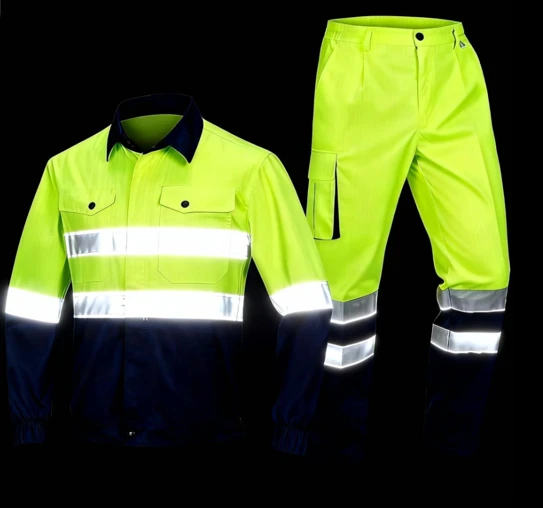
The class also depends on how much of the body is covered. A vest worn over a dark jacket leaves the arms in a non-compliant material, and a sleeved garment built to the same class covers more of the silhouette, which matters when a worker is seen from the side or from behind. Trousers or a full coverall extend the visible area further, which is why utilities, rail and highway crews increasingly specify garments rather than vests: the assessment is about how much of a person a driver can see, not how much material the garment contains.
The Ratings Buyers Are Asked to Prove
What a safety manager or a client auditor asks for is normally three statements: the class the assessment requires, the class the garment is tested to, and the evidence that links the delivered product to that claim. That last link is where orders commonly fall short, because the class is achieved by the arrangement of materials on a specific design, not by the fabric alone.
- The class required for the task, recorded in the assessment together with the traffic conditions that produced it.
- The standard and class the garment is tested to, and the marking that appears on the product as supplied.
- The care instructions that preserve retroreflective performance, and the inspection rule that decides when a garment is withdrawn.
Where a garment is also claimed as flame resistant, arc rated or antistatic, each additional property needs its own evidence. A single test report for one property does not document the others, and the marking on the garment is where all of the claims that apply can be read together.
How Test Methods Differ Between Frameworks
The two main frameworks produce classes from different combinations of material and area, so a class number in one is not a direct equivalent of a class number in the other. The North American framework defines classes by the configuration of background and retroreflective material and by the conditions the garment is intended for, with separate handling for garments that combine high visibility with other protective properties. The European framework works through three classes based on the area of visible material, with garments intended for higher-risk situations carrying the higher class.
For a buyer, the practical consequences are three. The specification should name the framework rather than a class number alone, because the same number can mean different things across frameworks. The comparison between suppliers should be made inside one framework. And where a garment carries an additional protective claim, the buyer should confirm that the high-visibility class is still valid in the configuration that includes the extra layers or properties, since added material can change the visible area that produces the class.
Reading the Marking on the Product
The marking tells the buyer which standard and class the garment achieves. On a vest or a jacket, it is usually printed on a permanent label inside the garment, with the size, the manufacturer, the care instructions and any additional protective claims. The visible arrangement of tape is not the marking: two garments with the same tape pattern can carry different classes if the background material or the tape performance differs.
Two checks catch most problems at goods-in. First, compare the class on the label with the class in the specification, not only the style number, because a range often contains several classes in visually similar models. Second, check the retroreflective tape for damage, contamination and correct placement, since a garment that has been stored folded, exposed to sunlight or laundered incorrectly can arrive with reduced performance even when the label is right.
A third check applies where the garment is issued as part of a set. Vests, jackets and trousers that come from different models or different suppliers have not been tested as an assembly, and the combined visible area may not match the class stated for any individual item. Where the specification calls for a class across the whole outfit, the set should be specified and documented as a set.
Comparing the US and EU Frameworks
| Question | North American practice | European practice |
|---|---|---|
| How is the class determined? | By material performance and configuration for the intended conditions | By the area of visible material, in three classes |
| How is a combined garment handled? | As a garment carrying high visibility plus other protective claims | As a garment tested to each applicable standard |
| What drives the required class? | Traffic speed, sight distance, task position and background | Risk conditions of the task, including traffic exposure |
| What appears on the product? | Standard, class, size, manufacturer, care instructions | Standard, class, size, manufacturer, care instructions |
| What sits outside the class? | Traffic management, lighting and whether the task belongs in the roadway | Traffic management, lighting and whether the task belongs in the roadway |
Read across the table, the difference is in how the class is derived rather than in what it is for. The buyer’s job is to keep the specification inside one framework, and to require that the marking and instructions supplied match the market the product will be used in.
Common Misreadings of the Rating
Most high-visibility failures are specification failures rather than product failures.
- Reading the class as a comfort tier. The class reflects visibility performance for defined conditions, not warmth, durability or build quality.
- Assuming a brighter colour improves the class. Class comes from the tested configuration of background and retroreflective material.
- Ignoring the background. A garment that stands out against a road surface may disappear against a bright sky, a lit wall or a low sun, and the assessment should consider what is behind the worker.
- Forgetting the night requirement. Fluorescent material performs in daylight; retroreflective material does the work at night and under headlights, so both have to be present for tasks that span both.
- Laundering that damages the tape. Industrial washing with unsuitable chemistry or temperature degrades retroreflective performance, and the care label controls.
- Assuming an FR garment is high visibility, or the reverse. The two claims are separate and each needs its own evidence on the same garment.
- Using clothing to manage traffic. Barriers, cones, signage, lane closures and lighting reduce exposure; clothing only helps a driver see what is already in the roadway.
- Treating the vest as a permanent solution. Vests survive for a shorter period than jackets and are easily damaged by vehicle contact, snagging and repeated laundering, so a replacement rule should sit alongside the inspection routine.
- Ignoring the wearer’s position. A worker facing traffic with a full front panel is visible; the same worker bent over a valve with the tape hidden from the driver’s line of sight is not, which is a task-position question rather than a garment question.
What Documentation to Request From a Supplier
A high-visibility order should arrive with the standard and class the garment is tested to, the declaration or test evidence covering that model and production site, the care and laundering instructions, and a batch traceability reference. For a combined garment, the pack should include the evidence for each additional property claimed, since a single document usually covers only one standard.
Two requests are specific to this category. Ask for the laundering instructions in the form the site will actually use, because a central laundry that follows a different process can quietly reduce the property the garment was bought for. And ask how the supplier manages design changes: if the tape, the background fabric or the placement changes, the class may change with it, and the buyer should be notified before shipment rather than after an audit.
The class system itself, including how the classes are defined and how they are marked, is covered in Shield Wings’ guide to high visibility classes and standards, which owns that explanation. The garments are listed in the high visibility workwear range and in the wider body protection category, alongside the FR and anti-static families that are often ordered with them.
Shield Wings manufactures high-visibility and protective workwear at a Guangdong production base and supports HSE teams and distributors with specification guidance, marking information and the documentation that each class claim requires. The decision worth getting right is not the one made in the storeroom; it is the one made when the task, the traffic and the background are described in the assessment.
For the wider topic and related decisions, see our Hi-Vis, Anti-Static & Cold Weather Workwear.
Frequently Asked Questions
What decides which high-visibility class a task needs?
The employer’s assessment, using the traffic conditions the worker is exposed to: the speed of the vehicles, the sight distance available to a driver, the position and duration of the task, and the background the worker appears against. Class selection follows from those conditions, and the class required for a specific job is not something a supplier can determine from a garment reference alone.
Can a garment be both FR and high visibility?
Yes, where it is tested to both requirements and the documentation names each claim. The combination is common in electrical, oil and gas and rail work, but the two properties are separate: a high-visibility garment is not automatically flame resistant, and an FR garment is not automatically compliant for traffic exposure. Where both are required, the specification should require evidence for each property on the same garment.
Why does the retroreflective tape lose performance over time?
Retroreflective tape returns light towards its source, and that property depends on the tape’s construction and surface. Abrasion, industrial laundering with the wrong chemistry, sunlight, soiling, cracks and heat exposure all reduce it, and the reduction is gradual rather than sudden. This is why care instructions and an inspection rule matter: the garment can look intact while the property that keeps the wearer visible has already degraded.
Does colour alone satisfy high-visibility requirements?
No. The requirement covers the fluorescent background material, the retroreflective material and the way the two are arranged, and the marking on the garment states the class that configuration achieves. A brightly coloured jacket without the required retroreflective area, or with the tape arranged differently from the tested design, does not carry the same claim even if it looks similar on the shelf.
What documentation should accompany a high-visibility order?
Ask for the standard and class the garment is tested to, the test evidence or declaration naming the model and production site, the care and laundering instructions that preserve the retroreflective performance, and the traceability reference for the batch. Where the order spans markets, confirm that the marking and instructions supplied match the framework each destination requires.

Specifying visibility for a mixed site?
Send the traffic conditions, the tasks and any FR or anti-static requirements in the same garment. Shield Wings confirms the classes available, the marking supplied and the care instructions that keep the property intact.
External references: 29 CFR 1926 Subpart E personal protective equipment in construction, 29 CFR 1910.132, 29 CFR 1910 Subpart I, UK HSE construction safety guidance, CCOHS PPE answers, CEN-CENELEC standards portal, Regulation (EU) 2016/425.
{“@context”:”https://schema.org”,”@type”:”FAQPage”,”mainEntity”:[{“@type”:”Question”,”name”:”What decides which high-visibility class a task needs?”,”acceptedAnswer”:{“@type”:”Answer”,”text”:”The employer’s assessment, using the traffic conditions the worker is exposed to: the speed of the vehicles, the sight distance available to a driver, the position and duration of the task, and the background the worker appears against. Class selection follows from those conditions, and the class required for a specific job is not something a supplier can determine from a garment reference alone.”}},{“@type”:”Question”,”name”:”Can a garment be both FR and high visibility?”,”acceptedAnswer”:{“@type”:”Answer”,”text”:”Yes, where it is tested to both requirements and the documentation names each claim. The combination is common in electrical, oil and gas and rail work, but the two properties are separate: a high-visibility garment is not automatically flame resistant, and an FR garment is not automatically compliant for traffic exposure. Where both are required, the specification should require evidence for each property on the same garment.”}},{“@type”:”Question”,”name”:”Why does the retroreflective tape lose performance over time?”,”acceptedAnswer”:{“@type”:”Answer”,”text”:”Retroreflective tape returns light towards its source, and that property depends on the tape’s construction and surface. Abrasion, industrial laundering with the wrong chemistry, sunlight, soiling, cracks and heat exposure all reduce it, and the reduction is gradual rather than sudden. This is why care instructions and an inspection rule matter: the garment can look intact while the property that keeps the wearer visible has already degraded.”}},{“@type”:”Question”,”name”:”Does colour alone satisfy high-visibility requirements?”,”acceptedAnswer”:{“@type”:”Answer”,”text”:”No. The requirement covers the fluorescent background material, the retroreflective material and the way the two are arranged, and the marking on the garment states the class that configuration achieves. A brightly coloured jacket without the required retroreflective area, or with the tape arranged differently from the tested design, does not carry the same claim even if it looks similar on the shelf.”}},{“@type”:”Question”,”name”:”What documentation should accompany a high-visibility order?”,”acceptedAnswer”:{“@type”:”Answer”,”text”:”Ask for the standard and class the garment is tested to, the test evidence or declaration naming the model and production site, the care and laundering instructions that preserve the retroreflective performance, and the traceability reference for the batch. Where the order spans markets, confirm that the marking and instructions supplied match the framework each destination requires.”}}]}