

Warehouse visibility is usually treated as a matter of policy rather than of assessment, and the policy is often inconsistent: vests required in one aisle and not in the next, contractors issued a different colour, and no rule at all for the people who move between areas during a shift. Forklift traffic is slower than road traffic but much closer, and proximity changes what the clothing has to achieve.
What This Environment Does to People and Equipment
The nature of the exposure is also different from road work in a way that matters for specification. Vehicle speeds are low, so the driver has time to see and react, but the distance is short and the vehicle may be turning, reversing or lifting, all of which occupy attention. That combination rewards garments that are consistently visible from several directions rather than garments with the highest available class, and it rewards the layout controls that keep people out of the vehicle’s path.
The dominant risk in a warehouse is the pedestrian-vehicle interface in confined space. Forklifts, reach trucks, order pickers and powered pallet trucks operate in aisles where the driver’s view is restricted by the load, by racking and by the vehicle’s own structure, and reversing is common. Pedestrians cross those routes constantly, often carrying or scanning items and therefore not looking at traffic. Speeds are low, but distances are short, and the consequence of a strike is still severe.
Other conditions change how visible a worker is. Racking creates a cluttered and repetitive background that hides the human shape; lighting varies from bright loading doors to dim back aisles; noise from equipment and conveyors limits the value of audible warnings; and shift patterns mean that part of the working day happens in the dark. Visibility clothing is one of several answers to those conditions, and it is the one that depends most on consistency of use.
The Hazards That Drive the Specification
- Where pedestrians and vehicles share space, and how often they interact during a shift.
- The vehicle types, their speeds, their turning circles and how much of the driver’s view is restricted by the load.
- Aisle geometry, including blind corners, doorways, crossings and the distance a driver has to see a pedestrian.
- The lighting in each area, including night shifts and the transition between loading areas and interior aisles.
- The background: dark racking, pallets and product, reflective floors and the glare from vehicle lamps.
- The tasks performed, including those where the worker bends, reaches into racking or works with their back to the traffic.
- The traffic management in place, since segregation and control remove the exposure before clothing is considered.
The last item is where the specification should start. Where pedestrians have their own routes, crossings are marked and controlled, and vehicle speeds are managed, the visibility requirement narrows and the residual risk is genuinely residual. Where those controls are weak, clothing is being asked to carry the whole problem.
Controls That Come Before the Equipment
Mirrors at blind corners, floor markings that survive pallet traffic, and the discipline of pedestrians using the marked route are all part of the same control set, and each of them reduces how much the garment has to achieve.
Driver behaviour deserves explicit attention because it is a control in its own right and often the weakest. Travel speed in aisles, the practice of sounding a horn at a crossing, the rule about travelling with a raised load that blocks the view, and the habit of stopping and looking at blind corners are all behaviours that a policy can define and a supervisor can check. Where those behaviours are not managed, the visibility garment is compensating for the way the vehicle is driven.
Warehouse traffic risk is reduced first by layout and procedure: separate pedestrian routes and marked walkways, controlled crossings with mirrors or signals, one-way systems, speed limits and speed monitoring, restricted access to live aisles, driver training and licence checks, load visibility rules, and the use of warning devices such as lights rather than only audible alarms. Good housekeeping and clear sight lines at corners complete the picture, and lighting improvements are often the cheapest change available.
Personal protective equipment is the last line of defence. High-visibility clothing helps a driver see a pedestrian who is already in the traffic area; it does not stop a vehicle, correct a blind corner or compensate for a route that puts people in the path of equipment. That distinction is worth making explicit in the policy, because it tells managers where to spend effort first.
What the Equipment Has to Do Here
It is worth separating daytime and night performance in the specification, because the two rely on different materials. Fluorescent background material provides contrast in daylight and in lit areas, while retroreflective material responds to light directed at it, such as a vehicle lamp or a work light. A garment chosen for daylight visibility alone may be much less effective on a night shift in a dim aisle, and the assessment should state which conditions apply rather than averaging them.
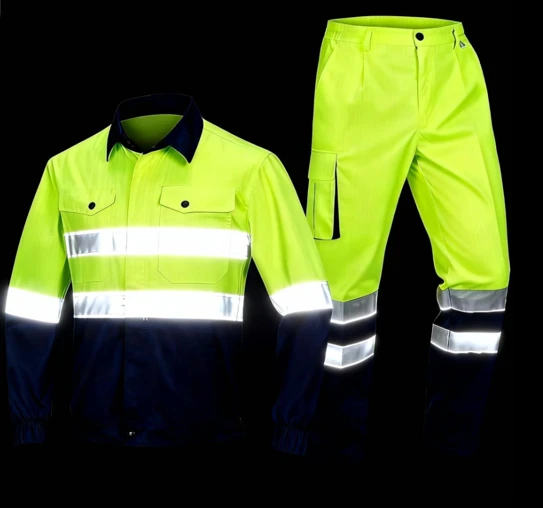
Visibility clothing in a warehouse has to make the wearer identifiable at close range against cluttered backgrounds, in mixed lighting and often for a driver whose attention is on the load. That means fluorescent material for contrast in daylight and well-lit aisles, retroreflective material to respond to vehicle lamps and work lights, and enough coverage that the wearer does not disappear when turned away or bent over a pallet.
The class comes from the assessment and from the site’s own policy. In warehouse environments the requirement is often met at a lower class than highway work, because speeds and sight distances are modest, but the choice should still be documented with the conditions that produced it. Where the class system itself needs clarification, Shield Wings’ guide to high visibility classes and standards owns that explanation.
Selection Criteria Specific to This Sector
Where the site has more than one building or tenant, the policy should state whether the requirement applies to shared areas such as service corridors and loading banks, since that is where two employers’ rules most often disagree.
| Area or task | What dominates | Garment that follows | What to verify |
|---|---|---|---|
| Live aisles with forklift traffic | Proximity, blind corners, restricted driver view | Visibility garment as standard issue for the area, with traffic controls first | Class marking and the traffic management arrangements |
| Order picking with vehicles in the aisle | Bending, reaching, working with the back to traffic | Garment rather than a vest, with material visible from behind | Coverage and the arrangement of retroreflective material |
| Loading docks and yard interface | Vehicle movements, daylight and darkness, outdoor weather | Higher class than interior work, with weather-resistant outer layer | Class documentation and the interface with drivers |
| Night shift in a poorly lit area | Retroreflective performance under work lights | Retroreflective material in good condition, supported by lighting improvements | Condition of the tape and the light levels recorded |
| Visitors, contractors and drivers | Intermittent presence without local knowledge | Garments issued on entry, at the class required for the area | Issue arrangements and consistent enforcement |
| Maintenance and cleaning teams | Work in aisles outside normal hours, unfamiliar routes | Same requirement as the area they enter, with traffic controls | Task briefing and the areas covered by the policy |
Read across the table, the class varies with the conditions while the principle does not: the worker has to be identifiable to the person operating the vehicle, in the light and against the background that exist in that area.
Typical Specification Failures in This Sector
One further failure is administrative: the site has a policy but no record of it, so it cannot be reviewed, audited or applied consistently by a new supervisor. Keeping the policy, the areas it covers, the garment issued for each area and the issue records together is what turns a habit into a control, and it is also what makes it possible to change the requirement deliberately when the layout or the traffic changes.
- No written policy. A general instruction to wear high visibility clothing leaves the areas and the exceptions undefined.
- Inconsistent enforcement. The same job in two aisles with two different rules teaches workers that the rule is optional.
- Visitors and contractors overlooked. The people who know the site least are often least equipped.
- Vests over dark clothing for bending tasks. The visible area disappears when the worker leans into racking.
- Worn or soiled garments. Retroreflective performance degrades quietly, and dirty material loses contrast.
- Lighting left out of the review. Improving a dark corner often does more than changing the class.
- Clothing used instead of traffic controls. Where routes, speeds and crossings are not managed, garments carry a problem they cannot solve.
Building the Full Set Rather Than Buying Pieces
Where a warehouse operates cold stores or outdoor yards alongside interior aisles, the same principle applies as in any mixed site: the garment for the coldest or most exposed area is not automatically right for the rest, and a single issue rarely serves both. Grading the specification by area, and making the requirement visible at each access point, keeps the protection where it is needed without adding cost elsewhere.
The set for warehouse work is simple, and that is part of its value: a visibility garment suited to the area, plus cold-weather layers that are themselves visibility garments rather than ordinary jackets worn underneath a vest. Where hearing protection is required, the combination should not obstruct the garment, and footwear should suit the surfaces. The garment range is set out in Shield Wings’ high visibility workwear pages and within the body protection category.
Shield Wings manufactures high-visibility and protective workwear at a Guangdong production base and supports warehouse operators, logistics contractors and distributors with class options, garment sets and the documentation each claim requires.
The specification that changes behaviour is the one written by area, applied consistently to everyone who enters that area, and supported by the layout and lighting changes that make the requirement smaller in the first place.
For the wider topic and related decisions, see our Hi-Vis, Anti-Static & Cold Weather Workwear.
Frequently Asked Questions
Do warehouse workers need high-visibility clothing?
Where pedestrians and powered equipment share space, or where pedestrians cross vehicle routes, visibility clothing is normally part of the control set. The requirement is not automatic for every warehouse: in an area with no vehicle traffic and good separation it may not be needed, while in a live aisle with forklifts it usually is. The decision belongs to the assessment, and the policy should be clear about which areas it covers.
What class is needed for forklift areas?
Forklift speeds and sight distances are usually much lower than road traffic, so the requirement is often met with a lower class than highway work would need, provided the lighting and the background support it. The class still has to come from the assessment, and the more common problem in warehouses is inconsistency, where some areas enforce a policy and others do not.
Is a vest enough in a warehouse?
Often it is, because the exposure is at low speed and close range, and a vest keeps the wearer visible from the front. Where workers bend, reach into racking or work with their backs to traffic, garments that cover more of the body give more consistent visibility. The choice should follow how the work is performed rather than the tradition of the site.
How does lighting affect the choice?
Considerably. Fluorescent material works with ambient light, retroreflective material works with light directed at it, and both depend on the lighting in the building. Poorly lit aisles, mixed light sources and glare from open doors or vehicle lamps all change how a garment performs, so the assessment should consider the light levels in the areas concerned, not only the traffic.
What should a warehouse visibility policy contain?
The areas and routes where visibility clothing is required, the garment specification for each, the rule for visitors, contractors and drivers, the responsibilities for issuing and replacing garments, and the inspection and care requirements. A policy of that shape is enforceable and auditable; a general instruction to wear high visibility clothing is not.

Writing a warehouse visibility policy?
Send the areas, the vehicle types and the tasks. Shield Wings confirms the garment options for each area, the classes available and the documentation that supports the specification.
External references: 29 CFR 1910.132 hazard assessment and equipment selection, 29 CFR 1910 Subpart I, CCOHS PPE answers, UK HSE personal protective equipment guidance, CEN-CENELEC standards portal, Regulation (EU) 2016/425.
{“@type”:”FAQPage”,”@context”:”https://schema.org”,”mainEntity”:[{“@type”:”Question”,”name”:”Do warehouse workers need high-visibility clothing?”,”acceptedAnswer”:{“@type”:”Answer”,”text”:”Where pedestrians and powered equipment share space, or where pedestrians cross vehicle routes, visibility clothing is normally part of the control set. The requirement is not automatic for every warehouse: in an area with no vehicle traffic and good separation it may not be needed, while in a live aisle with forklifts it usually is. The decision belongs to the assessment, and the policy should be clear about which areas it covers.”}},{“@type”:”Question”,”name”:”What class is needed for forklift areas?”,”acceptedAnswer”:{“@type”:”Answer”,”text”:”Forklift speeds and sight distances are usually much lower than road traffic, so the requirement is often met with a lower class than highway work would need, provided the lighting and the background support it. The class still has to come from the assessment, and the more common problem in warehouses is inconsistency, where some areas enforce a policy and others do not.”}},{“@type”:”Question”,”name”:”Is a vest enough in a warehouse?”,”acceptedAnswer”:{“@type”:”Answer”,”text”:”Often it is, because the exposure is at low speed and close range, and a vest keeps the wearer visible from the front. Where workers bend, reach into racking or work with their backs to traffic, garments that cover more of the body give more consistent visibility. The choice should follow how the work is performed rather than the tradition of the site.”}},{“@type”:”Question”,”name”:”How does lighting affect the choice?”,”acceptedAnswer”:{“@type”:”Answer”,”text”:”Considerably. Fluorescent material works with ambient light, retroreflective material works with light directed at it, and both depend on the lighting in the building. Poorly lit aisles, mixed light sources and glare from open doors or vehicle lamps all change how a garment performs, so the assessment should consider the light levels in the areas concerned, not only the traffic.”}},{“@type”:”Question”,”name”:”What should a warehouse visibility policy contain?”,”acceptedAnswer”:{“@type”:”Answer”,”text”:”The areas and routes where visibility clothing is required, the garment specification for each, the rule for visitors, contractors and drivers, the responsibilities for issuing and replacing garments, and the inspection and care requirements. A policy of that shape is enforceable and auditable; a general instruction to wear high visibility clothing is not.”}}]}