

Electric vehicle work introduces a hazard profile that many workshops were not designed for: systems that remain energised when the vehicle appears to be off, stored energy that cannot be switched away, and tasks performed by technicians who are not electrical workers by trade. Clothing is part of the answer, but it sits after isolation, verification, insulated tools and procedures, and the specification only works if the assessment has described the actual state of the system during each task.
What This Environment Does to People and Equipment
It is worth separating the states a vehicle can be in, because the protective requirement follows the state and not the task name. A vehicle can be powered down but not isolated, isolated but still holding stored energy in the pack, or genuinely de-energised with the isolation verified by measurement. Each of those conditions produces a different exposure for the technician standing at the vehicle, and the assessment should record which state applies to each task rather than treating the workshop as one environment.
Battery and high-voltage systems present several hazards that interact. There is electrical shock from contact with energised parts. There is arc flash, where a fault or an inadvertent short releases a large amount of energy at the point of contact. There is stored energy in the pack itself, which remains after the vehicle is powered down and after the service disconnect is removed in some designs. And there are chemical and thermal hazards from cell materials and electrolyte, including the possibility of a thermal event that develops rather than appearing instantly.
Those hazards behave differently from the ones a conventional workshop manages. The electrical exposure depends on the state of the system and on whether isolation has been verified, so the protective requirement changes with the task rather than with the job title. The thermal and chemical exposure can occur after the electrical risk appears to have been removed. And the environment is often a confined workshop bay rather than an open substation, which changes both the response and the equipment that can be worn.
The Hazards That Drive the Specification
Two further considerations belong in the same document. The first is the response: a thermal event in a battery can develop over time, which changes what the emergency arrangements have to cover and how the working area is set up. The second is the vehicle itself, because a damaged vehicle arriving for assessment may present a hazard that cannot be assessed from the outside, and the procedure for such vehicles should be written before the first one arrives.
- The system voltage and the tasks performed, including whether work is done on a verified de-energised system or on one that remains energised.
- The arc-flash exposure for those tasks, established by the study, calculation or applicable industry method the site uses.
- The state of the pack, including stored energy, and how isolation is confirmed before work begins.
- Chemical exposure from electrolyte and cell materials, taken from the material safety information for the cells concerned.
- Thermal hazards, including contact with hot components and the possibility of a developing thermal event.
- Mechanical hazards: lifting heavy modules, sharp edges, damaged structures and the tools used to separate and handle packs.
- The working environment, including confined bays, restricted escape routes and the equipment needed for a response.
The employer owns the assessment, and the supplier documents what the clothing is tested to. Where a workshop handles several vehicle platforms, the assessment should state the requirement by task and by platform rather than applying one standard to everything.
Controls That Come Before the Equipment
Where the pack cannot be de-energised, the procedure should state the additional controls and the supervision that applies.
High-voltage work is dominated by controls that reduce the exposure before clothing is considered. Isolation and lockout, verification of the de-energised state, insulated tools and equipment rated for the voltage involved, insulated barriers and covers, procedures that define who may work on which system, permits and supervision, and training specific to the platform all come first. Where the pack cannot be de-energised for a task, the procedure should say so and define the additional controls.
Administrative measures carry unusual weight here because the technologies and platforms change faster than the equipment. Competence requirements, platform-specific training, a rule that unverified systems are treated as live, and a defined response to a thermal event belong in the same document as the clothing requirement. Personal protective equipment is the last line of defence: it reduces the consequence of an event the earlier controls have not prevented, and in this environment the earlier controls are what make the task controllable at all.
What the Equipment Has to Do Here
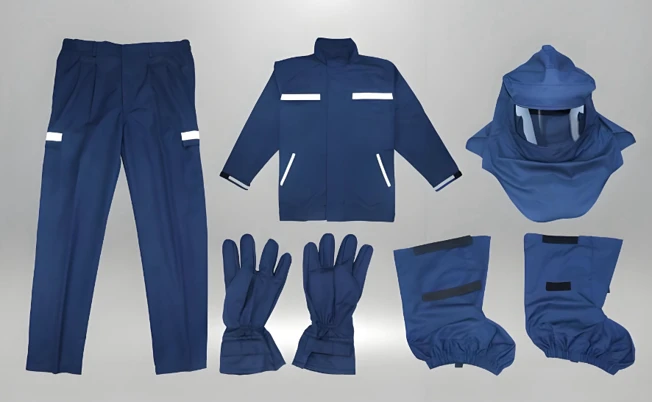
The clothing requirement follows from the exposure. Where an arc-flash hazard is identified, arc-rated garments are selected against the incident energy established for that task, following the framework the site applies, which in the United States is the arc-rated clothing system described in NFPA 70E and in Europe and internationally involves the IEC 61482 series for arc-rated materials and garments. Where no arc exposure is credible because the system is verified de-energised, the requirement may be ordinary workwear and eye protection, with the assessment recording why.
Chemical and thermal hazards add requirements that the electrical specification may not cover. A garment selected for arc performance is not automatically suitable for electrolyte contact, and the assessment should identify which tasks could involve cell materials and specify protection accordingly. That may mean a different garment, additional eye and face protection, or the use of splash protection over the arc-rated layer, and the combination should be confirmed rather than assumed.
Fit and compatibility matter as much as in any other electrical task: the clothing has to be worn over insulating gloves that overlap the sleeve, with the cuffs arranged so that no gap appears when the technician reaches into a pack. The detail behind arc-rated selection is set out in Shield Wings’ guide to arc flash protection for electrical workers, which owns that topic.
Selection Criteria Specific to This Sector
Where a task sits between two rows of that table, the more demanding state should govern the specification until the procedure is clarified.
| Task | State of the system | Protection that follows | What to verify |
|---|---|---|---|
| Diagnostics on an energised system | Energised, with measurement equipment in use | Arc-rated clothing at the level the assessment establishes, insulating gloves and eye protection | Task exposure, glove class for the voltage, and equipment condition |
| Pack removal from a verified de-energised vehicle | Isolation verified, stored energy considered | Workwear plus mechanical protection; arc-rated clothing where the assessment requires it | Verification record and the lifting equipment used |
| Module handling after a damaged or suspect pack | Unknown state, possible thermal and chemical exposure | Set chosen for the chemical and thermal risk as well as the electrical one | Emergency arrangements and the protection selected for each hazard |
| Work in a workshop bay | Variable, often energised until isolation is completed | Clothing worn for the task, with barriers and insulated covers in place | Bay layout, escape route and supervision |
| Roadside or recovery work | Unknown, and often a damaged vehicle | Conservative specification, since the state of the system cannot be confirmed | Procedure for treating the system as live, and the response arrangements |
| Training and demonstration | Controlled conditions | The same equipment as for live work, since the sequence is being learned | Instructor competence and equipment condition |
Read across the table, the specification changes with the state of the system rather than with the name of the task, which is why the assessment has to be written by task and by platform.
Typical Specification Failures in This Sector
One failure is organisational rather than technical: the workshop adopts battery work before the competence and procedure system catches up, and the protective equipment represents the only mature part of the programme. Where the training, the platform-specific procedures and the emergency arrangements are weaker than the clothing specification, the equipment is not the limiting factor in safety, and a review should start there rather than with a heavier garment.
- Assuming that a switched-off vehicle is de-energised. Stored energy and the absence of verified isolation are the core risks, and the protective requirement depends on which state applies.
- One garment for every hazard. Arc-rated clothing is not automatically suitable for electrolyte contact, and the assessment should say so.
- Clothing bought without the gloves and tools. The set works together; a garment without the insulating gloves rated for the voltage does not address the shock hazard.
- Platform-specific procedures left informal. Where packs differ between manufacturers, the procedure and the equipment should be recorded per platform.
- Response arrangements untested. A thermal event develops rather than appearing instantly, and the training for it belongs in the same programme as the clothing.
- Garments not maintained to the care instructions. Arc-rated performance depends on the care regime, including laundering.
- Contractor technicians working to their own standard. Where external technicians work on site, the host’s requirement should apply and be verified.
Building the Full Set Rather Than Buying Pieces
Where a workshop handles several platforms, it is worth recording which set applies to which vehicle family.
The set for battery work typically includes arc-rated body protection where the exposure requires it, insulating gloves and sleeves, eye and face protection, insulating tools and barriers, insulated mats or covers, and lifting equipment for module and pack handling. Where chemical exposure is credible, additional splash protection may be specified over the arc-rated layer, with compatibility confirmed. The garments themselves are set out in Shield Wings’ arc flash protection range and within the wider body protection category.
Shield Wings manufactures arc-rated and protective clothing at a Guangdong production base and supports automotive, fleet, utility and industrial customers with specification guidance, size ranges and the documentation for each claimed performance.
The specification that protects technicians in this environment is written by task and by system state, with the arc, chemical and thermal exposures each addressed and the equipment set confirmed as a combination rather than as a list.
For the wider topic and related decisions, see our Arc Flash & Electrical Safety PPE.
Frequently Asked Questions
What PPE is needed for high voltage battery work?
The set follows the hazards identified in the assessment for the specific task: arc-rated clothing and face protection where an arc-flash exposure is credible, insulating gloves of the class the task requires, insulating tools and barriers, and eye protection. Battery work also brings chemical and thermal hazards, so the assessment should cover the electrolyte, the possibility of a thermal event, and how the pack is isolated before any of it is specified.
Is arc-rated clothing required for EV battery work?
Where the assessment identifies an arc-flash exposure, arc-rated clothing is selected against the incident energy established for that task, following the framework the site applies. Many pack tasks do not involve an arc hazard at all if the system is de-energised and verified, but the assessment has to establish that rather than assume it. The requirement belongs to the task and the state of the system, not to the vehicle type.
How does stored energy change the specification?
A battery pack retains energy when the vehicle is switched off, so isolation has to be verified rather than inferred from an indicator, and the protective equipment has to be selected for the state the pack is actually in. That is why procedures, permits and verification come before clothing in this environment, and why the specification should record which tasks are performed on a verified de-energised system and which are not.
What about the chemical hazard from battery cells?
Electrolyte and cell materials present chemical and thermal hazards that are different from electrical ones, and the assessment should identify them from the material safety information for the cells concerned. Where those hazards are present, the clothing and eye protection specified for the electrical exposure may not be the appropriate choice, and the site should confirm compatibility rather than assuming that one protective set covers every hazard on the task.
What should be verified before a battery task begins?
The isolation and verification status of the system, the task’s arc-flash exposure where one exists, the gloves and tools specified for the voltage involved, the condition of the arc-rated clothing, and the emergency arrangements for a thermal event or a chemical exposure. All of that belongs in the task documentation, and it should be reviewed whenever the pack type, the procedure or the vehicle platform changes.
Specifying protection for high-voltage battery work?
Send the tasks, the system states and the platforms involved. Shield Wings confirms the clothing configurations available, the sizes and the documentation for each protective claim.
External references: NFPA 70E electrical safety in the workplace, 29 CFR 1910.137 electrical protective equipment, 29 CFR 1910.269 electric power generation, transmission and distribution, 29 CFR 1910.132, CEN-CENELEC standards portal, Regulation (EU) 2016/425.
{“@type”:”FAQPage”,”@context”:”https://schema.org”,”mainEntity”:[{“@type”:”Question”,”name”:”What PPE is needed for high voltage battery work?”,”acceptedAnswer”:{“@type”:”Answer”,”text”:”The set follows the hazards identified in the assessment for the specific task: arc-rated clothing and face protection where an arc-flash exposure is credible, insulating gloves of the class the task requires, insulating tools and barriers, and eye protection. Battery work also brings chemical and thermal hazards, so the assessment should cover the electrolyte, the possibility of a thermal event, and how the pack is isolated before any of it is specified.”}},{“@type”:”Question”,”name”:”Is arc-rated clothing required for EV battery work?”,”acceptedAnswer”:{“@type”:”Answer”,”text”:”Where the assessment identifies an arc-flash exposure, arc-rated clothing is selected against the incident energy established for that task, following the framework the site applies. Many pack tasks do not involve an arc hazard at all if the system is de-energised and verified, but the assessment has to establish that rather than assume it. The requirement belongs to the task and the state of the system, not to the vehicle type.”}},{“@type”:”Question”,”name”:”How does stored energy change the specification?”,”acceptedAnswer”:{“@type”:”Answer”,”text”:”A battery pack retains energy when the vehicle is switched off, so isolation has to be verified rather than inferred from an indicator, and the protective equipment has to be selected for the state the pack is actually in. That is why procedures, permits and verification come before clothing in this environment, and why the specification should record which tasks are performed on a verified de-energised system and which are not.”}},{“@type”:”Question”,”name”:”What about the chemical hazard from battery cells?”,”acceptedAnswer”:{“@type”:”Answer”,”text”:”Electrolyte and cell materials present chemical and thermal hazards that are different from electrical ones, and the assessment should identify them from the material safety information for the cells concerned. Where those hazards are present, the clothing and eye protection specified for the electrical exposure may not be the appropriate choice, and the site should confirm compatibility rather than assuming that one protective set covers every hazard on the task.”}},{“@type”:”Question”,”name”:”What should be verified before a battery task begins?”,”acceptedAnswer”:{“@type”:”Answer”,”text”:”The isolation and verification status of the system, the task’s arc-flash exposure where one exists, the gloves and tools specified for the voltage involved, the condition of the arc-rated clothing, and the emergency arrangements for a thermal event or a chemical exposure. All of that belongs in the task documentation, and it should be reviewed whenever the pack type, the procedure or the vehicle platform changes.”}}]}