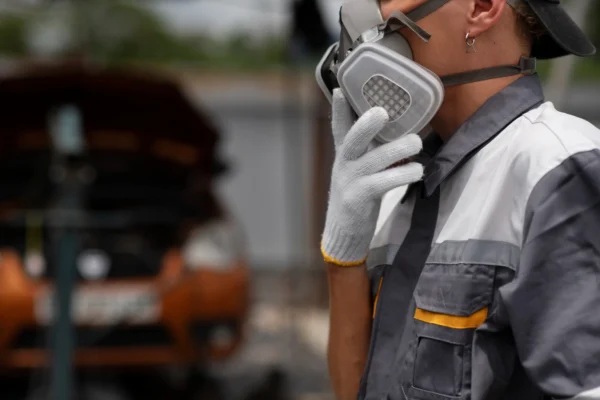
Manufacturing exposes workers to a wide range of hazards — cuts, impacts, heat, chemicals, noise, and dust — and a complete PPE program matches equipment to each task and role. This guide maps the hazards and the gear, with reference to Shield Wings’ manufacturing PPE.
(Last modified date: October 3, 2026)
Quick definition: Manufacturing workers face cuts and lacerations, crushing and impacts, heat and sparks, chemicals, noise, dust, and machine hazards — each controlled by a different piece of equipment.
Key Takeaways
- The program includes a task-by-task hazard assessment, a role-based equipment matrix, procurement from documented suppliers, training and fit, and audits that verify the field matches the paperwork.
- Choose gloves by the task’s hazards: cut level for blades and edges, impact level for crushing, heat rating for thermal exposure, and chemical resistance for solvents — with the task matrix naming the level per job.
- Head, eye, foot, and hearing protection follow the same task logic: helmets for impact and electrical hazards, safety glasses or goggles for particles and splash, safety shoes for impact and puncture, and hearing…
- Verify the program through documentation and audits: certificates match the models, training records are current, and the field check confirms the equipment on the worker matches the matrix.
What Hazards Do Manufacturing Workers Face?
Manufacturing workers face cuts and lacerations, crushing and impacts, heat and sparks, chemicals, noise, dust, and machine hazards — each controlled by a different piece of equipment.
| Hazard | Typical PPE |
|---|---|
| Cuts and lacerations | Cut-resistant gloves |
| Crushing and impact | Impact-rated gloves, safety shoes |
| Heat and sparks | Heat and FR protection |
| Chemicals | Chemical-resistant gloves, goggles |
| Noise | Earmuffs or earplugs |
| Dust | Filtering respirators |
| Falling objects | Helmets, safety shoes |
The table is the starting point; the task assessment decides the details. A fabrication line needs cut and impact gloves; a foundry adds heat protection; a finishing department adds chemical and respiratory protection. The hazard list drives both the equipment and the engineering controls that reduce exposure at the source.
What Does a Manufacturing PPE Program Include?
The program includes a task-by-task hazard assessment, a role-based equipment matrix, procurement from documented suppliers, training and fit, and audits that verify the field matches the paperwork.
The assessment names each task’s hazards; the matrix assigns the equipment per role; procurement standardizes tested, documented products; training covers wear and care; the audit checks the field. The program is reviewed after incidents, near-misses, and process changes. For manufacturing, the equipment must work with the machinery and the workflow, so fit and compatibility are part of the spec. A program with the paperwork and the field in alignment is a program that protects.
How Do You Choose Gloves for Manufacturing Tasks?
Choose gloves by the task’s hazards: cut level for blades and edges, impact level for crushing, heat rating for thermal exposure, and chemical resistance for solvents — with the task matrix naming the level per job.
The task matrix is the foundation: sharpness and force for the cut level, impact energy for the impact level, the heat source for the thermal rating, and the chemicals for resistance. Match the level to the task, because over-rated gloves reduce dexterity and get removed. Verify the ratings on the test reports for the exact models. The glove that matches the task is the glove that gets worn.
What About Head, Eye, Foot, and Hearing Protection?
Head, eye, foot, and hearing protection follow the same task logic: helmets for impact and electrical hazards, safety glasses or goggles for particles and splash, safety shoes for impact and puncture, and hearing protection for noise.
Manufacturing combines all of them: overhead loads need helmets; grinding and chemical work need eye protection; floors with debris need safety shoes; loud machinery needs hearing protection. Each is specified from the task and the measured hazard, and the equipment must work together without conflicts. The role matrix names the full set per job. A worker in a fabrication cell wears a matched set, not a collection of unrelated items.
How Do You Verify and Maintain the Program?
Verify the program through documentation and audits: certificates match the models, training records are current, and the field check confirms the equipment on the worker matches the matrix.
Verify the program is reviewed on the same cycle as the hazard assessment and the data feeds back into the matrix.
Confirm equipment selection against the site hazard register and the applicable standards; this guide is a starting point, not a site-specific decision.
What a Manufacturing PPE Program Has to Document (29 CFR 1910.132)
A manufacturing PPE program is audited on paper before it is ever judged on the floor. The general-industry rule fixes exactly which records have to exist.
| Requirement | Paragraph | Record it produces |
|---|---|---|
| Assess the workplace for hazards that require PPE | 1910.132(d)(1) | A hazard assessment by area and task |
| Certify the assessment in writing | 1910.132(d)(2) | A document identifying the workplace, the assessment date(s), and labelled as a certification |
| Train users, and retrain when things change | 1910.132(f)(1)–(3) | Training records; retraining triggered by changes in the workplace or in the PPE itself |
| Provide PPE at no cost to employees | 1910.132(h)(1) | A budget line covering replacement, not only first issue |
| Keep defective equipment out of service | 1910.132(e) | A withdrawal-and-replacement record |
| Hearing-conservation trigger | 1910.95(c)(1)–(2) | Monitoring plus a baseline audiogram within 6 months of first exposure at or above the 85 dBA 8-hour TWA (1910.95(g)(5)(i)) |
| Duration per day | Sound level (dBA, slow response) |
|---|---|
| 8 hours | 90 |
| 4 hours | 95 |
| 2 hours | 100 |
| 1 hour | 105 |
| 30 minutes | 110 |
| 15 minutes or less | 115 |
A shift checked against the noise table
Illustrative example: a press operator spends 5 hours at 92 dBA and 3 hours at 84 dBA. Using the table above, 92 dBA carries a 6-hour allowance, so that block on its own sits inside the limit. It does not follow that the shift is compliant — OSHA requires mixed levels to be combined through the dose calculation in 29 CFR 1910.95(b)(2) and appendix A, and adding hours across different levels by hand understates the exposure. What the example does show is the trigger everyone misses: any exposure at or above an 8-hour time-weighted average of 85 dBA puts the wearer into the hearing-conservation program, and that is the point at which hearing protection stops being a comfort item and becomes a documented control.
Boundary conditions
The hazard assessment belongs to the employer, so a supplier’s certificate cannot satisfy it. Selection has to follow the assessment rather than the other way round, and training has to be verified — an employee must demonstrate understanding and correct use before doing the work (29 CFR 1910.132(f)(2)). Where a plant runs several processes in one area, build the matrix by task, not by department.
For the wider topic and related decisions, see our PPE by Industry.
FAQs
Do we need a different glove for every task?
Most sites standardize a small set of glove types covering the main hazard groups, with the matrix naming which glove belongs to which task.
How do we start a PPE program?
Walk the tasks, build the hazard list and matrix, and procure documented equipment. The written hazard assessment required by 29 CFR 1910.132(d)(2) is the record that proves the work was done.
How often should the program be reviewed?
After incidents, near-misses and process changes, and on a scheduled annual cycle — the rule also requires retraining when the workplace or the equipment changes (29 CFR 1910.132(f)(3)).
Can one supplier cover the whole program?
Yes — a qualified manufacturer can supply the full equipment matrix with consistent certification and documentation.
What does OSHA say about PPE requirements?
The employer must assess the workplace for hazards requiring PPE, certify that assessment in writing, train users and provide the equipment at no cost to employees (29 CFR 1910.132(d), (f) and (h)).
Is there a fixed list of seven basic PPE items?
No — the regulation is organised by hazard, not by a numbered list. In practice manufacturing programs cover eyes and face, head, hands, feet, hearing, respiratory and body protection, and the assessment decides which apply.
Related Articles
- PPE Compliance Checklist for Manufacturers and Importers
- Auto-Darkening Welding Helmet Buying Guide: DIN Shades and Lens
- Cut Resistant Gloves for Food Processing: What to Look For
- PPE for Oil and Gas Workers: The Complete Guide
- PPE for Electrical Workers: The Complete Guide
- PPE for Construction Workers: The Complete Guide
Official Resources
- Manufacturing Ppe
- Safety Shoes And Boots The Complete Buying Guide
- The Role Of Ergonomic Design In Modern Protective Equipment
- Welding Gloves Types Heat Ratings And Selection
- Cut Resistance Levels En 388 Vs Ansi Isea 105 Explained
- Safety Glasses The Complete Buying Guide
- Contact Shield Wings