

Molten metal protection cannot be specified from a temperature alone. A foundry pouring iron into a mould, a steel mill running a casting sequence and a glass furnace drawing a gob are exposed to the same class of hazard with very different mechanics: pour size, projection distance, contact time and radiant load all differ, and each of those differences changes what the garment has to do. The comparison below is written for buyers who have to specify the clothing and defend the choice afterwards.
What This Environment Does to People and Equipment
Work around molten metal combines four exposures that each demand something different from protective clothing. There is the splash itself, where a quantity of liquid metal leaves the process and contacts the worker, arrives at temperature and solidifies where it lands. There is radiant heat, which at a pouring floor or a furnace mouth is continuous and drains the wearer over a shift. There is flame, where metal vapour ignites or a leak meets an ignition source. And there is the process safety problem that surrounds all three: water, moisture and damp tools become violent when they meet molten metal, which is why the hazard assessment in these plants looks at housekeeping and procedural controls with the same seriousness as it looks at clothing.
Equipment suffers alongside people. Clothing in these areas stiffens, burns through and contaminates, hoods and face shields become brittle with heat, and the seams and closures that keep splash out are the first parts to fail. Sites that treat protective clothing as a consumable with a defined inspection rule recover faster than sites that treat it as a long-term asset.
Duration is the variable that most specifications omit. Ten minutes at a pouring face and six hours on the same floor produce different requirements even when the metal, the pour and the position look identical, because radiant load accumulates in the wearer and in the garment. Where the assessment records the shift pattern as well as the task, several practical consequences follow: the specification can be graded across positions, rotation can be introduced where it reduces cumulative exposure, and the clothing weight can be justified rather than argued about.
The Hazards That Drive the Specification
Three process conditions decide the specification, and they are stated separately for each worker position rather than once for the plant.
- The metal and its condition — iron and steel behave differently from aluminium, and molten glass is a different problem again, because it is viscous, sticks to surfaces and holds heat.
- The quantity and geometry of the potential splash — a pour from a ladle, a breakout at a mould, a slag operation or a glass gob cut, each with its own projection direction and volume.
- The worker’s position and duration — standing at the pour face for a full shift is a different requirement from walking through the bay during a cast.
Additional exposures belong in the same document: radiant heat from the furnace or the metal stream, the presence of ignitable atmospheres and the clothing materials that behave in them, and the physical load of working in heavy protective garments under heat, which is an operational risk in its own right. The employer’s assessment owns the resulting requirement, and a supplier explains what a garment is tested to rather than deciding the exposure.
Controls That Come Before the Equipment
Molten metal safety is dominated by process design, and the clothing is the last layer of defence. Pour path layout that keeps workers out of the trajectory, fixed screens and barriers at the furnace mouth, remote or mechanised handling of ladles and moulds, controlled tilting and pouring systems, dry floors and dry tooling, planned housekeeping of dross and spillages, ventilation and heat extraction, restricted access during a cast, and clear escape routes all reduce the exposure before any garment is considered.
Administrative controls sit between those measures and the clothing: permit systems for hot work near metal, task sequencing that keeps people away from the pour, competence requirements for the operators involved, and communication between furnace and casting crews. A programme that leans on clothing instead of these controls ends up specifying heavier garments every year without changing the exposure behind them.
What the Equipment Has to Do Here
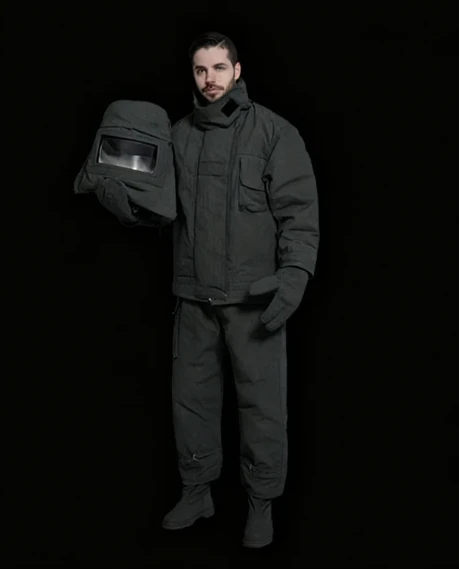
Molten metal protection is about surface behaviour as much as insulation. The material has to resist the metal sticking and burning through, shed it where possible, and avoid trapping it in folds. That is why the construction details matter more in this category than in most: a closed collar rather than an open one, flaps over pockets, cuffs designed to overlap the glove, trousers designed to overlap the boot or to be covered by spats, and no gaps at the waist when the wearer bends or reaches.
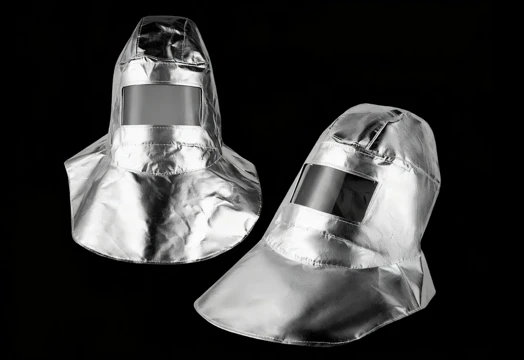
The requirements are framed by the heat and flame protection standards, in which molten metal splash performance is assessed alongside the other thermal properties, with the European framework built on EN ISO 11612 and the US market working to the flash fire and thermal standards its buyers reference. Aluminised garments are used where radiant heat is the dominant load, because the reflective surface reduces the radiant component reaching the wearer, and they are commonly specified with a hood and a face shield to complete the head and face coverage.
Two materials rules follow from the hazard. Natural or inherently flame resistant materials are used through the layers that can be exposed, because meltable synthetics can fuse to skin under heat. And the protection is treated as a system: the body garment, hood, face shield, gloves and footwear are specified together because the interfaces, not the individual items, are where a splash reaches the skin.
Selection Criteria Specific to This Sector
| Environment | Dominant exposure | What the specification has to cover | Evidence to request |
|---|---|---|---|
| Iron and steel foundry | Pour splash from ladles and moulds, plus radiant heat | Closed garment construction, hood and face shield, glove and boot interface | Documentation for the thermal and molten metal performance claimed for the model |
| Steel mill casting and slag area | Larger splash volumes, slag handling, high radiant load | Heavier outer layers or aluminised surfaces where radiant heat dominates, with coverage of limbs | Test evidence for the garment as supplied, including the layers specified |
| Aluminium handling | Splash plus the water and moisture interaction risk in the process | Dry process controls recorded alongside the garment, since the abnormal case drives severity | Documentation plus the assessment’s stated process controls |
| Glass furnace and gob handling | Radiant heat, sticky molten glass, sparks and heat soak | High radiant protection, non-stick surface behaviour, full limb coverage | Documentation for radiant and contact performance claimed for the model |
| Maintenance and refractory work | Intermittent high exposure during abnormal tasks | Higher protection for short tasks, with the ensemble assembled and checked beforehand | Task-specific specification and inspection record before the task begins |
Read across the table, the constant is coverage and closure; the variable is how much radiant and contact protection the specific position needs. That is why two crews working in the same bay can legitimately carry different specifications, and why the assessment should describe positions rather than job titles.
When the table row is converted into a written specification, four items are worth stating explicitly: the metal and process step, the worker’s position relative to the flow, the duration of exposure in the shift, and the ambient conditions such as furnace radiant heat. Those four lines are enough for a supplier to propose a garment family and for an auditor to follow the reasoning. Without them, the specification tends to drift toward whatever the last supplier offered, and the reasoning behind the garment disappears at the next staff change.
Typical Specification Failures in This Sector
The failures repeat across plants, and most of them are visible in ten minutes on the floor.
- Meltable base layers. Synthetic underlayers worn beneath protective clothing can fuse under heat, which is why the base layer is part of the specification.
- Openings and pockets. Metal collects in a fold, a pocket or an open cuff, and holds contact against the skin far longer than a splash on a flat surface.
- Gaps at the waist and boots. A garment that rides up when the wearer bends leaves the lower back exposed; trousers that sit outside the boot allow splash into the boot.
- Borrowed garments. A welding leather or a radiant heat garment used for a molten metal task is not the same product, even where both are described as heat protective.
- Contaminated garments returned to service. Metal splashes, hardened areas and burn-throughs are retirement triggers rather than cosmetic issues.
- Wet or damp protective clothing. Moisture both conducts heat and, in the aluminium context, belongs to the process safety discussion.
- Heat stress ignored. A specification that no one can work in for more than twenty minutes will be circumvented, and the workaround is what causes the incident.
- No defined inspection rule. Without a stated interval and criteria, garments stay in service long after their protection has gone.
Building the Full Set Rather Than Buying Pieces
The interfaces decide the outcome, so the set is specified as a set: body garment with closed closures, hood and face shield for head and face, gloves rated for the exposure and long enough to meet the sleeve, trousers or leggings with the right overlap, and footwear selected so that molten metal cannot enter at the boot opening. Spats, gaiters and sleeves are not accessories in this context; they are the components that close the gaps.
Shield Wings manufactures heat protective clothing and the head and face items that accompany it, including aluminium foil hoods and furnace face shields, from a Guangdong production base, and supports foundry, steel and glass customers with material selection and the documentation for the performance each task claims. The standards and test logic behind the clothing are covered in Shield Wings’ article on molten metal splash protection standards, and the wider body protection range shows how the heat family sits alongside the other protective clothing groups.
The buying decision that matters is whether the specification describes the worker’s actual position relative to the metal, and whether every opening in the ensemble is closed by something that carries its own evidence. Everything else in this category is downstream of those two questions.
For the wider topic and related decisions, see our Heat, Molten Metal & Furnace Protection.
Frequently Asked Questions
Why is a heat protective garment not automatically suitable for molten metal splash?
Radiant heat and molten metal contact load a garment in different ways. Radiant heat is about insulation over time, while molten metal can run down a surface, collect in a fold and stay in contact with the skin while it solidifies. That is why molten metal protection depends on the surface behaviour of the material and on the garment being closed at every opening, and why a garment chosen only for radiant heat performance may not meet the molten metal requirement.
Does the metal type change the specification?
Yes. Different metals differ in density, temperature and how they behave on contact, and the assessment should name the metal, the pour size and the worker’s position relative to the flow and the mould. The specification is then written against that description rather than against a general molten metal reference, and the test evidence is checked for the exposure the garment is expected to face.
How does water interact with molten metal in an aluminium plant?
Water in contact with molten metal can vaporise violently, which is why dry floors, dry tools and dry moulds are treated as process safety requirements rather than housekeeping preferences. The implications for protective clothing are indirect but real: the specification should assume the abnormal case as well as the routine one, and the assessment should record the controls that keep water and moisture away from the metal path.
What should be checked on a molten metal protective garment before use?
Check the closures, since open pockets, collars and cuffs are where metal collects; check the surface for holes, cracks, contamination and burnt or stiffened areas; check that the garment has not been laundered in a way the care instructions prohibit; and check the overlap with the trousers, hood and boots so that no gap is left where splash can enter. Any garment that has been contaminated with metal or damaged is withdrawn until assessed.
Should the full set be ordered together?
It is the most reliable approach. Body protection, hood, face shield, sleeves or gauntlets, trousers or spats, gloves and boots all interact at the overlaps, and the interfaces are where splash enters. Ordering the set from one specification keeps the interfaces consistent and gives one document set to present during an audit or an incident investigation.
Specifying for a pour floor or a melting shop?
Send the metal, the process step and the worker’s position relative to the flow. Shield Wings confirms the garment, hood and face protection combination and the documentation for the performance each task requires.
External references: 29 CFR 1910.132 hazard assessment and equipment selection, 29 CFR 1910 Subpart I, CCOHS PPE answers, UK HSE personal protective equipment guidance, CEN-CENELEC standards portal, Regulation (EU) 2016/425.
{“@context”:”https://schema.org”,”@type”:”FAQPage”,”mainEntity”:[{“@type”:”Question”,”name”:”Why is a heat protective garment not automatically suitable for molten metal splash?”,”acceptedAnswer”:{“@type”:”Answer”,”text”:”Radiant heat and molten metal contact load a garment in different ways. Radiant heat is about insulation over time, while molten metal can run down a surface, collect in a fold and stay in contact with the skin while it solidifies. That is why molten metal protection depends on the surface behaviour of the material and on the garment being closed at every opening, and why a garment chosen only for radiant heat performance may not meet the molten metal requirement.”}},{“@type”:”Question”,”name”:”Does the metal type change the specification?”,”acceptedAnswer”:{“@type”:”Answer”,”text”:”Yes. Different metals differ in density, temperature and how they behave on contact, and the assessment should name the metal, the pour size and the worker’s position relative to the flow and the mould. The specification is then written against that description rather than against a general molten metal reference, and the test evidence is checked for the exposure the garment is expected to face.”}},{“@type”:”Question”,”name”:”How does water interact with molten metal in an aluminium plant?”,”acceptedAnswer”:{“@type”:”Answer”,”text”:”Water in contact with molten metal can vaporise violently, which is why dry floors, dry tools and dry moulds are treated as process safety requirements rather than housekeeping preferences. The implications for protective clothing are indirect but real: the specification should assume the abnormal case as well as the routine one, and the assessment should record the controls that keep water and moisture away from the metal path.”}},{“@type”:”Question”,”name”:”What should be checked on a molten metal protective garment before use?”,”acceptedAnswer”:{“@type”:”Answer”,”text”:”Check the closures, since open pockets, collars and cuffs are where metal collects; check the surface for holes, cracks, contamination and burnt or stiffened areas; check that the garment has not been laundered in a way the care instructions prohibit; and check the overlap with the trousers, hood and boots so that no gap is left where splash can enter. Any garment that has been contaminated with metal or damaged is withdrawn until assessed.”}},{“@type”:”Question”,”name”:”Should the full set be ordered together?”,”acceptedAnswer”:{“@type”:”Answer”,”text”:”It is the most reliable approach. Body protection, hood, face shield, sleeves or gauntlets, trousers or spats, gloves and boots all interact at the overlaps, and the interfaces are where splash enters. Ordering the set from one specification keeps the interfaces consistent and gives one document set to present during an audit or an incident investigation.”}}]}