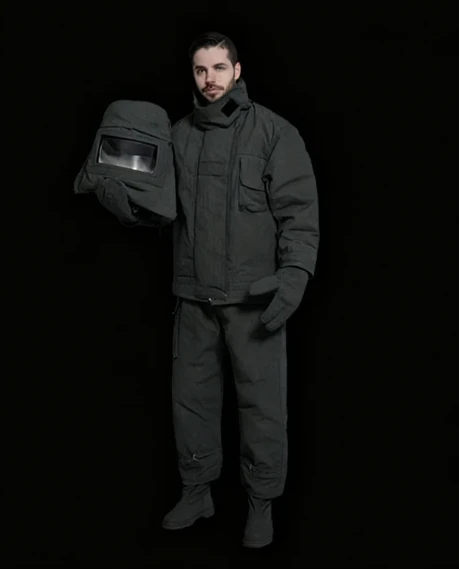
FR clothing only protects when it fits: a garment too loose snags and exposes gaps, one too tight restricts movement and tears under stress, and every worker needs their own correctly sized system. This guide covers FR clothing sizing and fit, with reference to Shield Wings’ FR clothing.
Last updated:
Quick definition: Measure chest, waist, inseam, sleeve, and height against the manufacturer’s chart, and take the measurements at the start of the sizing program and whenever new garments are ordered.
Key Takeaways
- Fit matters because the garment must stay in place while the worker moves, close securely at the cuffs and collar, and preserve the air layer that provides insulation — a poor fit creates gaps where flame enters.
- The fit should allow a full range of motion — reaching, bending, and crouching — without excess fabric at the cuffs, waist, or ankles, and closures should close without strain.
- Teams need a sizing program that covers the full range of body types — extended sizes, tailored fits, and women’s-specific patterns where needed — because protection must fit everyone, not just the average.
- Validate fit with a sample trial: order the sizes the crew needs, test the garments through real shifts and tasks, and collect feedback on movement, comfort, and closures before the bulk order.
Why Does Fit Matter for FR Clothing?
Fit matters because the garment must stay in place while the worker moves, close securely at the cuffs and collar, and preserve the air layer that provides insulation — a poor fit creates gaps where flame enters.
FR clothing is protection as well as clothing. Excess fabric can snag on equipment and expose the worker during a fall; a tight garment restricts movement and can tear under stress; and cuffs or collars that do not close leave the ignition point at the wrist or neck. Fit also drives compliance — workers wear what feels like their own gear, and discard what does not. The sizing program is therefore part of the safety system, not a convenience.
How Do You Measure Workers for FR Clothing?
Measure chest, waist, inseam, sleeve, and height against the manufacturer’s chart, and take the measurements at the start of the sizing program and whenever new garments are ordered.
| Measurement | How to take it |
|---|---|
| Chest | Around the fullest part, under the arms |
| Waist | At the natural waistline, not over the belt |
| Inseam | From the crotch to the floor, shoes off |
| Sleeve | Shoulder bone to wrist, arm slightly bent |
| Height | Standing straight, without shoes |
Measure over the under-layers workers actually wear, because FR base layers change the fit of the coverall or jacket. Record each worker’s sizes and review them when the crew changes. A measured size range across the team replaces the guesswork of one-size ordering.
What Should the Fit Look Like?
The fit should allow a full range of motion — reaching, bending, and crouching — without excess fabric at the cuffs, waist, or ankles, and closures should close without strain.
The wearer should be able to raise the arms, bend, and kneel without the garment binding or riding up. Cuffs should close snugly around the wrist, the collar should close without choking, and trouser legs should close at the ankle or over the boot. A coverall should not require rolling the sleeves or cuffs, which defeats the closure system. If a worker must adjust the garment to move freely, the size or the design is wrong.
How Do You Handle Diverse Body Types and Extended Sizes?
Teams need a sizing program that covers the full range of body types — extended sizes, tailored fits, and women’s-specific patterns where needed — because protection must fit everyone, not just the average.
One-size or narrow-range programs leave part of the crew in garments that do not fit, and unfit garments get modified or abandoned. Work with the supplier’s size range, order the extended sizes the crew actually needs, and test the fits on real workers. Tailored adjustments for high-turnover or specialized roles are part of the program. The cost of a few extra sizes is trivial next to the cost of a garment that fails at the moment it is needed.
How Do You Validate Fit Before Bulk Ordering?
Validate fit with a sample trial: order the sizes the crew needs, test the garments through real shifts and tasks, and collect feedback on movement, comfort, and closures before the bulk order.
The trial catches what the size chart cannot: how the garment behaves when the worker reaches, crouches, and carries tools. Ask each tester about binding, riding up, cuff closure, and overall comfort at the end of the shift. Adjust the size range or the design based on the feedback, then confirm the approved samples before production. A validated fit is a garment that gets worn.
Choose garments from the hazard assessment and the applicable standard; fabric or certification type alone does not establish suitability for a task.
The sizing program is also a procurement input: order the full size range the crew needs, keep records of each worker’s sizes, and re-measure when the crew changes. Work with a manufacturer that supplies a complete size range and can advise on fit across body types, because a supplier that only offers a narrow range forces the team to make do with garments that do not fit. Keep the approved samples as the reference for reorders, and confirm the certificate applies to the sizes delivered. A fit program that is measured, recorded, and linked to the order is a program that keeps every worker protected, not just the average one.
Sizing FR Clothing So It Still Protects After Ten Washes
FR garments are sized against a body that changes, and the fabric itself moves: most FR fabrics shrink at the first industrial wash. The specification therefore has to cover the shrinkage allowance, not only the measurement taken on the day of the fitting.
| Item | Why it matters | How to close it |
|---|---|---|
| Measurements taken over the under-layer | The garment is worn over other clothing, not on the skin | Measure in the layer set the wearer will use on site |
| Shrinkage allowance | First-wash shrinkage can remove the clearance the size assumed | Ask for the fabric’s shrinkage figure, or validate on the approved sample after washing |
| Range of movement | Reaching overhead exposes the back and wrist | Have the wearer reach, kneel and grip in the trial |
| Cuff and sleeve interface | Glove cuffs and sleeves must overlap | Check the gap with the actual gloves on |
| Size curve across the crew | One or two sizes cannot fit a whole team | Order per size with a float, and record the size each person accepted |
Worked example: the cost of fitting on the skin
Illustrative. A wearer measures as a medium on the skin, and the garment is worn over a base layer and a fleece in winter. If the medium is ordered on that measurement, the winter combination is tight across the shoulders and the wearer leaves it open — which is the failure mode that matters, because an FR layer worn open at the front does not cover what it was specified for. Measuring in the working layer set, and confirming the result after a first wash on the approved sample, is what prevents a resend of the whole order.
Where sizing guidance gets you into trouble
Size letters are not portable between markets or makers: the same L in two factories can differ enough that a fit that passed in one becomes an exchange in the other. Shrinkage figures are fabric-specific rather than brand-wide, so they cannot be carried over from a previous order. And a fit that passes on a standing wearer is not a fit that works crouching under a machine — the trial has to include the movements the job actually involves.
For the wider topic and related decisions, see our Flame-Resistant Workwear.
FAQs
How do we keep sizing records current?
Keep the sizing records current as part of the program: re-measure when the crew changes, review the size distribution before reorders, and confirm the supplier’s range still covers the team. A fit issue reported by workers should feed back into the spec — if a style consistently binds or gaps, adjust the size range or the design. The sizing program that is measured, recorded, and reviewed keeps every worker in a garment that protects.
Should FR clothing fit tight or loose?
Neither extreme. The garment should move with the worker, close securely, and preserve an insulating air layer without excess fabric that can snag.
Do FR base layers change the fit?
Yes. Measure over the layers workers actually wear, because the under-layer changes the outer garment’s fit.
How do we fit a diverse workforce?
Order the full size range including extended sizes, use tailored patterns where needed, and validate with a sample trial before bulk.
How do we get a sizing program set up?
Send us your crew measurements and task requirements, and we will confirm the size range via our contact page or the FR clothing page .
Does FR clothing shrink when it is washed?
Many FR fabrics shrink at the first industrial wash, and the amount depends on the fabric rather than the brand, so ask for the shrinkage figure and confirm it on the approved sample after washing. Sizing on the skin, or without the allowance, is what produces the resends and the garments that get worn open.
Should FR clothing fit loose or snug?
It should fit close enough to stay in place through the movement the job requires, with enough room for the layer set underneath. The practical test is the movement itself: reach overhead, crouch, and grip a tool with the gloves on, and check that the back, wrists and the sleeve-to-cuff gap stay covered.
Related Articles
- Cold Weather Work Clothing: Layering and Materials
- PPE Inventory Management: Keeping Your Stock Ready
- Welding Helmet Standards: EN 379 and ANSI Z87.1
- FR Clothing Fabrics Explained: Nomex Kevlar Modacrylic and More
- FR Clothing Certifications: NFPA 2112 ASTM F1506 and EN ISO 11612
- FR Clothing for Welders: What You Actually Need