

Head protection is issued once and then lives for years in a locker, a toolbox or a vehicle, and its condition at the end of that life is rarely the result of a single event. Shells degrade with sunlight and chemicals, suspensions stretch and absorb sweat, visors lose clarity through cleaning and abrasion, and helmets take impacts that are never reported. The inspection and replacement rules are what keep the equipment on the head equivalent to the equipment that was specified.
Where Performance Is Lost in Service
Storage deserves a place in that list because it causes damage before the first shift. Helmets stored on a parcel shelf in direct sun, hung by the suspension, or buried under tools in a van arrive at the task already degraded. Face shields stored flat under equipment, or pressed against a hard surface, develop deformation in the visor that no cleaning removes. Storage rules sound like housekeeping, but in this category they decide how much of the purchased service life is actually delivered.
Several mechanisms shorten the service life of a helmet, and they operate quietly. Ultraviolet light degrades many shell materials, which is why long exposure outdoors matters more than indoor use. Chemicals, solvents, oils and paints affect shells and suspensions, sometimes within a single exposure, and the effect is usually invisible until the shell fails or the suspension tears. Mechanical damage from impacts, dropping, standing on the helmet or storing it under load reduces the shell’s ability to absorb energy. Sweat, hair products and repeated adjustment degrade suspensions and padding. And the marking itself fades, removing the evidence that the helmet met the requirement in the first place.
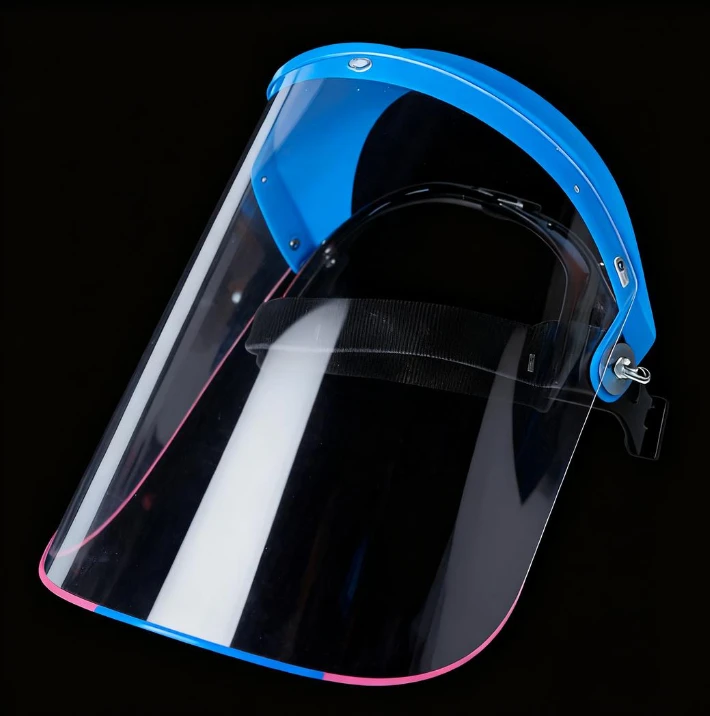
Face shields lose performance in a different way, because their working part is the optical surface. Scratches and clouding reduce the wearer’s ability to see the task, which is a safety effect rather than a cosmetic one. Coatings wear away, reflective surfaces lose their reflective behaviour, and heat or solvent exposure can craze a visor. Since a worker compensates for poor visibility by looking around the shield or lifting it, the practical protection falls faster than the material properties suggest.
Cleaning and Care Within the Manufacturer’s Instructions
Cleaning is where sites most often damage equipment while trying to look after it. The care instructions for a shell usually specify mild soap and water with a soft cloth, and they usually exclude solvents, abrasives and aggressive chemicals, because those attack the material or the marking. Suspensions and padding often need a different approach again, and some components are intended to be replaced rather than cleaned.
Face shields need the same discipline. Many visor materials are sensitive to solvents that a workshop has in abundance, and wiping a visor with the wrong cloth or chemical leaves a cloudy surface that never clears. Where reflective surfaces are involved, abrasion is the main risk, and cleaning should follow the procedure the manufacturer specifies rather than the nearest available rag.
For a programme rather than a single helmet, three arrangements make care practical.
- Keep the cleaning instructions with the issue record, so the person cleaning the equipment can see what is permitted.
- Provide the right consumables at the point of use, including lint-free cloths and the approved cleaning agent, so the nearest option is also the correct one.
- Separate cleaning arrangements for equipment with reflective or coated surfaces, which tolerate less handling than a plain shell.
Inspection Points Before Every Use
Two categories of helmet need closer attention than the rest. One is the helmet used near solvents, paints or process chemicals, because contamination can affect the shell without visible damage and the exposure may have been brief. The other is the helmet that has been left in a hot vehicle, a drying room or a welding area, where heat quietly changes the material. In both cases the inspection should look for the specific effects those conditions produce, rather than a general check for damage.
The pre-use check takes seconds and catches most conditions that matter. It is done by the wearer, and it works when the wearer has been taught what to look for and what to do when something is found.
- Shell: cracks, crazing, chalky or discoloured areas, dents, deformation, and any sign of chemical attack or heat exposure.
- Suspension: stretched or torn straps, a worn or contaminated headband, damaged adjustment, and damage at the attachment points.
- Chin strap and accessories: present, adjustable, undamaged and correctly fitted for the task.
- Marking: legible, complete and not obscured by stickers, paint or tape applied after issue.
- Face shield: clarity, scratches, crazing, contamination, cracks at the mounting points.
- Mount and headband: secure, undamaged, and holding the visor in the position the task needs.
Any item that fails the check is withdrawn immediately, marked as out of service and removed from the storage area. The rule that matters most is that a suspect helmet never returns to the rack, because the alternative is an unrecorded decision that the equipment is probably fine.
Periodic Inspection and Test Intervals
Periodic inspection is the site’s control, and the interval comes from the manufacturer’s instructions adjusted for the conditions the equipment meets. A helmet worn indoors in a clean workshop has a different service profile from one used outdoors in sunlight, around solvents or in a hot area, and treating them as the same shortens the life of one and extends the risk of the other.
| Equipment and conditions | Inspection arrangement | Who performs it | Record kept |
|---|---|---|---|
| Helmet in routine indoor use | Pre-use check plus a periodic inspection at the interval the site sets | Wearer, then supervisor or store | Issue date, inspection date, condition |
| Helmet exposed to sunlight, heat or chemicals | Pre-use check plus a shorter periodic interval, with shell and suspension assessed separately | Trained inspector | Inspection record against the helmet identifier |
| Suspension and padding | Replaced on the manufacturer’s interval or on condition, independently of the shell | Store or supervisor | Replacement record tied to the helmet |
| Helmet after any impact | Withdrawn and assessed before any return to service | HSE with the supplier’s guidance where needed | Event record and disposition |
| Face shield in daily use | Pre-use check plus replacement on condition, with consumable visors held in stock | Wearer, with store support | Replacement record, where the site tracks it |
Two rules prevent most disputes. Record the issue date for every helmet, because without it no service life can be applied. And treat the suspension as a service part with its own criteria, because a sound shell with a stretched suspension is not a helmet that still performs as specified.
Documenting Condition and Traceability
Records here are short and specific: the helmet identifier, the worker it was issued to, the issue date, the inspection dates and outcomes, the replacement of any component, and the date and reason for retirement. Where the site operates several sites or crews, the identifier is what allows a suspect batch to be found quickly rather than one helmet at a time over several months.
For face shields, the practical record is simpler, but two items are worth capturing: the visor type issued for each task and the reason the last one was replaced. Those two lines show whether the replacement rate is driven by the task, by cleaning practice or by a mounting problem, and they are usually enough to fix the underlying cause. How the marking on the product maps to the requirement is explained in Shield Wings’ guide to safety helmets under ANSI Z89.1 and EN 397, which owns that topic.
Repair, Withdrawal and Disposal
Repair options for head protection are narrow, and the manufacturer’s instructions define them. Shells are generally not repaired, suspensions and padding are replaced with approved components, and anything that involves drilling, painting or adhesive outside the permitted instructions moves the helmet outside the configuration that was tested. The same logic applies to face shields: a scratched visor is replaced, not polished, and a damaged mount is replaced rather than adjusted.
Withdrawal should be unambiguous. A helmet is withdrawn after a significant impact, after exposure to a substance or condition outside its specification, when the shell or suspension meets the retirement criteria, when the marking is no longer legible, or when the manufacturer’s stated life has been reached. Disposal ends the life of the item and should be recorded, particularly where the helmet carried a certification or where the site’s insurance arrangements require an audit trail.
The failure mode to design against is the returned helmet. Equipment that has been withdrawn but left in a locker or a van will eventually be worn again, and the person who wears it has no way to know its history. A quarantine location, a visible marker and a rule that only the responsible person may release an item from it are the three measures that keep the programme honest.
What to Ask the Supplier Before You Buy
The questions that make head protection easier to manage are best asked at the quotation stage.
- What is the manufacturer’s stated service life, and what conditions affect it?
- Which components are replaceable, and what are their intervals?
- What cleaning agents and methods are approved for the shell and for the suspension?
- What cleaning is approved for the visor, and what must be avoided?
- How is the product marked, and how is the marking protected from fading?
- What identification method does the manufacturer permit for site labelling?
- What documentation accompanies the product, and what traceability reference can be recorded?
Shield Wings manufactures safety helmets, welding helmets and face shields at a Guangdong production base and provides care, inspection and replacement information with the product documentation, so a site can build the maintenance side of a programme alongside the specification. The conventional helmets are covered in the helmet guide, the connected option appears on the smart safety helmet page, and the wider range sits in the head and face protection category.
The measure of an inspection programme is whether a supervisor can pick up any helmet in the store and say when it was issued, when it was last checked and why the previous one was replaced. If that answer needs a phone call, the programme is a document rather than a control.
Frequently Asked Questions
How often should a safety helmet be replaced?
The interval comes from the manufacturer’s instructions and from the helmet’s history, not from a single number that applies to every site. A helmet is replaced when the shell or the suspension meets the manufacturer’s retirement criteria, after a significant impact, after exposure to substances or conditions outside its specification, or when the date the manufacturer states has been reached. The issue date therefore needs to be recorded at the point of issue.
Does the suspension need replacing separately from the shell?
It often does. The suspension is a service part that carries the fit and the clearance the shell relies on, and it can degrade faster than the shell through sweat, contamination and repeated adjustment. Manufacturers commonly specify a shorter interval or a set of condition criteria for the suspension, and the programme should treat it as a replaceable component rather than as part of the helmet’s fixed life.
Can a helmet be painted or have stickers applied?
Only where the manufacturer permits it. Solvents in paints and adhesives, and the hiding of the original marking, both affect the helmet: the chemicals can attack the shell and the obscured marking removes the evidence that the product meets the requirement. Where identification is needed on site, use the method the manufacturer allows, such as a designated label area, and keep the standard marking legible.
What should be checked on a face shield?
Check the visor for scratches, crazing, cracks, clouding, heat damage and contamination, check the headband or helmet mount for damage and a secure fit, and confirm that the visor can still be seen through clearly. Coatings and reflective surfaces degrade with abrasion and cleaning, so the manufacturer’s cleaning instructions matter. A visor that fails the visual check is replaced rather than polished.
How should helmets and face shields be stored?
Store them clean and dry, out of direct sunlight, away from heat sources and away from chemicals, oils and solvents, following the manufacturer’s instructions. Helmets should not be stored with heavy items stacked on the shell or hung by the suspension, and face shields should be stored so that the visor is not deformed or abraded. Storage conditions are part of the programme because damage before first use is invisible.
Reviewing head protection maintenance?
Send the helmet and shield models in use and the site conditions. Shield Wings confirms the care, inspection and replacement guidance for each product line, along with the spare components that keep them serviceable.
External references: 29 CFR 1910.135 head protection, 29 CFR 1910.133 eye and face protection, 29 CFR 1910.132, CCOHS guidance on headwear, UK HSE personal protective equipment guidance, CEN-CENELEC standards portal, Regulation (EU) 2016/425.
{“@context”:”https://schema.org”,”@type”:”FAQPage”,”mainEntity”:[{“@type”:”Question”,”name”:”How often should a safety helmet be replaced?”,”acceptedAnswer”:{“@type”:”Answer”,”text”:”The interval comes from the manufacturer’s instructions and from the helmet’s history, not from a single number that applies to every site. A helmet is replaced when the shell or the suspension meets the manufacturer’s retirement criteria, after a significant impact, after exposure to substances or conditions outside its specification, or when the date the manufacturer states has been reached. The issue date therefore needs to be recorded at the point of issue.”}},{“@type”:”Question”,”name”:”Does the suspension need replacing separately from the shell?”,”acceptedAnswer”:{“@type”:”Answer”,”text”:”It often does. The suspension is a service part that carries the fit and the clearance the shell relies on, and it can degrade faster than the shell through sweat, contamination and repeated adjustment. Manufacturers commonly specify a shorter interval or a set of condition criteria for the suspension, and the programme should treat it as a replaceable component rather than as part of the helmet’s fixed life.”}},{“@type”:”Question”,”name”:”Can a helmet be painted or have stickers applied?”,”acceptedAnswer”:{“@type”:”Answer”,”text”:”Only where the manufacturer permits it. Solvents in paints and adhesives, and the hiding of the original marking, both affect the helmet: the chemicals can attack the shell and the obscured marking removes the evidence that the product meets the requirement. Where identification is needed on site, use the method the manufacturer allows, such as a designated label area, and keep the standard marking legible.”}},{“@type”:”Question”,”name”:”What should be checked on a face shield?”,”acceptedAnswer”:{“@type”:”Answer”,”text”:”Check the visor for scratches, crazing, cracks, clouding, heat damage and contamination, check the headband or helmet mount for damage and a secure fit, and confirm that the visor can still be seen through clearly. Coatings and reflective surfaces degrade with abrasion and cleaning, so the manufacturer’s cleaning instructions matter. A visor that fails the visual check is replaced rather than polished.”}},{“@type”:”Question”,”name”:”How should helmets and face shields be stored?”,”acceptedAnswer”:{“@type”:”Answer”,”text”:”Store them clean and dry, out of direct sunlight, away from heat sources and away from chemicals, oils and solvents, following the manufacturer’s instructions. Helmets should not be stored with heavy items stacked on the shell or hung by the suspension, and face shields should be stored so that the visor is not deformed or abraded. Storage conditions are part of the programme because damage before first use is invisible.”}}]}