

Cut resistant gloves in food processing must balance cut protection with food-contact safety, washability, and hygiene — a glove that fails on any of the three is a risk in a different direction. This guide explains what to look for, with reference to Shield Wings’ cut resistant gloves.
Last updated:
Quick definition: Food processing adds three requirements to cut protection: the glove materials must be food-contact compliant, the gloves must survive repeated washing and sanitizing, and hygiene programs need color-coding and…
Key Takeaways
- Food tasks range from light handling to heavy knife work: ANSI A2–A3 for general handling, A4–A5 for slicing and boning, and higher levels for extreme blade exposure.
- Food-safe gloves use materials and coatings that pass food-contact requirements — high-performance polyethylene with food-compliant coatings, or metal mesh for extreme knife work — and survive the wash cycle.
- Set a hygiene program with color-coded gloves per zone, a count-and-recover system at shift end, and a wash and replacement cycle that keeps gloves food-safe.
- Verify the cut rating, the food-contact compliance documentation, and the wash-test results on the exact model, and confirm the delivered batch matches.
What Are the Special Requirements in Food Processing?
Food processing adds three requirements to cut protection: the glove materials must be food-contact compliant, the gloves must survive repeated washing and sanitizing, and hygiene programs need color-coding and traceability.
Cut hazards in food processing come from knives, slicers, blades, and broken glass, but the glove also touches the product. Materials and coatings must comply with food-contact regulations, and the glove must tolerate the wash and sanitize cycle without degrading. Hygiene programs often use color-coded gloves so a glove lost in production can be found and kept out of the product, and traceability matters if a recall happens. Selection starts with the cut hazard and then adds these food-specific requirements.
What Cut Levels Do Food Tasks Need?
Food tasks range from light handling to heavy knife work: ANSI A2–A3 for general handling, A4–A5 for slicing and boning, and higher levels for extreme blade exposure.
| Task | Recommended level (ANSI/ISEA 105) |
|---|---|
| General handling, packing | A2–A3 |
| Slicing, boning, trimming | A4–A5 |
| Heavy knife work, bandsaw | A6–A7 |
| Extreme blade exposure | A8–A9 |
The straight-blade rating is the relevant number for knife and blade hazards, because it measures force against a sharp edge. Match the level to the task and the knife technique, and confirm the rating on the test report for the exact model. A glove that is over-rated for the task costs dexterity; one that is under-rated costs injuries.
Which Materials and Coatings Work in Food Environments?
Food-safe gloves use materials and coatings that pass food-contact requirements — high-performance polyethylene with food-compliant coatings, or metal mesh for extreme knife work — and survive the wash cycle.
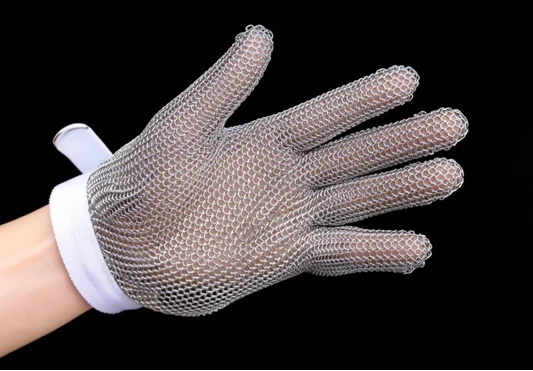
HPPE knit gloves with food-safe nitrile or polyurethane coatings provide cut protection with grip for wet and slippery product. Metal mesh gloves offer the highest protection for bandsaw and heavy knife work, at the cost of comfort and dexterity. The coating must comply with food-contact rules and hold up to repeated washing and sanitizing. Ask for the food-contact compliance documentation and the wash-test results before ordering, because a glove that is cut-rated but fails the hygiene program is not a solution.
How Do You Manage Hygiene and Color Coding?
Set a hygiene program with color-coded gloves per zone, a count-and-recover system at shift end, and a wash and replacement cycle that keeps gloves food-safe.
Color coding lets each zone recognize its gloves, and the count-and-recover system ensures gloves do not end up in product. Gloves are washed and sanitized on a schedule, and damaged or worn gloves are replaced immediately — a torn glove is both a cut hazard and a contamination risk. Train workers on the system and audit it regularly. The hygiene program is as important as the cut rating, because both protect the consumer and the worker.
How Do You Verify Food-Processing Gloves?
Verify the cut rating, the food-contact compliance documentation, and the wash-test results on the exact model, and confirm the delivered batch matches.
The test report proves the cut level; the food-contact documentation proves the materials are compliant; the wash test proves the glove survives the care cycle. Request all three for the exact model, keep them with the order, and re-check on reorders. A supplier that provides the full documentation set is a supplier that understands food processing. The glove that passes all three checks is the glove to standardize.
Confirm food-contact compliance, washability, and hygiene with the manufacturer before selecting food-processing gloves; cut ratings alone do not establish food safety, and the applicable standard should guide selection.
Food processors should also plan the glove program around the shift cycle: how many pairs per worker per day, how the wash and sanitize cycle works, and how lost gloves are tracked. A glove that cannot be recovered at shift end is a contamination risk, so the count-and-recover system is part of the spec. Work with a manufacturer that supplies food-processing gloves with the compliance documentation and the wash-test results for the exact models, and that can advise on color-coding and size runs for the workforce. The program — hazard, hygiene, and documentation — is what keeps both the workers and the product safe.
Food-Processing Gloves: Where the Requirement Changes
In food handling the cut hazard sits on top of two requirements the rest of the plant does not have: the glove has to be cleanable and acceptable for contact with food, and it has to survive a wash cycle that will not be kind to it.
| Requirement | Why it matters here | What to specify |
|---|---|---|
| Food-contact suitability | The glove touches the product, not just the operator | A construction and colour the site’s food-safety plan accepts |
| Colour and detection | A fragment in product is a recall, not an incident | A colour that contrasts with the product, plus a detectable option where the plan requires it |
| Cleanability | Gloves are washed between tasks or shifts | A coating and liner that tolerate the site’s cleaning rather than degrading |
| Wet grip | Blades and slicers are wet and fatty | Coating chosen for grip first, then the cut level that matches the task |
| Task segmentation | One glove rarely covers boning and cleaning | A small set of gloves mapped to the tasks, with the cut level stated for each |
Worked example: cutting the glove count without cutting protection
Illustrative. A kitchen with four task groups — receiving, boning, slicing on a machine, and cleaning — where the site currently buys one mid-level cut glove for everyone. Mapping the tasks shows that the machine work is guarded (so the glove is for handling, not for the blade), boning is the genuine cut task, and cleaning needs grip rather than cut levels. Re-specifying by task typically reduces the variety of gloves while raising the level where it matters; the saving is in not holding four levels for a task that never needed the third one.
Where a food glove stops being suitable
Two limits catch out buyers new to food. A cut level says nothing about food suitability — the site’s own plan decides what may contact product, and a colour the plan will not accept is a non-starter however well it performs on cut. And usability drives the outcome: a glove the crew finds slippery or too hot comes off for the task it was bought for, which is why grip and fit are specified alongside the rating rather than after it.
For the wider topic and related decisions, see our Hand, Cut & Impact Protection.
FAQs
How do we validate the food-processing glove program on the line?
The food processing glove program should also be validated on the line: run a trial with the actual knives and tasks, confirm the gloves survive the wash and sanitize cycle, and check that the color-coding and count system work at shift speed. Track glove failures and contamination incidents and feed them back into the spec. A program that is tested on the line, documented, and reviewed keeps both the workers and the product safe through every shift.
Are cut resistant gloves also food-safe?
Only if the materials and coatings meet food-contact requirements — confirm the compliance documentation, not just the cut rating.
Can the gloves be washed and sanitized?
Most knit gloves can, within limits; check the wash-test results and follow the care cycle to keep them food-safe.
Do we need metal mesh gloves for every knife task?
Only for the most extreme blade exposure. Most slicing and boning tasks are covered by A4–A6 HPPE gloves with better comfort.
How do we get food-processing gloves with documentation?
Send us your task list and hygiene requirements, and we will recommend options via our contact page or the cut resistant gloves page .
What is a food-grade cut-resistant glove?
One whose construction, coating and colour the site’s food-safety plan accepts for contact with product, and whose cut performance matches the task. Cut rating alone does not make a glove food-safe, so ask for both: the food-contact suitability and the test evidence for the cut level on the exact model.
Should cut-resistant gloves be worn at a slicing machine?
Check the machine’s guarding and the procedure before assuming a glove is the control. Powered blades are not a cut-level problem — the glove protects the handling around them, while the guard and the technique prevent contact. Where the guard has been removed or bypassed, the fix is the guard.
Related Articles
- PPE Sourcing Risk Management for Importers
- EN 388 Explained: Cut Resistance Testing for Gloves
- PPE Import Shipping Guide: Incoterms Lead Times and Costs
- Hand Safety in Manufacturing: Injuries Prevention and PPE
- Cut Resistant Gloves: The Complete Buying Guide
- Cut Resistance Levels: EN 388 vs ANSI/ISEA 105 Explained