

Cold weather changes the way workers behave, and that is what makes it a protection problem rather than a comfort problem. Hands that are numb handle tools less precisely, judgement slows, layers get added from whatever is in the locker, and a carefully specified arc-rated or flash fire garment becomes the outer layer of a system nobody planned. The specification has to keep the hazard protection intact while the site does what every site does in a cold snap: adds clothing.
The Hazard First, the Product Second
Cold-weather protective clothing sits where two hazards meet. The first is thermal: flash fire or electric arc exposure, which sets the level of protection the garment system has to provide and is determined by the employer’s assessment, the arc-flash study or the equipment labels. The second is the environment: temperature, wind, moisture and duration, which set how much insulation is needed and how long the worker can stay outside it.
Those two requirements pull in different directions. Insulation adds bulk, which reduces mobility and increases the effort of the task; protective materials add weight; and both reduce dexterity in the tasks that need it most. The selection therefore addresses the whole set — base layer, insulating layer, outer protective layer, gloves, footwear, head and face protection — rather than the outermost garment alone. A well-chosen jacket over an unsuitable base layer is still an unsuitable system.
What the Risk Assessment Has to Establish
The assessment has to state the hazard protection requirement first, because that is what limits the materials that may be used. It then states the environmental demand, because that decides how much insulation is justified and how long the exposure lasts.
- The thermal hazard and the required protection level, taken from the arc-flash study, the equipment labels or the flash fire assessment.
- The lowest expected temperature, the wind exposure and the duration of outdoor work, including abnormal tasks such as night work or emergency response.
- The metabolic rate of the task, since heavy work generates heat while standing watch does not.
- Whether the worker moves between an outdoor exposure and a hot indoor area, because that cycle changes both clothing needs and heat stress risk.
- The presence of moisture: rain, snow, wet surfaces and the possibility of the garment becoming wet during the shift.
- The interfaces with the rest of the set, including glove dexterity requirements and the footwear needed for ice and snow.
The employer owns the requirement, and the layering rules that follow come from the applicable standard and from the garment manufacturer’s instructions. What a supplier can do is supply garments that are documented for the properties specified, and confirm what the layers are tested to. What no supplier can do is declare a system safe from a garment catalogue alone.
Which Hazards This Category Covers and Which It Does Not
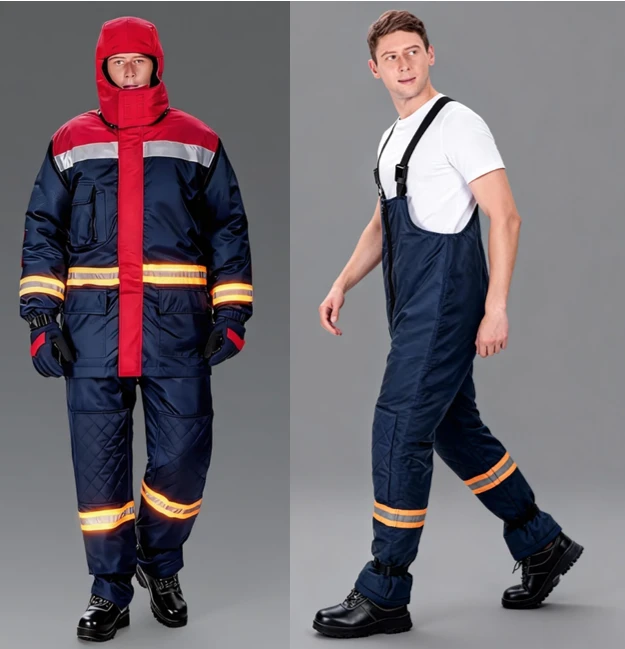
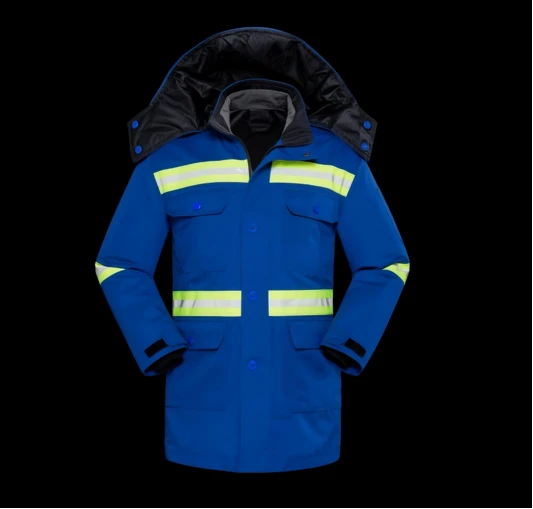
This category covers insulated and uninsulated flame resistant and arc-rated garments used as part of a cold weather system: base layers, mid layers, jackets, parkas, trousers, bibs, hoods and accessories such as liners and neck protection. The family sits inside the wider body protection range, alongside the high-visibility and anti-static families that are frequently required on the same site.
Three boundaries are worth stating. An insulated FR garment is not automatically high visibility, and a high-visibility vest worn over FR clothing does not make the vest FR; where both are needed, each claim has to be documented on the garment concerned. Cold weather clothing is not weatherproof by definition, and a rain shell worn over the system has to be compatible with the thermal protection rather than simply waterproof. And this category addresses body protection only: hands, feet, head and face have their own requirements, and the cold weather set is only complete when those are specified too.
Matching Task to Protection Level
The protection level for the hazard comes from the assessment; the environmental response comes from the conditions. The table below shows how the two are combined in a specification and what evidence a buyer should hold for each element.
| Condition | What decides the requirement | Garment element affected | Evidence to request | Flash fire or arc exposure | Required protection level from the study, labels or assessment | Outer layer, and any layer that could be exposed | Documentation for the protective property claimed for each specified layer | Low temperature with moderate activity | Temperature, wind and duration | Insulating mid layer and outer shell | Insulation and construction data for the specified garments | Low temperature with light activity | Time standing or watching, and the ability to take breaks | Additional insulation or a heated welfare arrangement | Specification as issued, plus the site’s warming provision | Wet or snowy conditions | Moisture exposure and drying arrangements | Outer shell and care rules for drying | Care instructions that preserve both thermal and protective properties | Work moving between cold and hot areas | Frequency of the transition and the task in each area | Removable layers and how they are stored | Specification that states which layers may be removed and where | Visibility requirement on the same site | Traffic exposure and task position | High-visibility outer layer tested for both properties | Evidence for the visibility class and the protective property on the same garment |
|---|
Two rules bound the layering discussion, and both come from the standard and the manufacturer rather than from preference. Materials that can melt are not worn against the skin where arc or flash fire exposure is credible, because a melting layer fuses to skin and worsens the burn. And the protection of an assembly is not the simple sum of its parts: adding a layer changes the system, which is why the employer establishes the requirement and the supplier confirms what the specified garments are documented to provide. Treat this article as a description of what the standards and manufacturers require, not as a guaranteed safe configuration for any particular task.
Where Selection Usually Goes Wrong
Cold weather programmes fail in ways that are easy to predict.
- Personal clothing under protective garments. A synthetic base layer or a non-FR fleece worn underneath turns a compliant outer garment into part of a system that fails the meltable-material rule.
- Insulation chosen for warmth alone. Bulk that restricts movement increases the effort of the task and the chance that the outer layer is removed for a difficult job.
- High-visibility vests over FR clothing. The vest is not FR unless it is documented as such, and the combination is often assumed rather than verified.
- Wet garments left on. Damp insulation loses its thermal value, and a wet garment in freezing conditions is a health risk in its own right.
- Care practices that destroy the property. Heavy detergents, conditioners, high heat and repairs outside the instructions are common causes of lost protection; the care label controls.
- Gloves and boots left out of the specification. Cold hands and cold feet are the most common reasons a worker stops following a procedure.
- Heat stress when the worker moves indoors. Removable layers and a stated storage practice matter as much as the insulation itself.
The Hierarchy of Controls Around the Selection
Cold exposure is reduced most effectively by engineering and administrative measures: heated cabs and control rooms, windbreaks and screens, radiant heaters in welfare areas, scheduled warming breaks, rotation of outdoor tasks, controlling the duration of exposure rather than only the clothing, and the provision of dry changing and drying facilities. Where the hazard is arc or flash fire, isolation, de-energisation, work procedures and permits come first in the same way.
Personal protective equipment is the last line of defence. The clothing reduces heat loss and provides the required thermal protection, but it does not remove the cold, the wind or the hazard the outer layer protects against. It also depends on being worn as specified for the whole task: the worker who opens a jacket to cool down, removes the outer layer indoors and forgets to replace it, or substitutes a personal garment for a specified layer has stepped outside the system the assessment assumed.
There is one further control that cold weather programmes often overlook: what the site does with the clothing between shifts. Storage that leaves garments damp, a drying room that runs too hot for the fabric, and a laundry that uses the wrong chemistry all reduce the life of a specification that was correct on paper. Where several crews share garments, the issue record also becomes a protection control, because a garment that has been worn hard in a wet environment is not equivalent to a new one from the same batch.
Specification Points to Fix Before Ordering
Cold weather protective clothing is best specified as a layer system rather than as individual items.
- The hazard statement with the required protection level, and the source it was taken from.
- The environmental conditions: lowest temperature, wind exposure, moisture and duration of outdoor work.
- The layer structure, naming what each layer is for and which materials are permitted against the skin.
- The standard each layer is tested to, with the marking expected on the product.
- Any additional claims required on the same garment, such as visibility class or anti-static property.
- The interfaces: gloves that keep dexterity, footwear for snow and ice, head and face protection that fits over the hood.
- Care, drying, storage and inspection rules, including the material restrictions the manufacturer states.
- Documentation required with the quotation: test evidence for each garment, care instructions and batch traceability.
- Size range that allows the specified layers to be worn together rather than over a nominal size.
The cold weather range itself is shown in Shield Wings’ cold weather clothing section, and the distinction between inherently flame resistant and treated fabrics — which decides how a garment behaves after repeated laundering — is explained in the article on inherent versus treated FR fabric, which owns that topic.
Shield Wings manufactures cold weather protective clothing and protective workwear at a Guangdong production base, and supports oil and gas, utility, rail and construction customers with material selection, layer combinations and the documentation that each protective claim requires. The specification that works is the one that describes the whole system, and that states plainly who decides the required protection level and who confirms what the garments provide.
For the wider topic and related decisions, see our Flame-Resistant Workwear.
Additional guidance retained during consolidation
Consolidated guidance from fr-cold-weather-clothing-staying-warm-and-safe.
Why Does Cold Weather Complicate FR Protection?
Cold weather complicates FR protection because the extra layers needed for warmth are exactly the layers that can melt or ignite — so every layer must be FR, not just the outer garment.
Workers in cold climates add base layers, mid layers, and insulated outerwear to the FR system, and each added layer is a potential weak point if it is not flame resistant. A non-FR synthetic base layer melts under the FR jacket in a flash fire or arc event. The solution is a full FR layering system: FR base, FR insulation, and FR outer, each certified and documented. The warmth and the protection are built together, not layered separately.
What Does the FR Cold Weather System Include?
The system includes an FR base layer, FR insulating mid layers, and an FR outer shell — with FR head, hand, and foot protection to close the gaps where heat and flame enter.
| Layer | Warmth role | FR requirement |
|---|---|---|
| Base | Wicks moisture | FR knit |
| Mid | Traps heat | FR insulation |
| Outer | Blocks wind and water | FR shell |
Each layer must carry FR certification for the hazard — flash fire or arc — and the layering system’s combined rating is documented together. The hood, gloves, and FR boots complete the coverage, because a gap at the neck or wrist defeats the system. Specify the full set so the warmth and the protection stay together.
What Standards Apply to FR Cold Weather Layers?
Each layer is certified to the applicable FR standard — NFPA 2112 or EN ISO 11612 for flash fire, ASTM F1506 for arc — and the certificate must state the standard for the exact model.
The standard follows the hazard: flash fire sites need NFPA 2112 or EN ISO 11612, electrical tasks add arc ratings, and combined hazards need both. The outer shell may also need hi-vis certification where vehicles are present. The certificate for each layer names the standard and the performance values. When you specify, name the hazard and confirm every layer’s certification, because the system is only as strong as its weakest layer.
How Do You Choose FR Cold Weather Clothing?
Choose by the climate, the activity, and the hazard: match the insulation to the temperature and work rate, confirm the FR standard for each layer, and validate the fit with the layers worn together.
Workers who move generate heat and need breathable layering; stationary workers need more insulation. The layers must fit together without binding or gaps, so fit is validated with the full system worn. Verify the FR certification of every layer for the exact model, and trial the system in the real conditions. The system that keeps the worker warm, mobile, and protected is the system that gets worn.
How Do You Care for FR Cold Weather Clothing?
Care follows the FR laundry rules for every layer — no bleach or fabric softeners — and the insulation and shells are dried and stored properly to keep their performance.
The FR chemistry of every layer depends on the care cycle, and the insulation and waterproof shells need their own care to keep working. Inspect the layers for damage, worn closures, and degraded surfaces, and replace them on evidence. Keep the documentation per layer and re-check on reorders. A cold weather FR system that is clean, intact, and certified keeps the worker warm and protected through the season.
Choose garments from the hazard assessment and the applicable standard; fabric or certification type alone does not establish suitability for a task.
Which FR Cold Weather Questions Do Buyers Ask Most?
Does the base layer need to be FR?
Yes. A non-FR base melts or ignites in a thermal event even under an FR outer layer.
Can FR insulation be added to any jacket?
No. The insulation must be FR-certified as part of the layered system, with the combined rating documented.
How do the layers affect the FR rating?
The combined system’s rating depends on all layers; confirm the documentation covers the set as worn.
How do we get FR cold weather clothing for our team?
Tell us your climate, tasks, and hazards, and we will recommend the system via our contact page, or ask Shield Wings’ factory team on the cold weather clothing page.
For the wider topic and related decisions, see our Flame-Resistant Workwear.
Frequently Asked Questions
Can FR clothing be layered for cold weather?
Layering is normal practice, and standards and manufacturers accept it within defined rules: the layers that could be exposed to the hazard have to be suitable for it, and meltable materials are not used against the skin where the exposure is arc or flash fire. What cannot be assumed is that any combination of approved garments produces a known system rating. The employer establishes the required protection, and the supplier confirms what the specified layers are documented to provide.
Why are meltable base layers a problem under FR clothing?
Under flash fire or arc exposure, a material that melts can fuse to skin, which turns a survivable thermal event into a much more serious burn injury. That is why the standards and the clothing system are designed so that the layers worn against the body do not melt, and why a synthetic base layer or a non-FR fleece worn underneath can undermine the protection of an otherwise correct outer garment.
Does insulated FR clothing lose warmth when it gets wet?
Wet insulation loses much of its ability to trap air, so a garment that performs adequately when dry may feel and behave very differently when wet. Outer shells that shed rain and snow while keeping the thermal properties intact are usually part of the answer, together with storage and drying practices that follow the care instructions. Damp clothing should be replaced and dried rather than worn for the rest of the shift.
How does cold weather affect the rest of the PPE set?
Cold reaches the other items too. Gloves thick enough for the temperature reduce dexterity, boots become stiffer and their slip performance on ice differs from a wet floor, face shields fog and helmet suspensions stiffen. The cold weather specification should therefore cover the whole set rather than the jacket alone, and the assessment should record the tasks that become difficult in low temperatures.
What should a cold weather FR specification contain?
It should record the hazard and its required protection level, the temperature, wind and duration the work involves, the layer system with the material requirement for each layer, the interfaces with gloves, footwear, head and face protection, the moisture management and care rules, and the documentation required with the quotation. It should also state how the system will be reviewed when the season, the task or the site changes.
Building a cold weather protective set?
Send the temperature, the exposure duration and the protective level your assessment requires. Shield Wings confirms the layer options, the interfaces with gloves and footwear, and the documentation each garment carries.
External references: NFPA 2112 flash fire resistant garments, NFPA 70E electrical safety in the workplace, 29 CFR 1910.132, 29 CFR 1910 Subpart I, UK HSE personal protective equipment guidance, CEN-CENELEC standards portal, Regulation (EU) 2016/425.